
The Week in One Sip
This was a week where the plumbing dictated everything. A thirteenth straight night of US strikes on Iran, plus Houthi attacks on two Saudi oil tankers in the Red Sea, sent Brent crude (the global oil benchmark) storming toward $100 a barrel by Thursday.
Higher oil feeds directly into headline inflation, and inflation is the one thing that keeps a central bank from cutting interest rates. So bond investors did the logical thing: they sold Treasuries, pushing the US 10-year yield to 4.70%, its highest since January 2025, and began pricing a real chance the Federal Reserve actually raises rates next week rather than cutting.
Rising yields make future company profits worth less today, and they landed at the exact moment two of the largest US firms spooked the market over how much they are spending on artificial intelligence. Alphabet and Tesla both fell hard Thursday, dragging the Magnificent Seven megacaps down by roughly $800 billion in a single session.
Friday brought relief: reports that Pakistan, backed by China, was trying to revive US-Iran talks knocked oil back below $96, letting stocks steady into the close. The S&P 500 ended the week almost flat, the tech-heavy Nasdaq around 2% lower, and the bond market walked away having quietly changed its mind about where the Fed is heading.
The Scoreboard
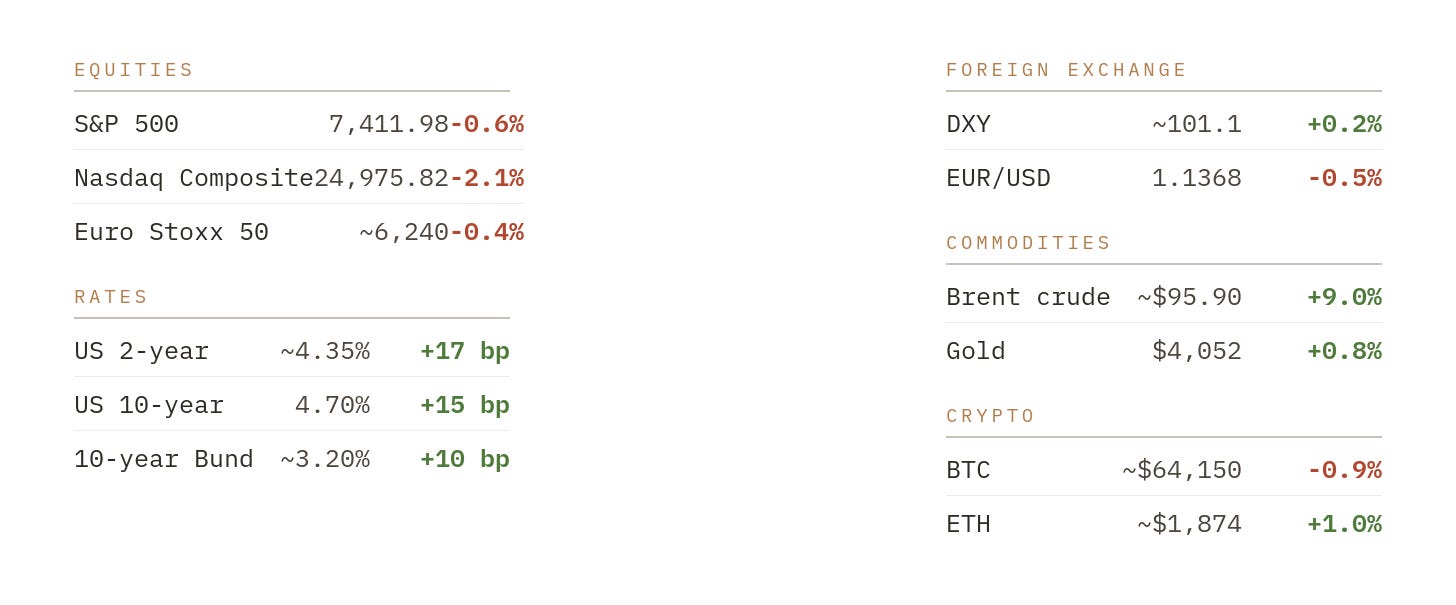
A basis point (bp) is one hundredth of a percentage point, so +15 bp means a yield rose from 4.55% to 4.70%. Yields and bond prices move in opposite directions: when a yield rises, the price of the bond you already own falls, and the cost of new borrowing for governments, companies and mortgage holders goes up. Equities, currencies and commodities are shown in percent. US equities and Treasury yields are the 22:00 CET close; European indices and the Bund settle earlier at 17:30 CET; foreign exchange and crypto are a fixed 22:00 CET snapshot. Levels marked ≈ are approximate where the official settlement was not yet confirmed.
Reading the Board
Equities split along a clear line. US large caps held up because strong company earnings offset the oil and rates pressure, leaving the S&P 500 barely changed. The damage sat in technology, where the Nasdaq’s 2% weekly drop came almost entirely from chipmakers and the AI-spending scare. Europe drifted lower as higher energy costs raised the odds of more rate increases from its own central bank.
Rates were the story. Both the 2-year yield (the market’s best summary of where the Fed is heading over the next two years) and the 10-year yield climbed together, a sign investors now expect tighter policy for longer. The German Bund, the euro area’s benchmark government bond, touched its highest level since 2011 for the same reason: oil-driven inflation forcing central banks toward the exit.
Foreign exchange stayed quiet by comparison. The dollar firmed slightly, helped by its role as a safe haven during Middle East conflict, and the euro slipped below $1.14, near its weakest in a year, as traders weighed Europe’s exposure to the energy shock.
Commodities were the pressure source. Brent’s near 9% weekly jump captures the entire chain of events, even after Friday’s pullback. Gold added a modest 0.8%, doing its usual job as insurance when geopolitics turns dangerous.
Crypto went nowhere fast. Bitcoin drifted just below $64,150 and finished slightly down, caught between improving internal demand and the same macro storm hitting every risky asset.
Three Brews That Mattered
1. Oil is now the Fed’s problem.
The mechanism is direct. When a barrel of Brent jumps roughly 30% above its pre-conflict level, petrol and diesel prices follow within weeks, and that shows up in the inflation numbers the Fed watches. A central bank cannot cut rates into rising inflation without losing credibility, so every dollar oil gains pushes rate-cut hopes further out and pulls a rate hike closer. That is why a war thousands of miles away moved your mortgage rate this week: the 10-year yield, which sets the tone for US home loans, rose because oil made a Fed cut harder to justify. Goldman Sachs flagged a “VaR shock” risk into the weekend, meaning the size of the rates move was large enough to force leveraged funds to cut positions to control their measured risk, which can feed on itself. Why it matters: the path of oil, more than any Fed speech, now decides the path of rates.
2. The AI bill is coming due.
Alphabet and Tesla did not disappoint on profits so much as on spending. Alphabet signalled capital expenditure (the money a company pours into data centres and chips) far above what analysts expected, with some estimates running toward $325–375 billion against a Street figure nearer $250 billion. Investors reacted by asking the uncomfortable question of when all that hardware starts earning its keep. The answer for now is later than hoped, which is why the Magnificent Seven shed around $800 billion on Thursday. The people who ultimately pay are shareholders, whose future profits are being reinvested today at the exact moment higher yields make those distant profits worth less. Why it matters: the market has started charging megacaps for AI ambition rather than rewarding it.
3. A jobs number rewrote the Fed math.
Weekly jobless claims, the count of Americans filing for unemployment benefits for the first time, fell to 187,000, the lowest in nearly 60 years and far below the 212,000 economists expected. A labour market this tight gives the Fed no reason to rush to support the economy, and every reason to worry that low unemployment plus rising oil keeps inflation sticky. Within hours, the probability of a July rate increase priced by futures traders jumped past one in three, from near zero only weeks ago. Why it matters: the Fed’s excuse to cut has evaporated, and the meeting on July 28–29 just became live.
Data Check
“Consensus” is the average forecast economists submit before a release. Markets move on the gap between the actual number and that expectation, not the number on its own.
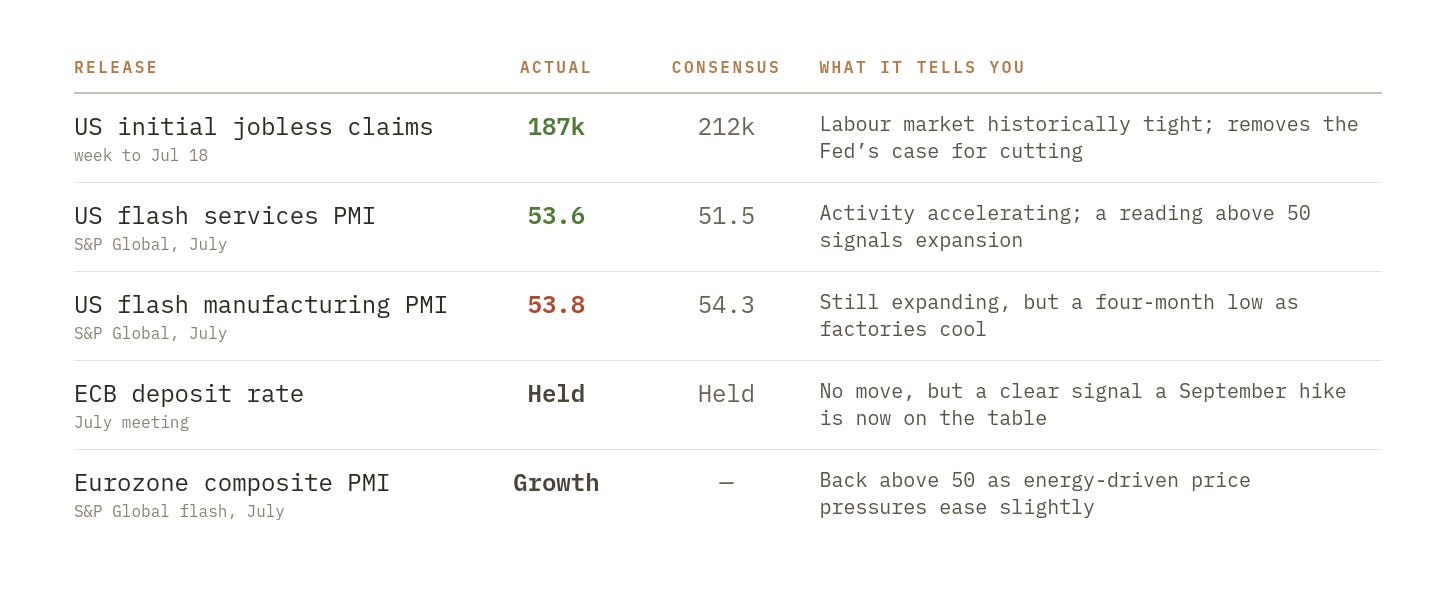
The services survey was the standout, running well ahead of forecast and pointing to growth of roughly 2% on an annualised basis. One caveat worth keeping: S&P Global noted July activity was flattered by hospitality spending around the FIFA World Cup and the USA 250 anniversary, so some of the strength may fade. The European Central Bank left its main rate unchanged as expected, yet the message underneath was the harder part, with policymakers including Bundesbank chief Joachim Nagel warning that inflation risks from energy remain elevated.
The Onchain Pour
Bitcoin spent the week doing something quietly interesting while everyone watched oil. Its price sat close to its “realized price,” the average level at which all coins last moved on-chain, which acts as a rough cost basis for the whole market and often marks where committed holders step in. Long-term holders, wallets that have not sold in months, accumulated at the fastest pace in six years, a sign the strongest hands are buying weakness rather than selling it. The demand is not only retail: exchange-traded products that hold Bitcoin for investors have pulled in around $5 billion more than their gold equivalents since March, a genuine rotation from the old safe haven into the new one. Against that, real risks remain. Analyst André Dragosch called Bitcoin the “canary in the macro coal mine,” pointing to the Strait of Hormuz, rising yields and stress in the credit that funds AI data centres as the things that could still drag it lower, while fresh worries about quantum computing weighed on sentiment. On the policy side, the CLARITY Act, the bill that would finally define which US regulator oversees which crypto asset, lost some momentum after last-minute amendments, even as exchanges pushed the Senate to pass it. The setup is a market with improving foundations sitting inside a hostile macro backdrop, waiting to see which one breaks first.
Last Drop
Next week is the one that counts. The Fed decides on July 28–29 with a rate hike no longer unthinkable, and the numbers in this Scoreboard are the ones traders will be pricing off. Sunday’s Weekly Steep will go deeper on what a hiking Fed would mean for a government that has quietly turned itself into a floating-rate borrower, and why the bond market’s mood this week is the real signal to watch. Until then, keep an eye on the oil tape. It is running the show.