
The Week in One Sip
Europe’s central bank raised interest rates on Thursday, for the second time this year. Christine Lagarde, who runs it, called the decision an easy one and named her reason plainly: the war in the Middle East keeps pushing energy prices up, and energy gets into the price of almost everything else.
Then came Friday, and American inflation figures that matched the forecast to the decimal. Prices were 3.4% higher than a year ago, as predicted. Leave out food and fuel and you get 2.4%, also as predicted.
Markets repriced anyway. Within an hour the chance of the Federal Reserve raising rates next Wednesday had gone from 72% to 87%. What America pays to borrow for two years finished the week 26 basis points higher — a basis point being one hundredth of a percentage point.
One number sits underneath all of it, and it is not an inflation rate. Brent crude, the oil price most of the world quotes, rose 8.5% this week to $104.61 a barrel.
The Scoreboard
Nineteen numbers, and the ones worth your attention are all in the same place: what governments pay to borrow.
The thing to look for is which maturity moved. When two-year money moves much further than thirty-year money, the market is saying something quite specific — that it expects the central bank to act soon.
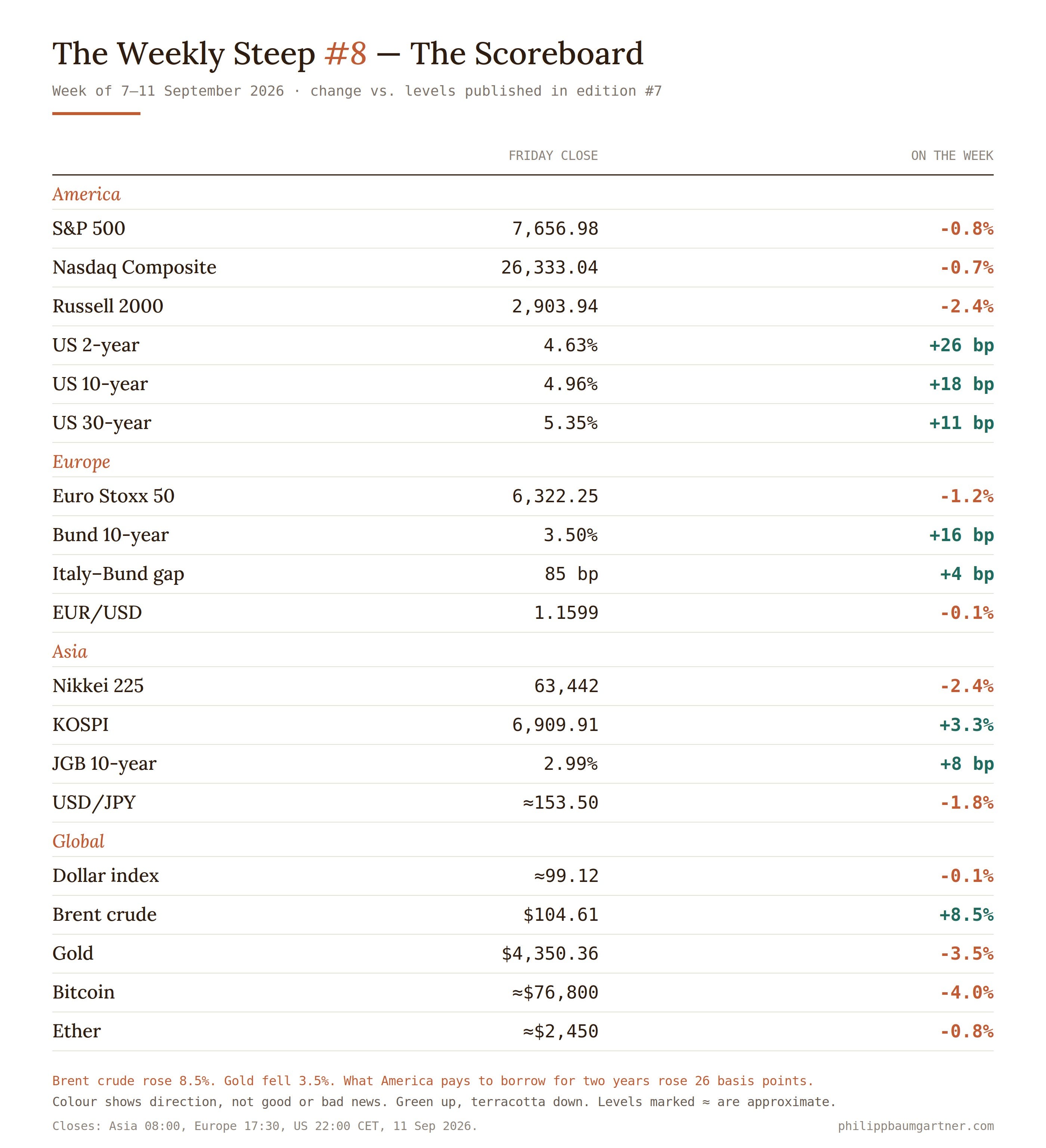
America is where the week happened. What the government pays to borrow for two years rose 26 basis points to 4.63%, for ten years 18 to 4.96%, for thirty years only 11 to 5.35%. Shares fell for four days and took most of it back on Friday: the S&P 500 closed at 7,656.98, down 0.8% on the week. Smaller American companies did worse, with the Russell 2000 down 2.4% — they borrow at floating rates and feel a central bank sooner than large firms do.
Europe had the rate rise and still finished calmer. The Euro Stoxx 50, which tracks the fifty largest listed companies in the euro area, lost 1.2% to 6,322.25. Germany’s ten-year borrowing cost rose 16 basis points to 3.50%, its highest since August 2009. What Italy pays above Germany moved 4 basis points, to 85.
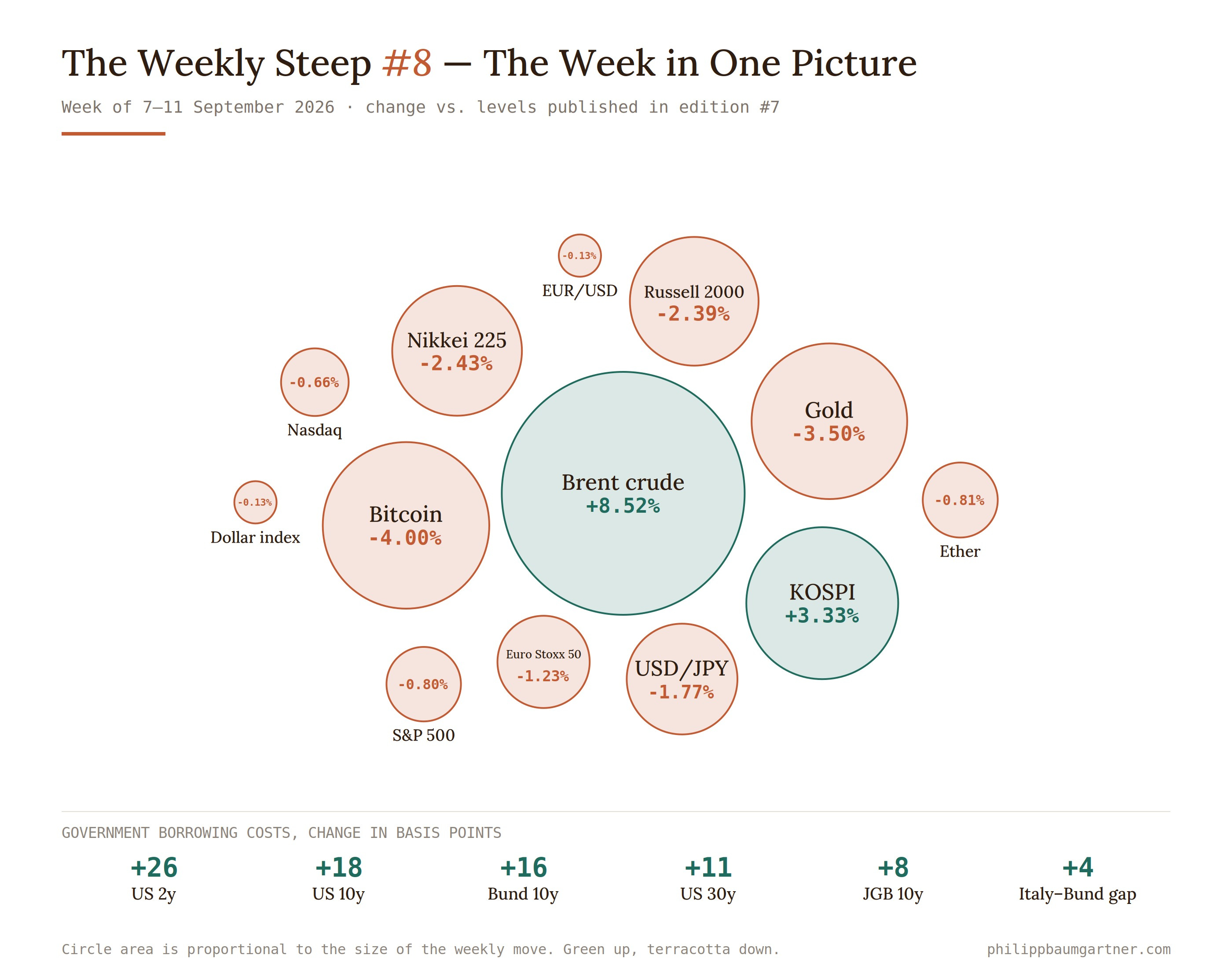
Asia split. The Nikkei 225 fell 2.4% to 63,442, most of it on Friday, as higher oil and rising domestic borrowing costs landed on Tokyo together. Korea went the other way and finished 3.3% higher at 6,909.91 — foreign and institutional money came back earlier in the week and that was enough to carry it. Japan’s ten-year rate rose 8 basis points to 2.99%, just under the 3% it touched last week for the first time since 1996.
Gold is the one worth a pause. It fell 3.5% to $4,350.36, a third losing week in a row, in the same days inflation turned out to be stickier than hoped. Higher interest rates make holding something that pays you nothing more expensive, and this week that beat the inflation story completely.
1. Europe raised rates against a price it cannot control
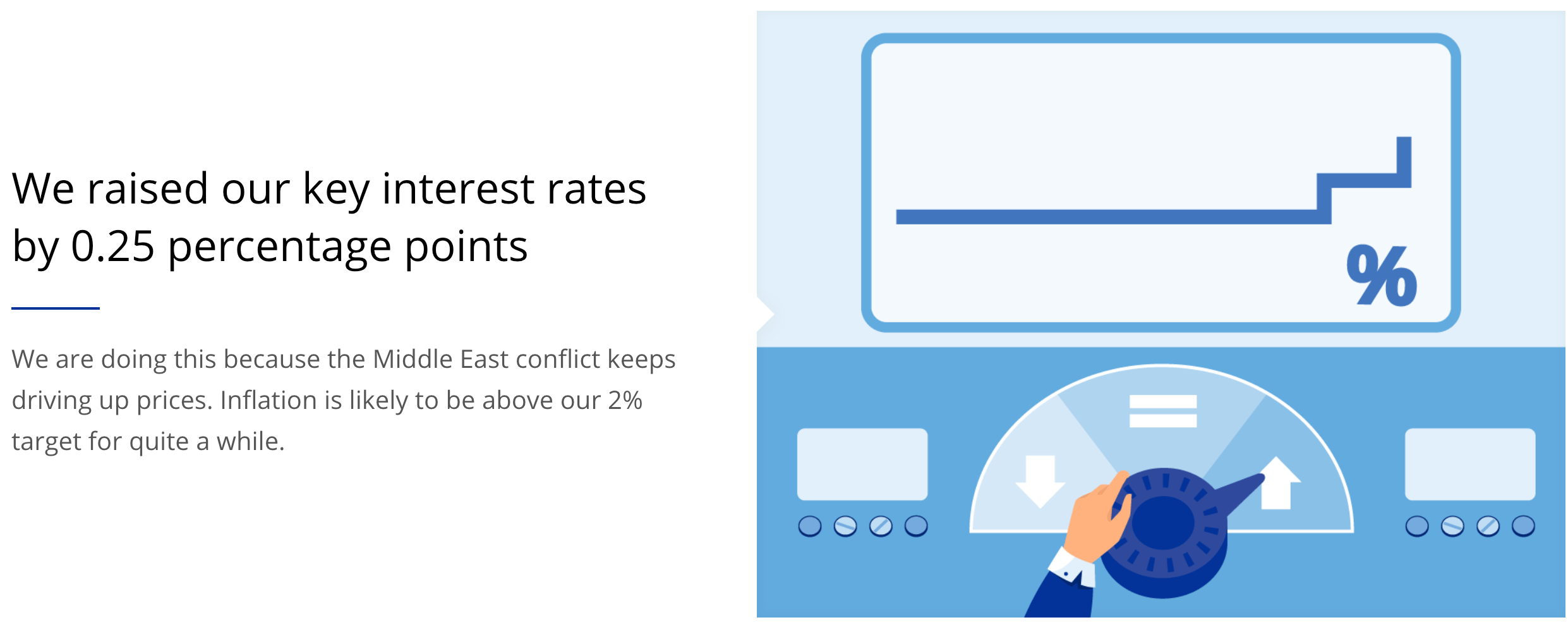
The ECB lifted its rate a quarter point on Thursday, and the thing pushing euro area inflation up is a barrel of oil in the Persian Gulf.
The European Central Bank sets the price of money for twenty countries. Its main tool is the deposit rate, which is what commercial banks earn for parking money there overnight. On Thursday it went from 2.25% to 2.50%. Everything else in the euro area — mortgages, business loans, savings accounts — sits downstream of that number. The bank’s own statement gave the reason: the Middle East conflict keeps driving prices up, and inflation should stay well above the 2% target for most of 2027.
Oil is not only fuel. It is the cost of moving a pallet, heating a factory, making plastic and fertiliser. When crude rises, those costs reach consumer prices a few months later. American wholesale prices, published Thursday, show it happening: up 0.4% in August, with more than three quarters of that coming from energy. Diesel alone rose 24.1% in the month.
Now the obvious objection, and it is a good one. A central bank cannot drill a well. Raising the cost of borrowing in Frankfurt does nothing about a tanker route near Iran.
What the bank is defending is the second round. Energy passes into wages, into the prices firms feel safe setting next year, and into what people simply expect inflation to be. Those are things a rate can reach. The cost of being wrong is that borrowers across twenty countries pay more for a barrel of oil nobody in Frankfurt can move.
2. The forecast was right and the market moved anyway
August consumer prices came in exactly as predicted on the year, and traders spent the morning repricing the Federal Reserve regardless.
Friday at 14:30 CET the Bureau of Labor Statistics, the American government’s statistics office, published August consumer prices. Up 3.4% over twelve months against 3.4% expected. The core measure, which leaves out food and energy because those swing for reasons a central bank cannot influence, came in at 2.4% against 2.4% expected.
A forecast that lands twice is usually a quiet morning. The reason this one was not is a number that gets much less coverage.
Month to month, core prices rose 0.3%. Economists had it at 0.2%, and July had been 0.2%. That tenth of a point is the fastest monthly pace since April, and monthly figures are what tell you about now. The annual number is twelve months averaged together, most of it already known.
Petrol explains the headline: up 3.9% in the month, more than a third of the entire price rise. Take fuel out and the core still sped up, which is the part a central banker will worry about. The energy is no longer staying in the energy column.
Traders repriced within the hour. The chance of a rate rise on Wednesday went from 72% to 87% on CME’s measure, briefly touching 91%. Prediction markets, where people bet with their own money, moved from 63.7% to 81.3%.
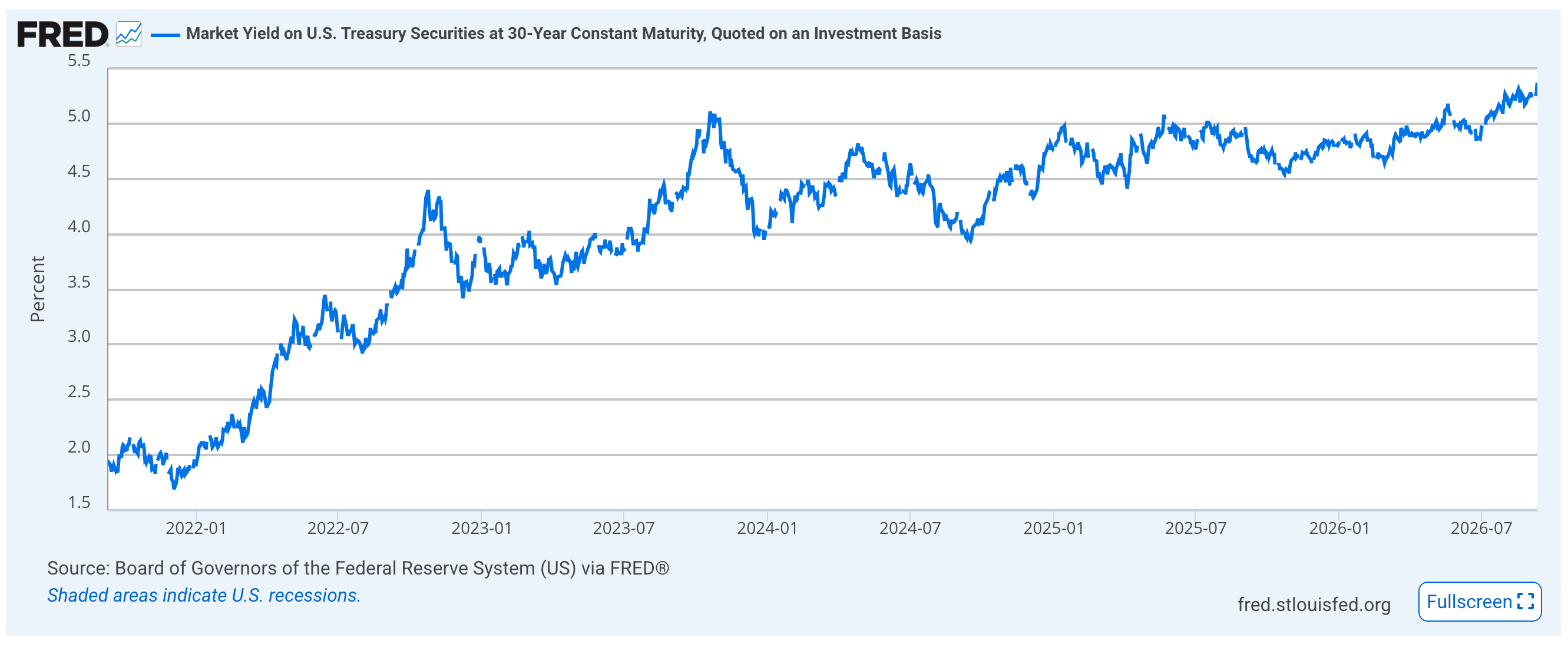
You can see the same thing in borrowing costs. Two-year money rose 26 basis points on the week, thirty-year money 11. The two-year rate mostly reflects what people think the central bank will do soon; the thirty-year reflects how much debt is being sold and who wants it. The gap between them narrowed sharply, and that shape means tighter soon, calmer later.
3. Japan decides last and may move furthest
The yen strengthened again without anyone buying it, and Japan’s central bank meets on Friday.
This letter has followed the yen since July, when Japan and the United States bought it together for the first time since 1998 to stop it falling. That is called intervention, and it worked for about two weeks.
What has been doing the job since is the expectation of higher Japanese rates. The yen ended the week around 153.5 per dollar, against 156.26 a week earlier, so it strengthened roughly 1.8% — in a week when the dollar was otherwise being pushed up. That takes some force.
Japan’s central bank meets Thursday and Friday and is widely expected to raise its policy rate to 1.25%, the highest in about thirty-one years. Its ten-year borrowing rate sits at 2.99%, a level that belonged to the 1990s until a few weeks ago.
Why this matters outside Japan: for three decades money has been borrowed cheaply in yen and invested in things that pay more elsewhere. Raising Japanese rates narrows that gap and gives some of that money a reason to come home. It gets sold in New York and Frankfurt, and shows up as weakness in places with no obvious link to Tokyo.
Two things went genuinely well this week. Oil fell 2.8% on Friday as the spike eased, and shares on both sides of the Atlantic took much of their weekly loss back in one session. And Italy’s borrowing costs stayed calm straight through a European rate rise — three years ago that would have been the story of the month.
Data Check
Six releases mattered this week, and the pattern across them says more than any single one. Four landed on forecast. The two that missed went in opposite directions, and the market cared about only one.
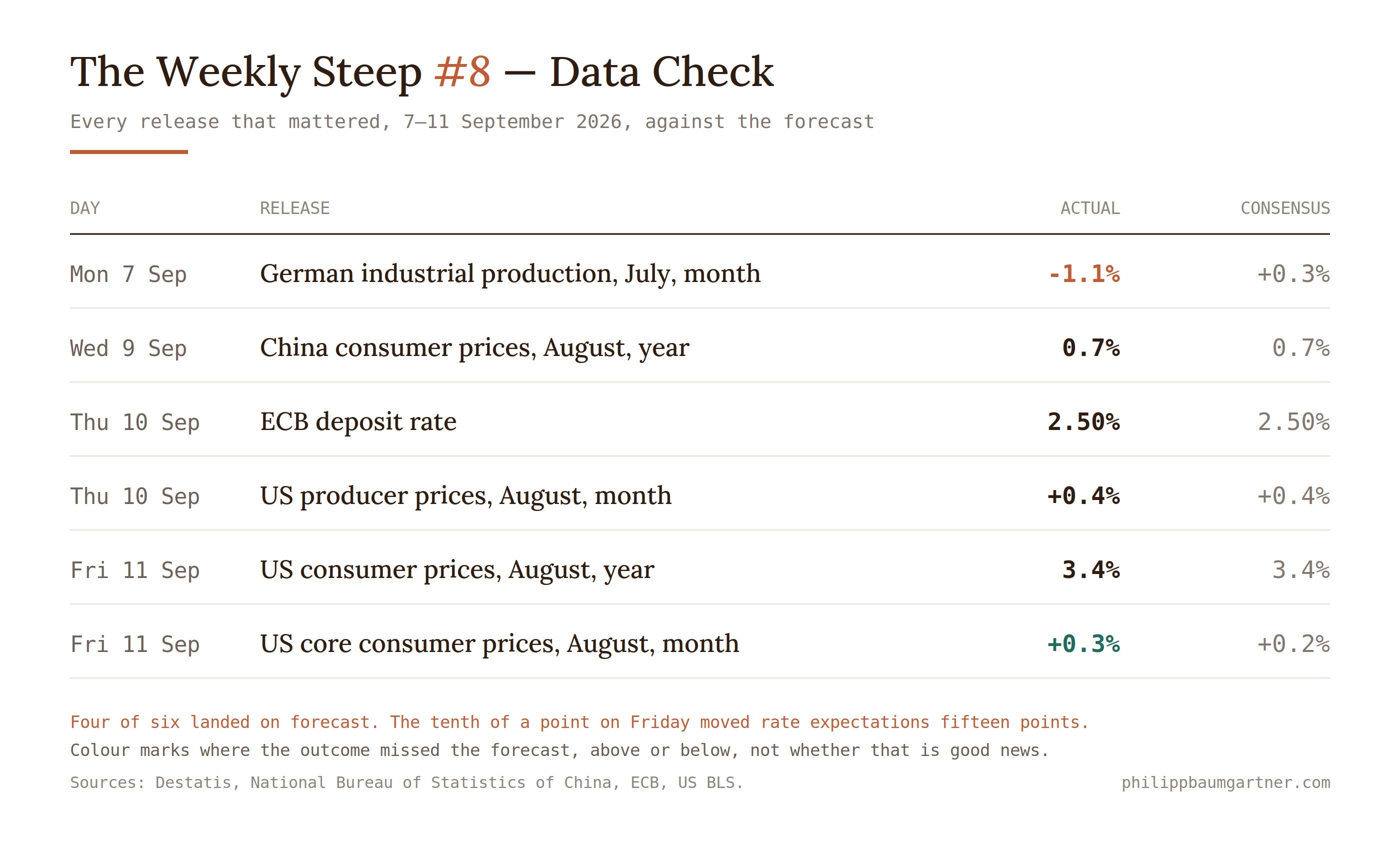
The row worth a second look is Friday’s monthly core figure: 0.3% against 0.2% expected. Everything else in that report was as predicted, and this one tenth moved rate expectations fifteen points. Monday was the opposite. German industrial production fell 1.1% in July against an expected rise of 0.3% — a far bigger miss, in the wrong direction for the ECB’s growth story, and it moved nothing. Two days later the ECB raised rates anyway.
The Credit Grind
The cost of borrowing for Europe’s safest governments has never been higher in the past year than it was on Thursday. What companies pay on top of that moved by three basis points.
Anyone lending to a company is paid for two things. One is the price of money itself, which governments set, because a state is the safest borrower in its own currency. The other is compensation for the chance this particular company stops paying. Central banks move the first directly. The second depends on how much money is looking for somewhere to go.
The board below has six rows and one job: to show what borrowing costs right now, and how unusual that is against the past year.
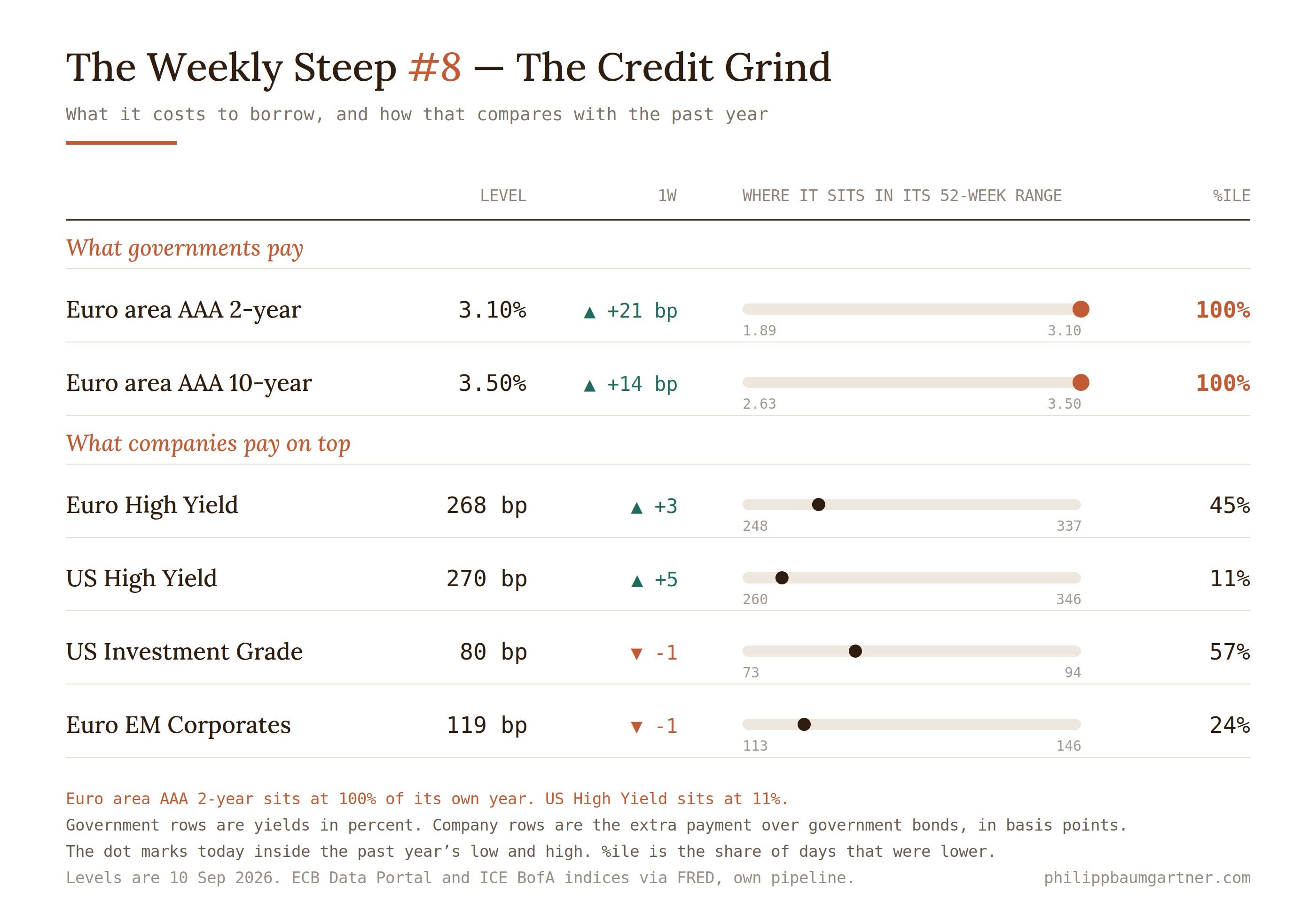
Both government rows read 100% in the final column. That column counts the share of the past year’s trading days that sat lower than today, so 100% means there was no day in twelve months when a top-rated European government paid more to borrow. Two-year money in the euro area now costs almost a full percentage point more than it did in January.
European high yield — the debt of companies rated least likely to repay — rose 3 basis points to 268, the 45th percentile of its year. Investors were paid more than this on roughly half the past year’s days. Against 21 basis points on the government row above it, that is close to nothing.
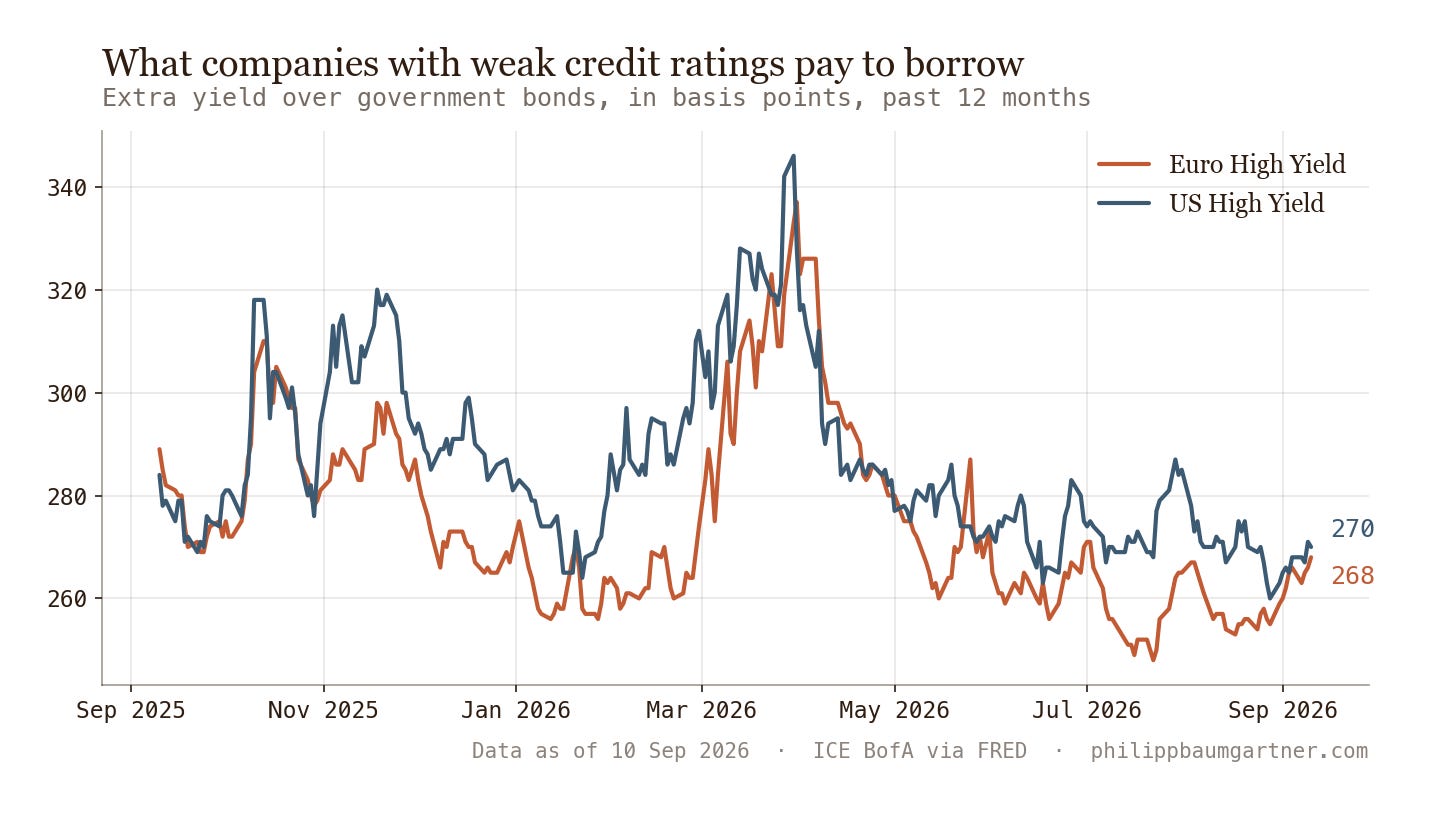
America is the surprise. Its high yield row rose 5 basis points to 270 in a week when the Federal Reserve did nothing at all, carrying it from the 2nd percentile of its year to the 11th. Two weeks ago that column read 0%. The gap between the two continents flips back to 2 basis points in Europe’s favour after touching parity last week.
So a European bond fund paid you more this week, and nearly all of that came from the government part. The thing you are taking risk for is still priced as though nothing could go wrong, with the Fed meeting on Wednesday.
The Onchain Pour
Bitcoin lost ground in a week built for it to lose ground, while money kept moving into ether.
Bitcoin ended near $76,800, down 4% against the $80,000 published here last Sunday. Ether barely moved by comparison, off 0.8% at around $2,450. Both face the same problem: higher rates for longer make an asset paying no interest more expensive to hold when the alternative pays 4.6%. Only bitcoin was sold on it.
The flows say the same thing. American bitcoin funds saw money leave on four consecutive trading days, $462.7 million over the week. Ether funds took in about $197 million across the same days, including $216.4 million on Friday alone, and finished a fourth straight week of inflows.


That split has been building all summer. Institutions that arrived for bitcoin as a scarce asset are increasingly buying ether as a bet on something else — the plumbing underneath stablecoins and tokenised assets, now around $346 billion across dozens of asset types. Whether that is the better bet is not obvious. It is certainly a different one.
The Week Ahead
This is the week the argument gets settled, or at least the American half of it. Three central banks meet within three days of each other, all of them looking at the same oil price, and none of them able to do anything about it.
The Federal Reserve goes on Wednesday with the market already 87% sure of the answer. That certainty is itself the risk: when a decision is this fully priced, what moves markets is not the decision but the sentence afterwards about what comes next. Britain follows on Thursday with a genuinely open question, and Japan on Friday, where a rise would take rates to their highest since the mid-1990s.
Underneath the three meetings, two data points are worth more than they look. American retail sales on Wednesday will say whether the consumer is still spending while prices climb. And British inflation the same morning lands hours before the Bank of England has to decide.
Canadian inflation — Monday, 14:30.
Last at 3.0% for the year. Canada is running its own experiment in what 50% American tariffs do to prices, and this is the first clean read on it.
Chinese industrial production and retail sales — Tuesday, 04:00.
Previously 5.9% and 6.4% over the year. China is still sending falling prices out into the world while everyone else imports rising ones.
British labour figures — Tuesday, 08:00.
Unemployment expected to stay at 4.9%. Wage growth here is what the Bank of England will be reading two days later.
British inflation — Wednesday, 08:00.
Last at 2.6%, closer to target than America’s, which is why Thursday is a harder call than Wednesday.
American retail sales — Wednesday, 14:30.
The previous month fell 0.6%. A consumer already pulling back would make a rate rise that afternoon considerably harder to defend.
The Federal Reserve decision — Wednesday, 20:00, press conference 20:30.
An 87% chance of a rise to 3.75–4.00%. The press conference matters as much as the decision, because the disagreement between Kevin Warsh and Christopher Waller has not been settled in public since.
The Bank of England decision — Thursday, 13:00.
From 3.75%, and genuinely unclear. Inflation nearer target, a weaker labour market, and the same oil price as everyone else.
The Bank of Japan decision — Friday, press conference 08:30.
Expected to raise to 1.25%, the highest in about thirty-one years.
☕ Last Sip
Last week this letter said three central banks were leaning the same way for the first time since 2022. One has now acted, and the other two answer this week.
What makes it awkward is the cause. Oil is up more than 16% in a month because of a conflict none of them can influence, and all three are raising the cost of borrowing for households and businesses who had nothing to do with it. That is the trade-off central banking actually is, most of the time. It usually just happens with a less obvious cause sitting in plain view.
Watch Wednesday evening, then Friday morning. If both the Fed and the Bank of Japan move, the cheapest money in the world gets meaningfully more expensive inside thirty-six hours.
Enjoy what is left of the weekend. See you next Sunday.
Sources
Market levels from the Associated Press, the US Treasury, Trading Economics, ANSA, News On Japan and Seoul Economic Daily. Economic releases from the US Bureau of Labor Statistics, Destatis and the European Central Bank. Credit and euro curve data from ICE BofA indices via FRED and the ECB Data Portal, as of 10 September. Weekly changes are measured against the levels published in edition #7. Analysis and personal opinion — never investment advice.