
The Week in One Sip
Kevin Warsh, who runs the US central bank, has spent two weeks warning that inflation is not coming down fast enough. On Thursday one of his own colleagues said the exact opposite in public.
Christopher Waller who sits on the Fed board and votes on interest rates said he would rather leave them where they are this month. Markets believed him. The dollar fell to a four-month low, and traders cut the odds of a September rate rise from about 60% to something close to 50-50.
Friday reversed these expectations. The official jobs report showed 162,000 new jobs in August against a forecast of 53,000, which was the best month since March, and the odds climbed back to 58%.
This report and the immediate change is the main story of this week. Not because of what it says, but because two other measurements of the same month say something quite different.
The Scoreboard
The board below is the week in nineteen numbers, and two of them stand out.
Oil moved further than anything else on the board, and it is the number to keep in mind while reading the rest of this letter. Fuel goes into making things, moving things and heating buildings. So when it climbs, prices climb behind it a few months later. That is why three central banks are now leaning towards higher interest rates at the same time.
The yen also went up. It has spent most of this year going the other way, through two interventions and a good deal of official worry, so a week of quiet strengthening is worth the notice.
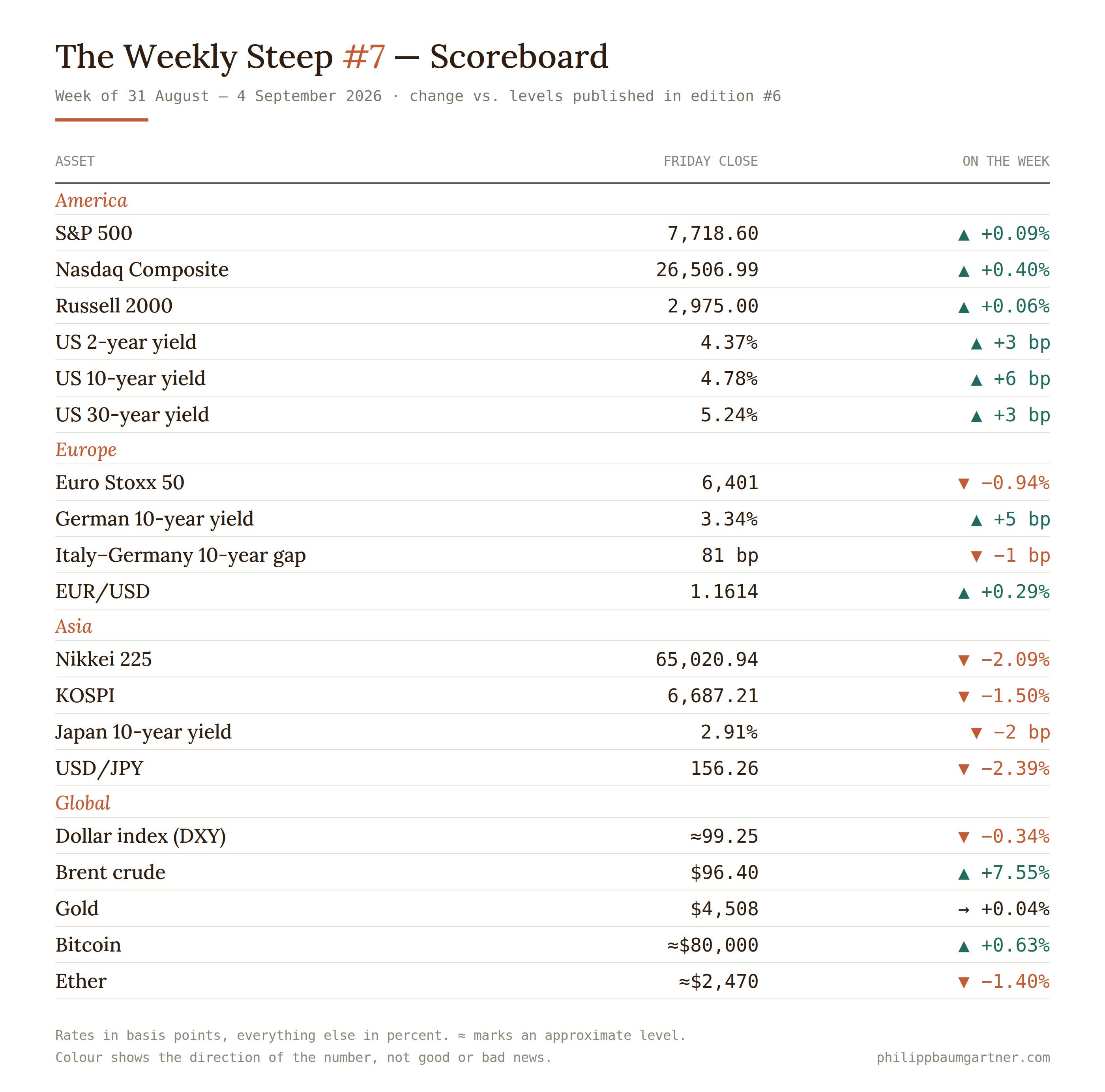
The US equities finished the week where they began. Thursday’s rally and Friday’s fall cancelled out each other.
Europe had a worse week, and Tuesday was the worst day of it. Euro area inflation came in at 3.3%. German thirty-year borrowing costs reached their highest level since 2011. The Euro Stoxx 50, which tracks the fifty largest listed companies in the euro area, dropped to a one-month low and ended the week down 0.9%.
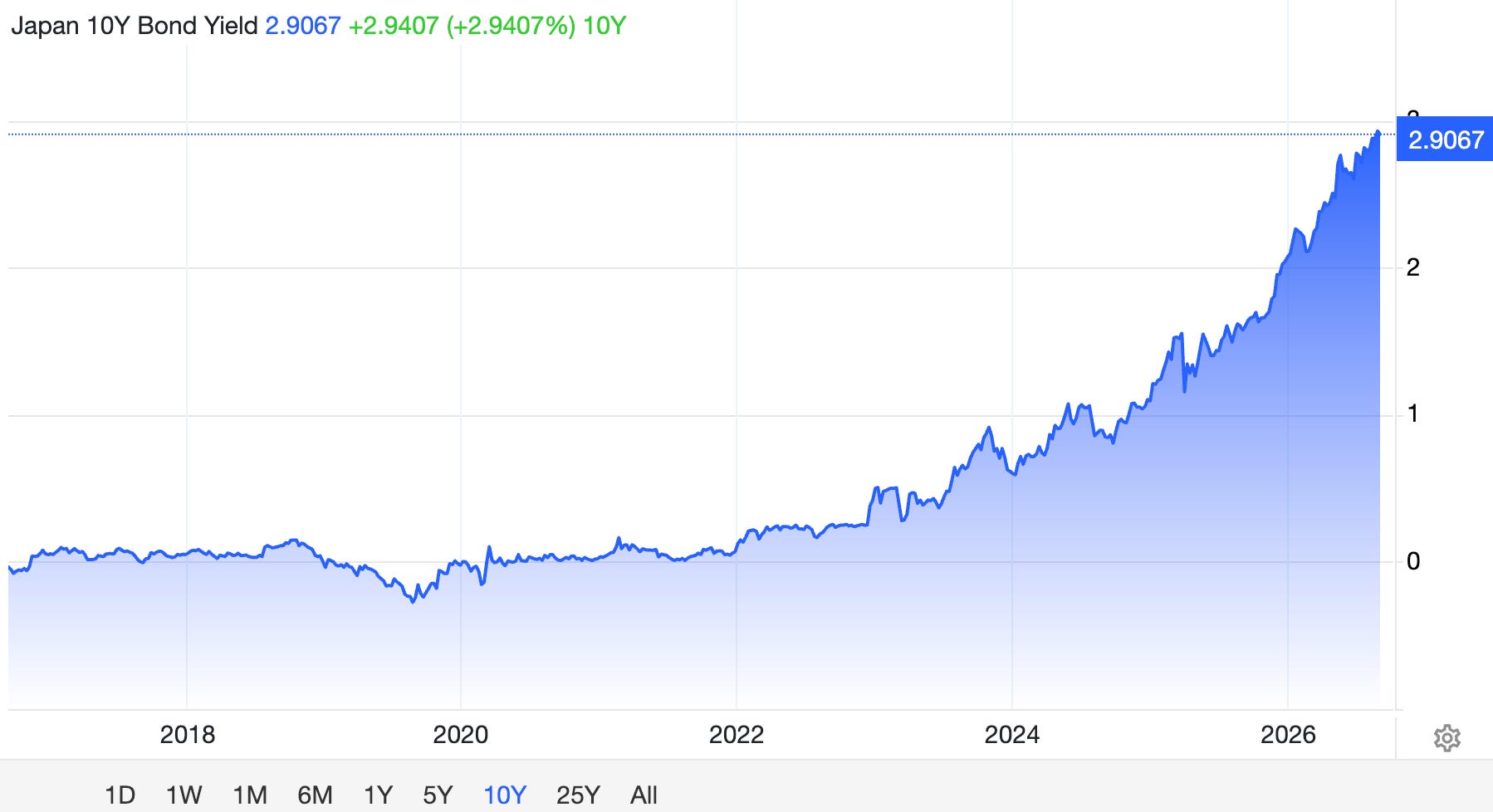
Asia fell even further. Japan’s ten-year government bond yield touched 3.00% on Tuesday, a level it last reached in 1996. The Nikkei lost 2.1% over the week and Korea’s main index 1.5%.
Those are three regions and a dozen numbers, all given equal space in a table. The chart below gives them the space they earned, and one of them takes up most of it.
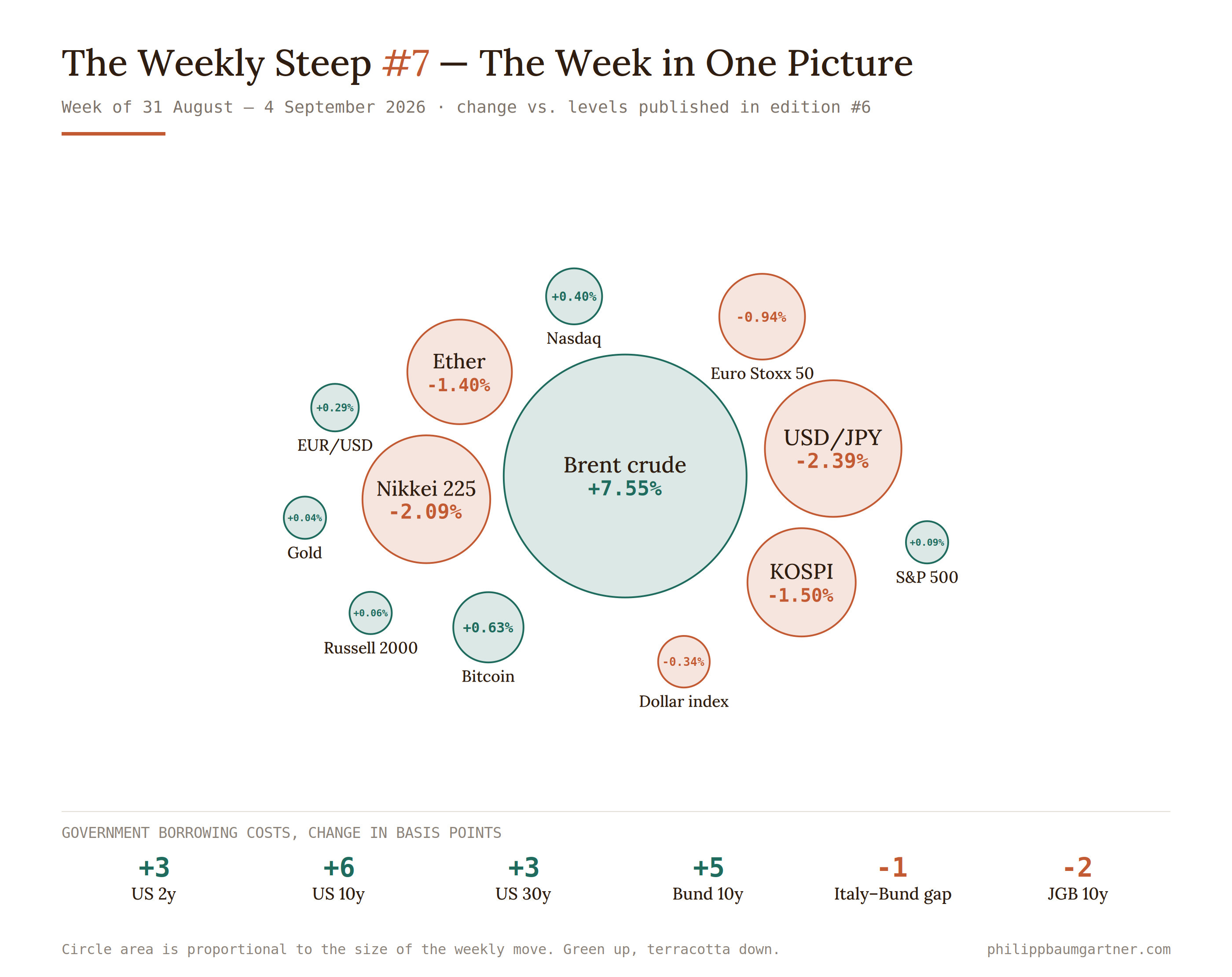
The large green circle is Brent crude, the oil price most of the world quotes. It rose 7.6% to $96.40 a barrel after tensions in the Persian Gulf worsened again. US petrol should pass $4 a gallon this weekend.
Most of this letter comes back to that number. But why is that? Simply put: Energy costs feed into nearly every other price, which is why euro area inflation rose, why the European Central Bank is about to act, and why central bankers sounded more nervous this week than last month.
1. Three counts of one month
The government says American hiring got faster in August. Two other measurements disagree.
Let’s start with the official figure. The Bureau of Labor Statistics is the US government’s statistics office. On Friday morning it reported 162,000 new jobs for August, against a forecast of about 53,000 from a survey of bank economists.
It also revised July, which had shown a loss of 23,000 jobs, into a gain of 23,000. Unemployment stayed at 4.1%. Of those 162,000, private companies accounted for 127,000. The rest was government hiring. Now let’s look into the second count.
ADP is a payroll company. It handles wage administration for roughly a fifth of American private-sector workers, which means it can see how many people were actually on payrolls without asking anyone. Its August figure, published on Wednesday, was 38,000 new private jobs.
So what does that actually tell us? Two organisations counted the same weeks and landed 89,000 apart. Neither is inventing anything.
The third count is narrower but points the same way. Challenger, Gray & Christmas tracks layoffs that companies announce publicly. August brought 52,881 of them, against 33,429 in July, which signals a 58% rise in the month the official data says hiring sped up.
1.1 Why all three can be right at once.
The government’s headline number is seasonally adjusted. Some months always add jobs and some always lose them. Shops hire for Christmas. Schools stop paying staff over the summer. Seasonal work ends in August. So rather than publish the raw count, the statistics office compares each month against what that month normally does, and reports the difference. Without that step, the figures would swing wildly every year for reasons nobody needs to think about.
Now look at where August’s gains came from. Restaurants and bars added 59,000 jobs. Hotels and hospitality added 62,000. That happened in the month when summer work traditionally ends.
Taken at face value, that is a hiring boom in kitchens. Measured against the seasonal pattern, it more likely means employers cut fewer summer workers than expected — because they never took on the usual number in the first place.
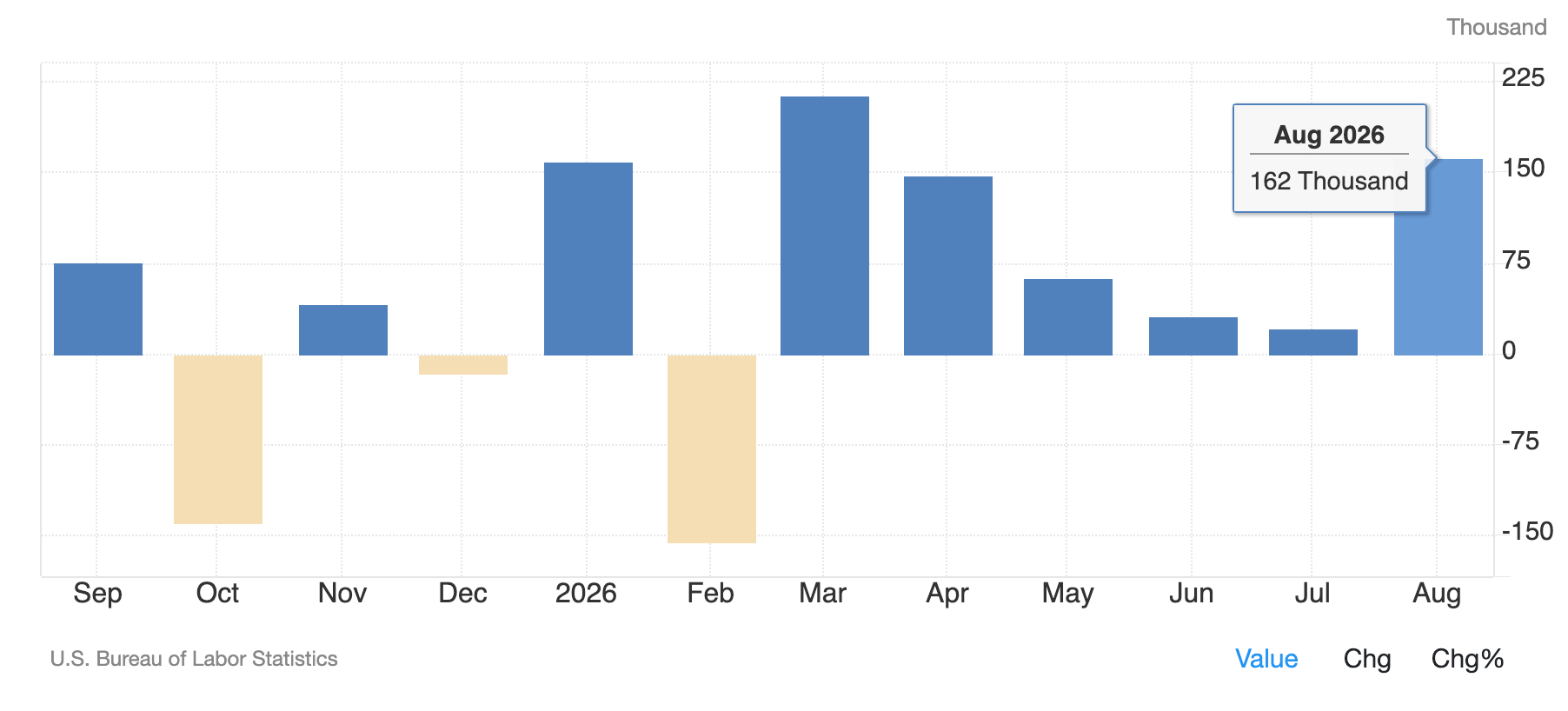
The adjustment assumes companies hire and fire the way they always have. This year they have done far less of both. And every month that continues, the headline number rests on a shakier assumption.
None of this makes the report wrong. It makes it weaker evidence than 162,000 suggests, in a week when that one figure moved the entire bond market.
2. The Fed disagreed with itself in public
One governor wants to hold. The chairman has spent two weeks arguing the opposite. Both vote in eleven days.
Warsh gave his first speech as Fed chair last month at Jackson Hole, the annual conference where central bankers say the things they have avoided all year. His message: inflation is not improving, and money is still too cheap. Markets heard someone preparing to raise rates.
Waller said the opposite on Thursday. He would rather leave rates at 3.50–3.75% this month, provided inflation keeps easing.
Central bankers disagree often. It is less common for the second-most-watched person at the institution to reject the first one’s case in public, two weeks before a vote.
You can measure what that did, because people bet on Fed decisions. They do it through futures contracts, and the price of those contracts converts into a probability.
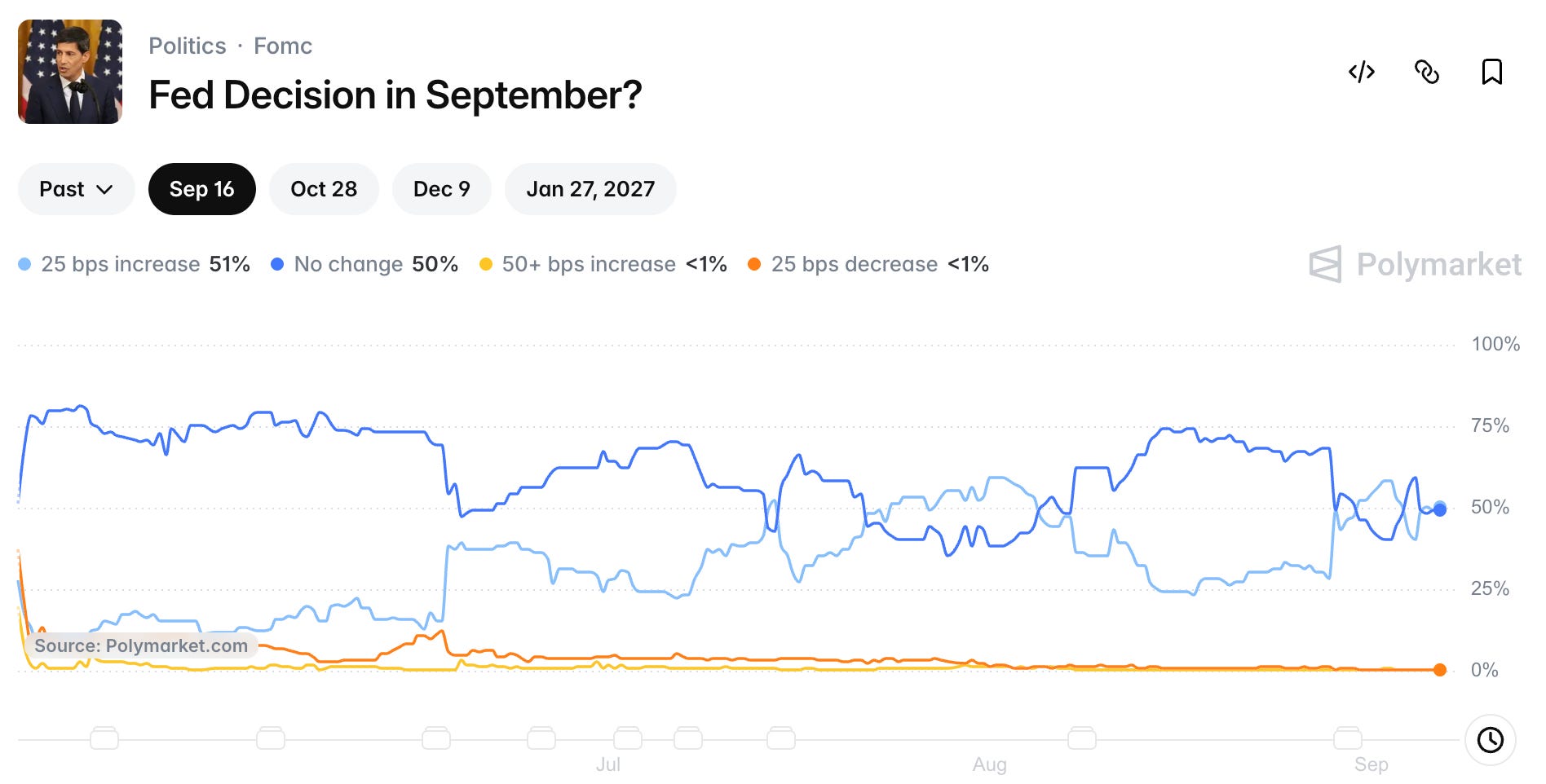
Before Waller spoke, the chance of a September rise was about 60%. By Thursday evening it was even. After Friday’s jobs report it was 58%. Bloomberg’s version of the same calculation reached 63%.
Twelve people vote on 15 and 16 September, Warsh and Waller among them. The evidence that settles it arrives first: US inflation figures on Friday 11 September.
The Fed is built to argue, so none of this is a crisis. It does mean nobody knows the answer yet, including the people who will decide. That is why a single data release moved expectations by ten points twice in two days.
3. The yen turned, and nobody had to buy it
Two interventions failed. The prospect of a rate rise did it in one week.
This letter has followed the yen since late July, when Japan and the US bought it together for the first time since 1998.
Buying your own currency to hold its price up is called intervention. A government sells foreign reserves and buys its own money, which lifts the price for as long as the buying lasts. Japan did it alone on 30 July and together with the US the day after. It held for about two weeks. Then the yen slid back through 160 to the dollar last week.
This week it rose 2.4%, to 156.26. On Friday it briefly touched its strongest level since 3 August. Nobody bought anything.
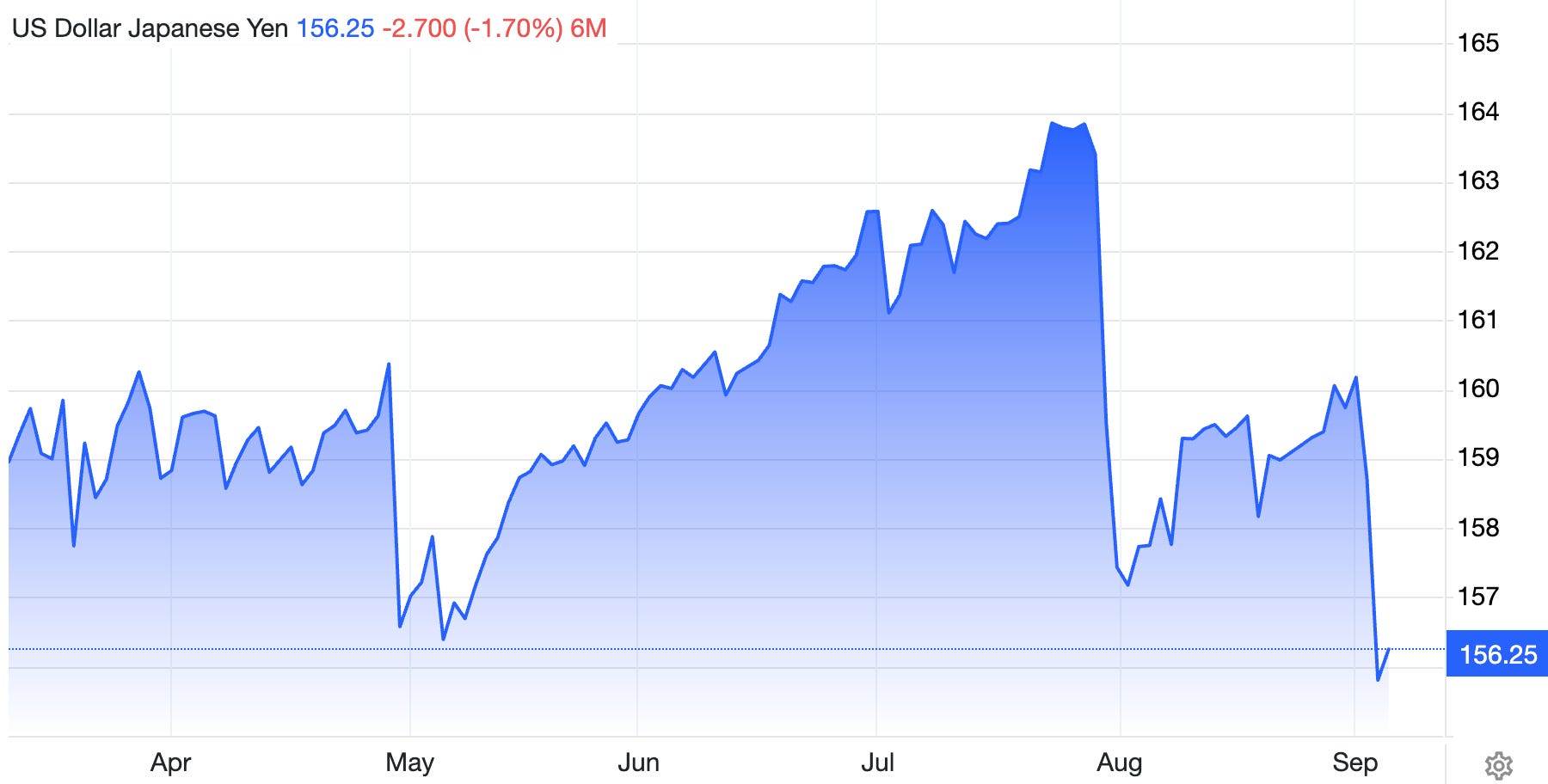
What changed is what people expect. Reports emerged that the Bank of Japan will raise its interest rate by a quarter point at its meeting on 17 and 18 September, and may go further after October. The market now puts the chance of that at 77%.
3.1 Why a Japanese rate rise moves the currency more than buying it does.
Japan’s official rate is 1.0%, but Japanese inflation runs higher than that. Subtract one from the other and the real cost of borrowing in Japan is around minus 0.9%. Money there is still effectively free, even after several increases. The central bank has room to keep raising without damaging its own economy.
Every rise also narrows a gap that has shaped markets for thirty years. Investors borrow yen at almost no cost and buy assets elsewhere that pay more. Raise Japanese rates and that stops being worth doing, so some of it gets unwound.
Japanese money is already coming home. The ten-year yield touched 3.00% on Tuesday, and a thirty-year auction this week met strong demand from Japanese pension funds, who bought their own government’s debt instead of sending the money abroad.
Both failed interventions taught the same lesson. Buying a currency moves the price for a few weeks. Only the interest rate changes anyone’s reason to sell it.
Data Check
Four economic releases landed this week that were worth watching. Two of them came in far above what economists expected, and both point the same way — towards a central bank that raises rates rather than holds.
The table below shows what was forecast and what actually arrived. The gap between those two columns is what moves markets, not the number itself.
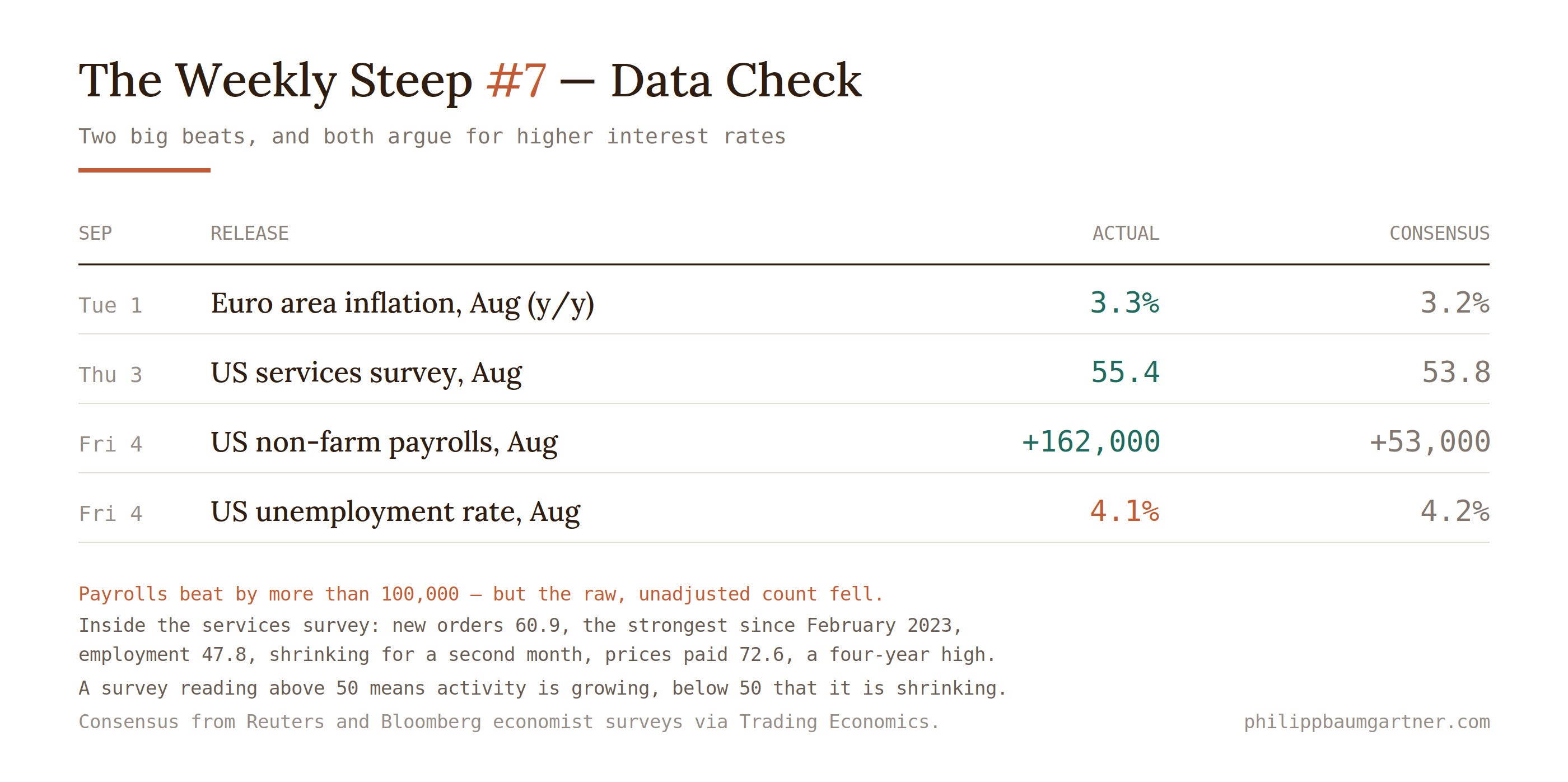
The US services survey needs a short explanation. Every month the Institute for Supply Management asks purchasing managers at service companies one question: is business better or worse than last month? Fifty is the dividing line, so anything above it means growth.
August came in at 55.4, the second-highest reading since October 2024. The detail underneath is messier. New orders were the strongest since February 2023, which is good news. Employment came in at 47.8, meaning service companies cut staff for a second month running. Prices paid reached 72.6, the highest since July 2022.
Growing, hiring less, charging more. That combination is exactly what a central bank worried about inflation watches for.
The Credit Grind
Europe’s riskiest borrowers had their worst week in months. They now pay the same as America’s, for the first time this year.
A company that borrows pays two things added together.
The first is whatever the government pays. That sets the floor, because no company borrows more cheaply than the state it operates in.
The second is a premium on top, because companies go out of business and governments almost never do. The riskier the company, the larger the premium. That premium is what this section follows.
The table below has six rows and one job: to show what borrowing costs right now, and whether that is high or low compared with the past year.
The top two rows are governments. The four underneath are companies, sorted from riskiest to safest. And the last column is the one to read first — it tells you how unusual today’s number is.
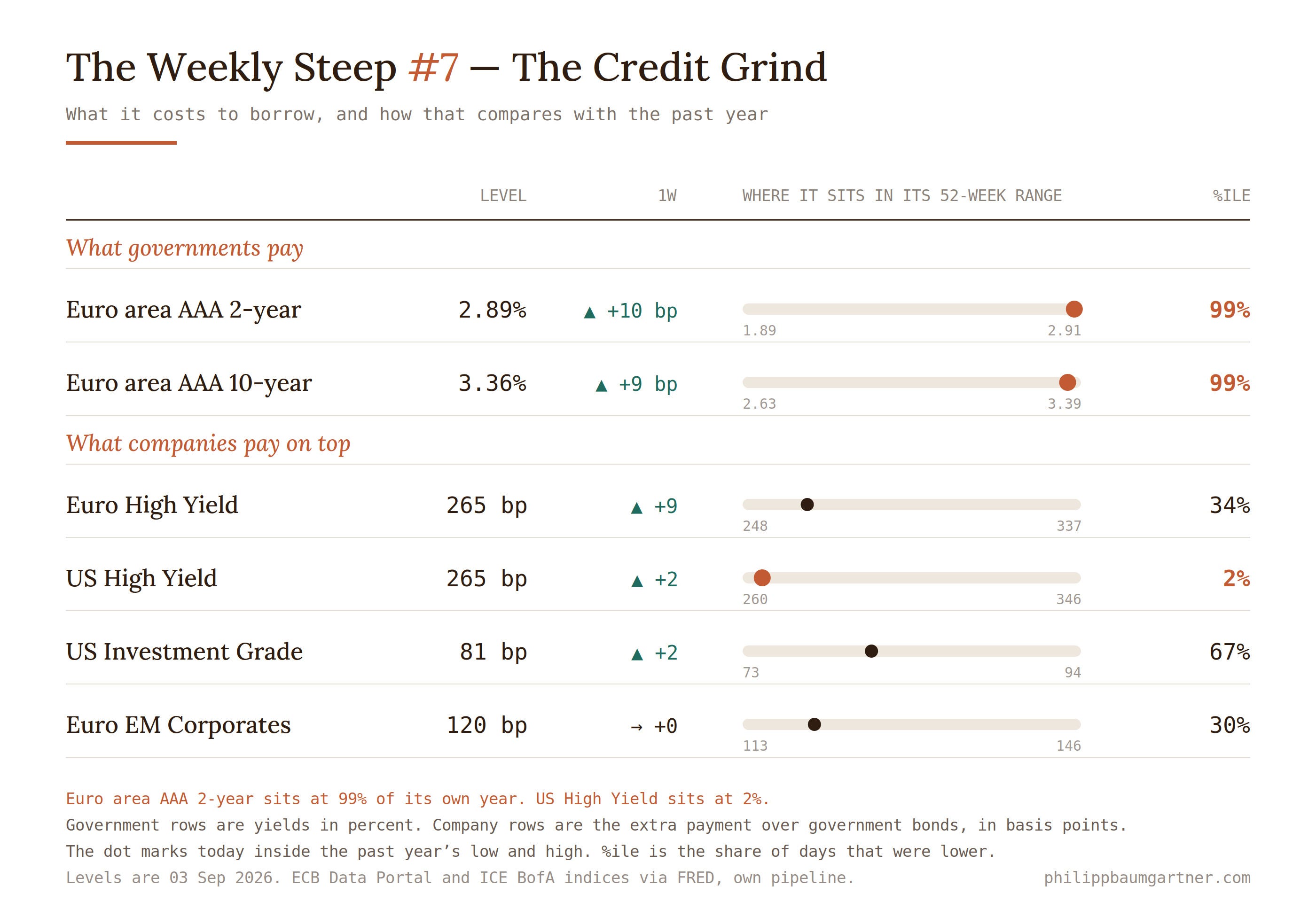
Look at the first company row. European high yield means the debt of companies rated least likely to repay. It rose 9 basis points this week, to 265.
A basis point is a hundredth of a percentage point. So 265 means those companies now pay 2.65 percentage points more than governments do.
Nine basis points is the largest move on the board. It carried European high yield from the 6th percentile of its own year to the 34th. That final column counts how many days over the past twelve months were cheaper than today, so 34% means roughly a third of the year was lower. Two weeks ago the same column read 6%.
Now the row below. US high yield sits at 265 as well. That has not happened once this year. Europe has been the cheaper of the two for months — 19 basis points cheaper three weeks ago, 7 last week, and nothing at all now.
The two government rows above explain why. Both reached fresh twelve-month highs this week, up 10 and 9 basis points, because the ECB is expected to raise rates on Thursday. European companies were hit from both directions: the floor went up, and the premium on top went up with it.
US companies were not. Their high yield row moved 2 basis points and remains in the 2nd percentile — cheaper than 98% of the past year.
What this means if you own a corporate bond fund.
You are lending money to companies, so you should be paid for the risk that some of them fail. A fund holding European debt paid you more this week than last, which has not been true for a while. A fund holding US debt is still paying you close to the least it has all year, and the Fed may raise rates in eleven days.
The Onchain Pour
Bitcoin held $80,000 through a week that gave it every reason not to.
Bitcoin finished around $80,000, up under 1%. It crossed that level on Thursday, when Waller’s comments pushed the dollar to a four-month low. Tuesday had looked very different: $76,600, on the day Japan’s ten-year yield touched 3% and almost every risky asset in the world fell together.
That connection explains something that otherwise looks like coincidence. Cheap Japanese money has funded bets on higher-paying assets for thirty years, and crypto is one of them. When borrowing in Japan stops being nearly free, some of those bets get closed. The selling then shows up in places with no obvious link to Japan.
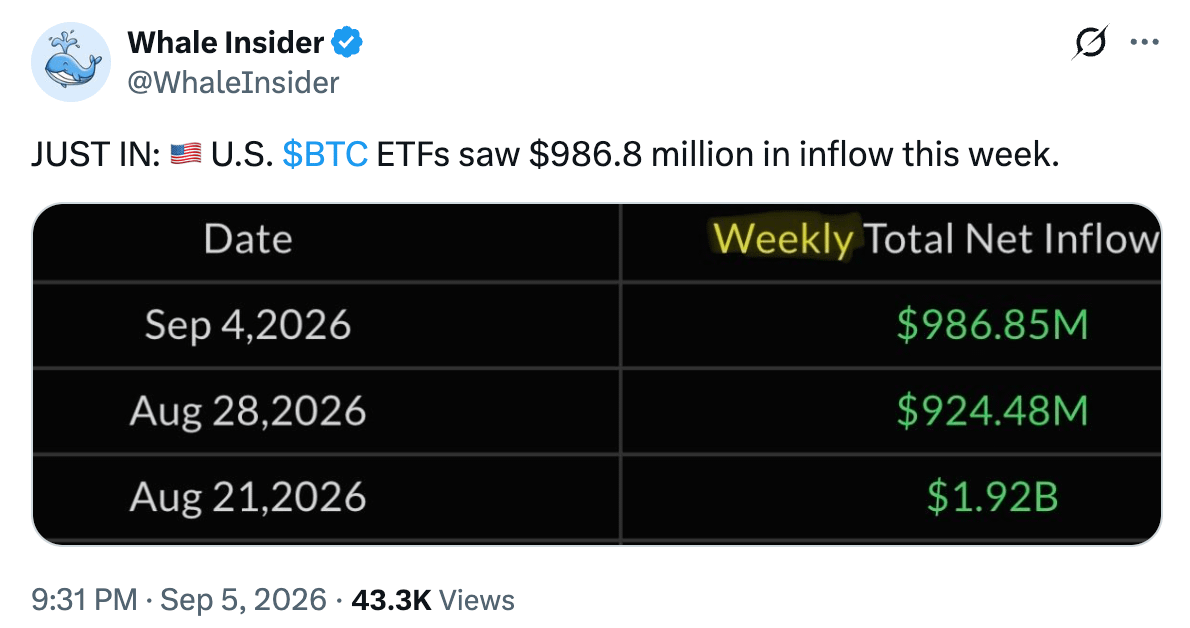
US bitcoin funds still took in $986.8 million across the week. The summer pattern holds: institutions keep buying while the price moves sideways. Ether recorded its third-best third quarter.
One oddity worth noting. Five wallets, each holding 50 bitcoin and untouched for sixteen and a half years, moved their coins this week. They date from 2010, when bitcoin traded for fractions of a cent and 50 coins was the reward for mining a single block. Each wallet is worth about $4 million today.
The Week Ahead
Thursday is the day that matters. The European Central Bank is expected to raise interest rates.
Monday 7 September.
German industrial production at 08:00, forecast 0.3%. Euro area growth for the second quarter is revised again at 11:00 and should confirm 0.4%.
Tuesday 8 September.
Japanese wage growth at 01:30, forecast 3.9%. The Bank of Japan watches this more closely than almost anything else before deciding. Chinese trade figures at 05:00 — exports rose 23.9% last month, and a slowdown there would matter for factories everywhere. German and French trade balances at 08:00.
Wednesday 9 September.
Chinese inflation at 03:30, forecast to slow to 0.7% from 0.9%. China is still exporting falling prices while everyone else imports rising ones. Christine Lagarde, who runs the ECB, speaks at 19:00 — the evening before her own decision.
Thursday 10 September — the one that counts. The ECB decides at 14:15.
The deposit rate is expected to rise to 2.50% from 2.25%. That rate is what banks earn for leaving money at the central bank overnight, and it sets the floor for what everything else in the euro area costs. Markets have almost fully priced the increase since inflation reached 3.3%. The press conference at 14:45 matters as much as the decision, because the real question is whether the ECB keeps going afterwards. US producer prices and jobless claims at 14:30.
Friday 11 September — US inflation at 14:30.
Forecast is 3.4% for the year and 2.4% for the core measure, which leaves out food and energy. This is the last major evidence before the Fed votes, and given how openly Waller and Warsh disagree, it may decide the outcome. UK growth figures at 08:00.
☕ Last Sip
Three central banks meet within eight days of each other, and the same thing is pushing all of them the same way: an oil price that will not stop rising.
Europe goes first on Thursday. America and Japan both decide the following week, almost at the same hour. Between now and then, the only new evidence is Friday’s US inflation report.
It has been a while since three of the world’s largest central banks were all leaning towards higher rates at once. You have to go back to 2022.
Enjoy the first proper weekend of September. See you next Sunday for the next episode of The Weekly Steep.
Sources
Market levels: CNBC and Investrade for the US closes; Trading Economics for European and Asian indices and yields; Bloomberg for the euro area government curve; Zaikei Shimbun and MyForex for the New York close in dollar-yen and euro-dollar; News On Japan for the Nikkei. Economic releases: US Bureau of Labor Statistics, ADP, Challenger Gray & Christmas, Institute for Supply Management, Eurostat, Trading Economics calendar. Credit and euro curve: ICE BofA indices via FRED and the ECB Data Portal, from my own pipeline. Onchain: Cointelegraph and CoinGecko. Weekly changes are measured against the levels published in edition #6. Analysis and personal opinion — never investment advice.