
The Week in One Sip
Wednesday’s inflation report missed by one tenth of a percentage point. The Federal Reserve’s preferred measure came in at 3.7% for the year against 3.6% expected — a rounding error by most standards.
It was enough. Gold, which had spent a month rising on worries about government debt, fell below $4,600 and closed the week at $4,506, down 3.4% on Friday alone. Bitcoin, which had reached $81,235 that morning, was under $78,000 by the American open.
Then Friday brought Kevin Warsh to Jackson Hole, in his first keynote as Fed chair. He said inflation indicators do not suggest the trend has meaningfully improved, and that describing financial conditions as restrictive is difficult. Traders moved the odds of a September rate rise from 35% to 57% in a single afternoon.
Underneath all of it, Nvidia reported the strongest quarter of its life and added $442 billion of market value in a day.
The Scoreboard
Look at the two ends of the American yield curve. They moved in opposite directions, and they swapped places with last week.
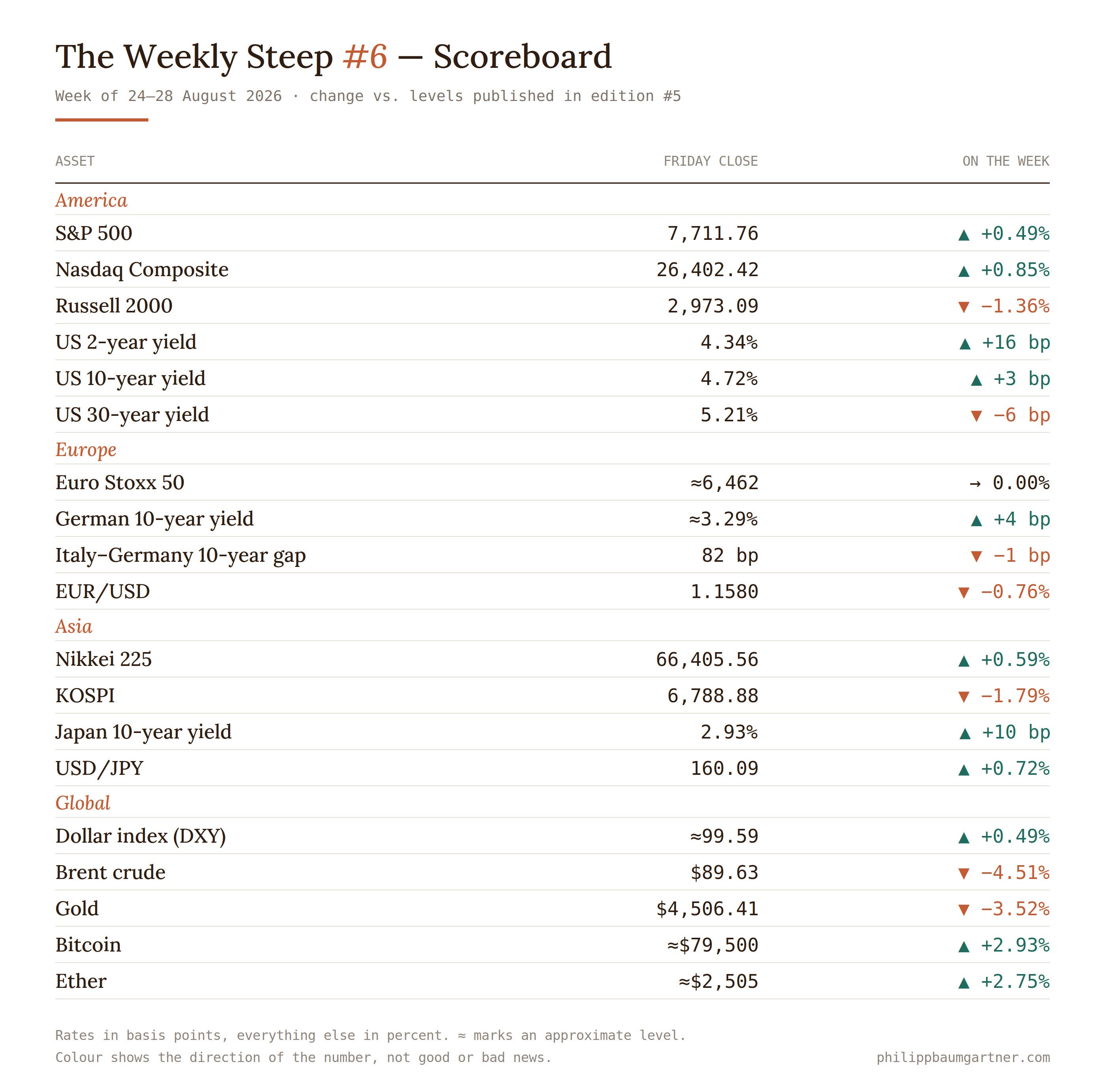
American shares finished higher for the week despite falling on Friday. The S&P 500 was up 0.5%, the Nasdaq 0.9%, and all that while smaller domestic companies dropped 1.4% during the week.
The two-year government borrowing rate rose 16 basis points while the thirty-year fell 6. That move is the exact opposite of what happened last week. Korea gave back the whole week on Friday alone, they are down 1.8% as foreign investors sold 1.76 trillion won of equities.
But the most interesting line on the board is the yen. On Friday it fell back through 160 per dollar which was the fifth falling day in a row. On 31 July, Japan and the United States bought yen together to stop it falling. They had not done that since 1998. The yen got stronger for about two weeks, but it has lost all of it already again. But why should a European reader even care about a Japanese currency that much you might ask?
Japan has kept interest rates near zero for thirty odd years. Money is cheap there and expensive almost everywhere else. So for decades, investors have borrowed yen cheaply and used it to buy things that pay more. Whether that was American government bonds, European bonds, shares, almost anything that yields more than owning a falling currency. Japanese savers and pension funds did the same with their own money. Japan became the world’s biggest lender.
That works while the yen keeps falling, because you repay your loan in a currency worth less than when you borrowed it. It’s like shorting a company that keeps on delivering bad earnings releases. A no brainer one might think. But what happens when the yen turns around, and then everyone tries to unwind the same trade at once?
They sell what they bought and buy yen to repay. That is why a currency most people never think about can move share prices in New York and bond prices in Frankfurt.
Two things pushed it down this week. Warsh made a US rate rise more likely, and higher American rates pull money out of yen and into US-dollars. Secondly Japan’s finance ministry said it may plan its 2027 budget around paying 3.8% interest on its debt, up from 3%. This would mark a government getting ready for its own borrowing to cost much more.
Above 160, people watch for another intervention. Treasury Secretary Bessent wrote to Senator Warren this week that big, messy moves in the yen would be bad for world markets. Nobody has said what level would make them act.
That is one line on the board. Here is the whole board at once, with each asset drawn as big as its move.
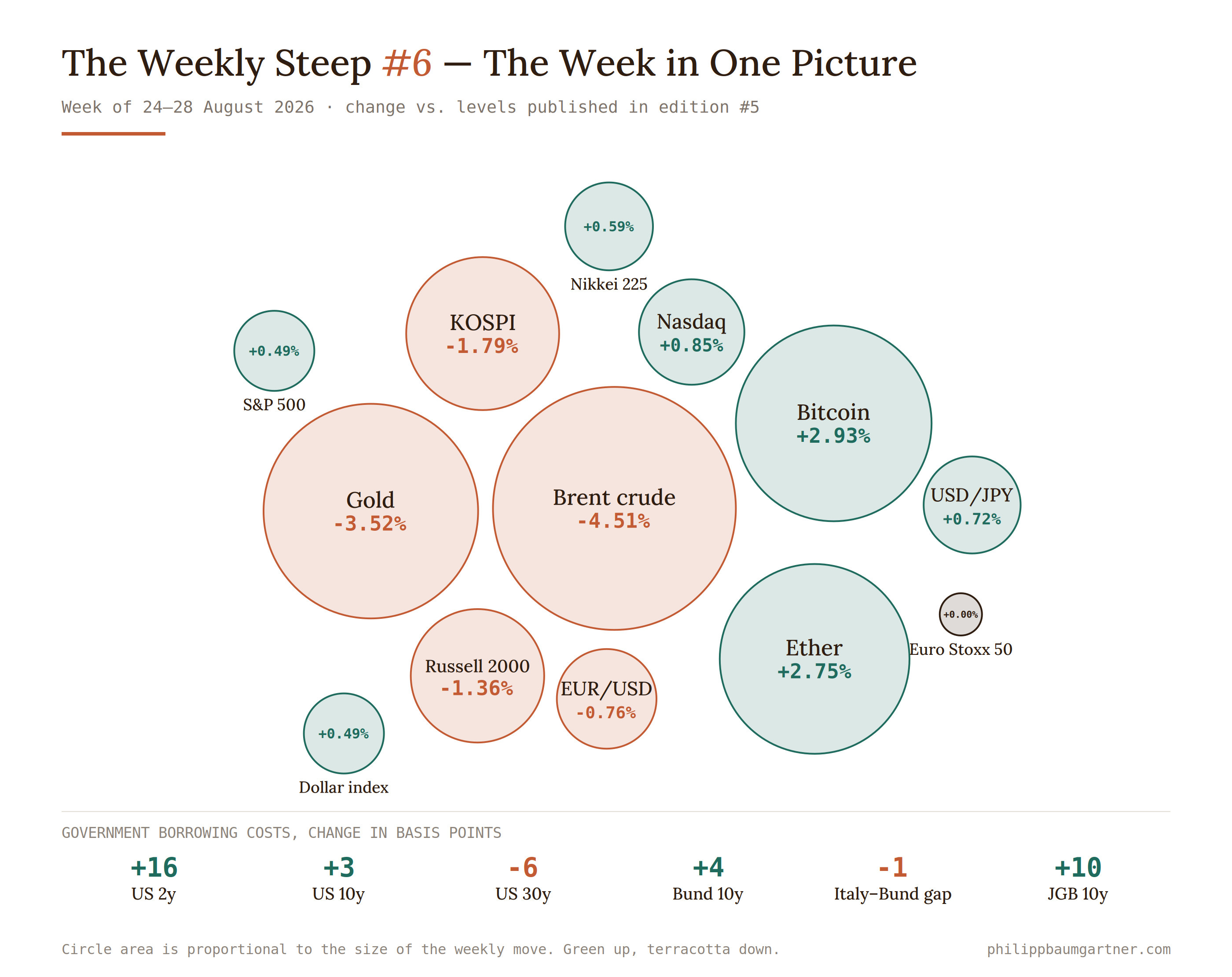
The two largest circles are both commodities, and both are red. Oil fell 4.5% as Iran and Oman kept talking about the Strait of Hormuz. Gold fell 3.5% for a completely different reason and that reason is the first chapter that we cover shortly.
Notice what is missing: any big green circle among the equity indices. The four stock markets on the board barely moved. Everything that did move was a currency, a commodity or a crypto asset. That is what a week looks like when the news is about central banks rather than companies.
1. The trade that needed soft inflation
Last week’s letter named the condition that would break the gold-and-bitcoin story. It broke three days later.
Two weeks ago this letter argued that gold and bitcoin were rising for the same reason: investors doubting that governments could handle their debts without inflating them away. It closed with a test to watch whether the two keep moving together, because if they separate, the story was doing less work than it looked.
On Wednesday the Bureau of Economic Analysis reported that the price index the Fed actually targets rose 3.7% over the year, against 3.6% expected. The core measure, which strips out food and energy, came in exactly on forecast at 3.3%.
One tenth of a percentage point, on the headline number only. Gold broke below $4,600 within the hour. Bitcoin gave up $3,000. By Friday, after Warsh spoke, gold had fallen another 3.4% to $4,506, its worst day in months.
But what does this tell us? If the trade were really about governments debasing their currencies over years, a one-tenth miss on a monthly inflation print should not touch it. What actually happened is that both assets were being bought on the expectation of falling interest rates. Higher rates make holding something that pays no interest more expensive, and both gold and bitcoin pay no interest and no dividends
So the trade was real, but its reasoning was shorter-term than its own story suggested. Worth remembering the next time a market move arrives with a grand explanation attached.
2. Warsh, and the curve that turned around
The Fed chair gave no guidance and moved the market anyway.
Last week’s letter described a market worried about government debt: long-term borrowing costs rising, short-term ones falling. This week it did the exact opposite and the reason was the Fed’s chairman.
Warsh spoke at Jackson Hole on Friday afternoon. He committed to nothing and declined to say what would make him move. But he said inflation data do not show meaningful improvement, that if inflation does not head to 2% quickly there is work to do, and that it is hard to call current financial conditions restrictive.
You can watch the market change its mind in real time, because people bet on this. Polymarket runs a market on the September Fed decision with $66 million of money in it — anyone can buy a share that pays out if the Fed raises rates, and the price of that share is the crowd's probability.
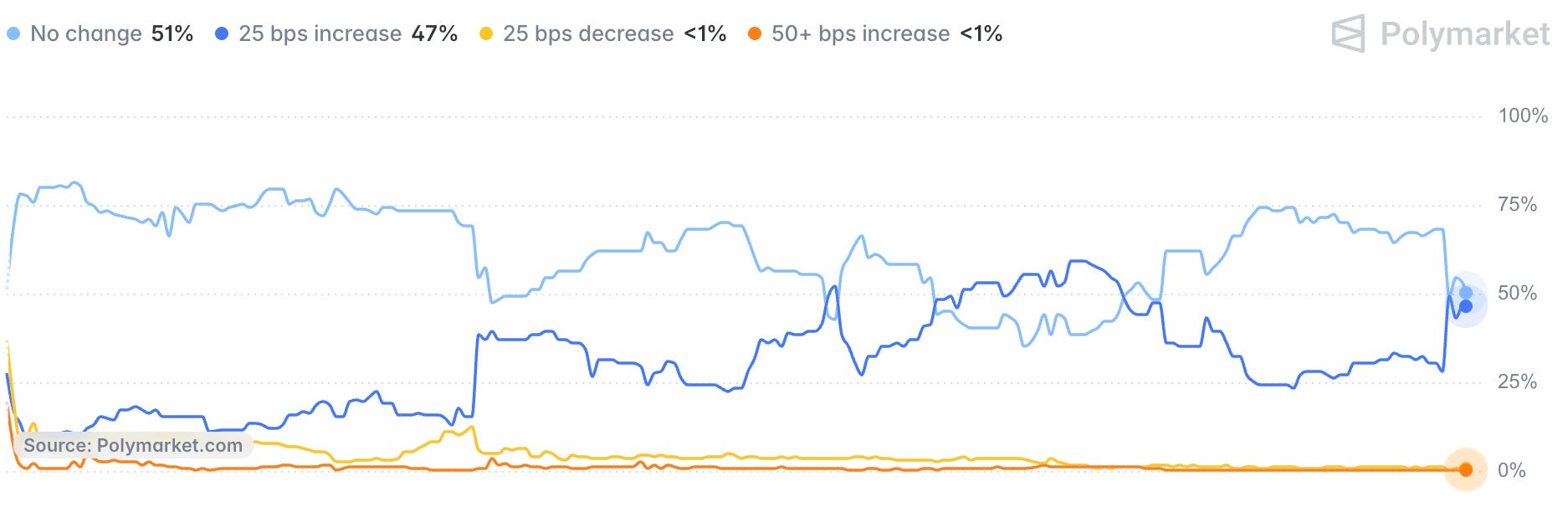
At two o’clock on Friday afternoon, before he spoke, the crowd gave a rate rise a 28% chance. By two in the morning it was 50%. As of Sunday morning it sits at 47%, against 51% for no change at all.
The futures market, where banks hedge rather than bet, moved even further. From about 35% to 57%.
The two-year yield, which mostly reflects what people expect the central bank to do, rose 16 basis points on the week to 4.34%. The thirty-year, which depends more on how much debt is being sold and who wants it, fell 6 basis points to 5.21%.
So what does that mean? Higher short-term rates slow the economy, and a slower economy means less inflation later. So the market is saying: tighter now, calmer later. It is the opposite of last week, when the message was that nobody wanted to lend long at any price.
But note where it landed. Not at “he will raise”, just at “it could go either way”. One speech turned a settled question into a coin flip, and Friday’s jobs report will most likely decide further steps.
3. Nvidia had the best quarter of its life
$96 billion of revenue, a forecast of 70% growth, and $442 billion added in a single day.
Nvidia reported on Wednesday after the close. Revenue of $96.22 billion, more than double a year earlier. Adjusted earnings of $2.22 a share. And guidance for roughly 70% revenue growth in the coming financial year. These numbers are just incredible to say the least.
Based on these news the stock rose nearly 9% on Thursday, adding $442 billion of market value. This was the largest single-day gain for any company since April 2025. That one move lifted the entire Nasdaq 100 by 1.4%.
Then on Friday it fell more than 3%, because Warsh spoke.
That sequence is the whole argument about this market in miniature. The company that carries the index delivered everything anyone could have asked for. But still, it was not enough to outweigh a central banker declining to rule out a rate rise. When borrowing costs go up, profits arriving years from now are worth less today. And Nvidia’s valuation rests almost entirely on profits arriving years from now not today.
4. France is where Europe is nervous now
Not Italy, not Greece. French banks fell 5% on Thursday over the country’s public finances.
Two weeks ago this letter noted, almost in passing, that France is not usually where European bond stress shows up first. It is now showing up there in equities as well.
On Thursday the CAC 40 fell about 1.7% to a one-month low while the broader European index dropped 0.7%. BNP Paribas, Société Générale and Crédit Agricole each lost roughly 4% to 5%. The trigger was a growing doubt about whether France can control its budget deficit while candidates for next year’s presidential election promise more spending.
Banks fall first in this kind of worry because they hold large amounts of their own government’s debt. If those bonds lose value, the banks holding them do too.
France’s ten-year borrowing cost touched 4.10% earlier this month, its highest since 2009. Germany’s sits at 3.29%, the highest since 2011. Meanwhile the gap between Italy and Germany finished the week at 82 basis points and barely moved. The country the market used to worry about is now the calm one.
Data Check
Every inflation report comes in two versions. The headline counts everything people buy. The core version leaves out food and energy, because those two jump around for reasons that have nothing to do with the wider economy. Let it be a cold winter, a war, a bad harvest.
Central banks watch the core number, because it shows the trend they can actually influence. So on paper, Wednesday was fine: core came in at 3.3%, exactly as forecast.
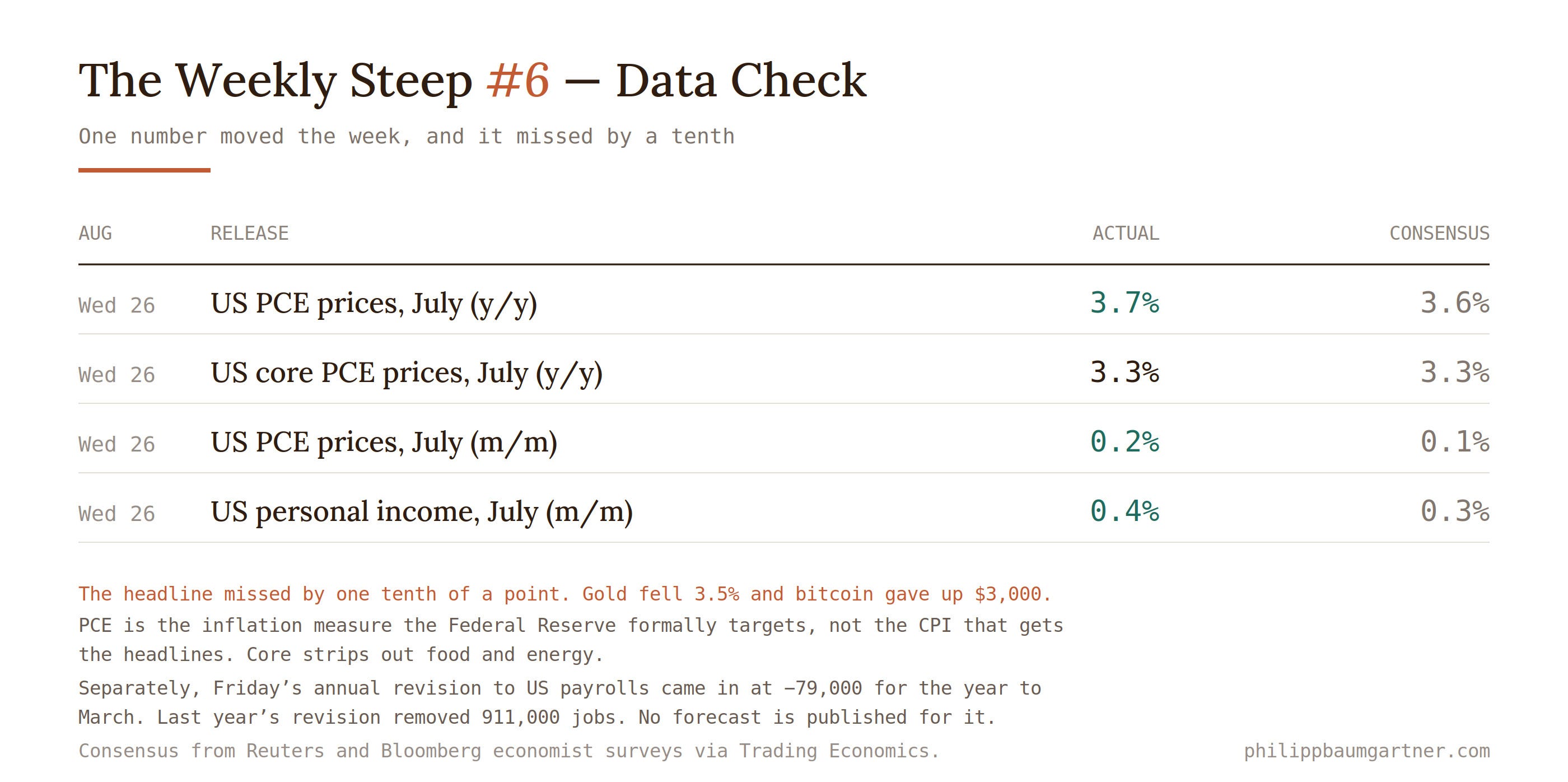
The headline came in at 3.7% against 3.6% expected. And that is the number the market traded.
The reason is simple enough. Households do not get to exclude petrol and groceries from their own budgets. Neither do the people setting wages, and neither do the traders trying to guess what a new Fed chair will do at his first meeting. When a central banker has spent the month sounding worried about inflation, a hot headline is what he gets asked about.
One tenth of a point, on the number that officially matters less, and it took 3.5% off gold and $3,000 off bitcoin.
A second number, quietly good.
Two weeks ago this letter flagged Friday’s annual revision to American job figures. This is the exercise where the statistics office goes back and corrects a year of its own counting. Last year it removed 911,000 jobs after the fact, which was one reason nobody trusted the labour data. This year it removed 79,000. A tenth as much.
The Credit Grind
Lending to America’s weakest companies pays less right now than on any day in the past year. In the same week the Fed chair said rates may go up.
When a company borrows money, the rate it pays consists of two things.
First, whatever the government pays. Governments are the safest borrowers there are, so their rate is the floor. Nobody borrows cheaper than the state they sit in.
Then you add a premium on top of that base rate. A company can go out of business and stop paying. A government almost never does so. That’s why lenders want more to take on that kind of risk. A large, solid company might pay a little extra. A struggling one pays a lot. That extra payment is what this section follows every week.
The size of it tells you two things at once. It says how likely lenders think it is that they will not get their money back. And it says how badly they want to lend at all. When there is more money looking for a home than there are potential borrowers, lenders compete, and competing means accepting less compensation.
This week the second reason (the competition among lenders)) is the one to watch. The premium did not fall because these companies got safer. Nothing about them changed. It fell because there is more money looking to lend than there are companies looking to borrow, so lenders simply undercut each other.
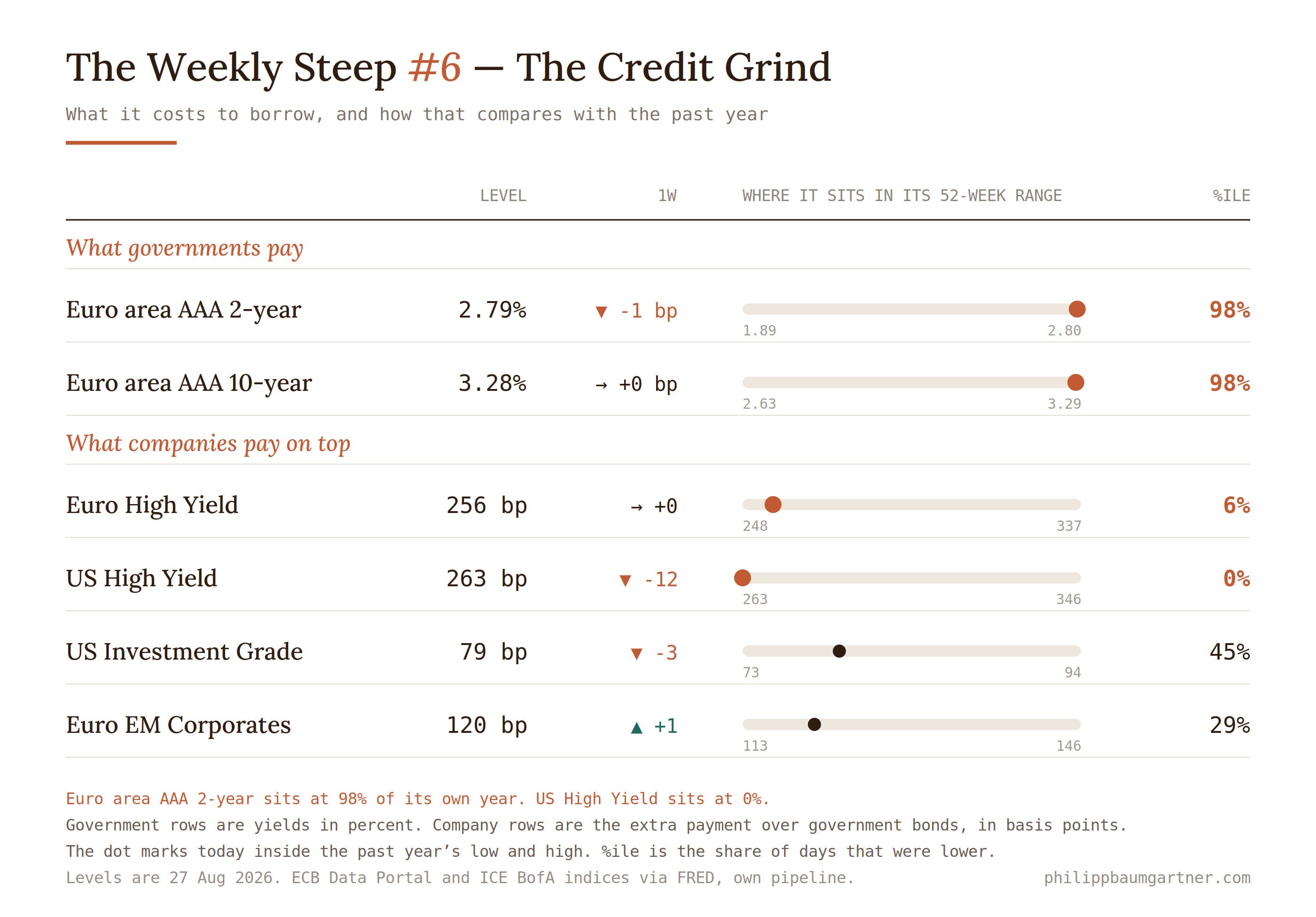
Now let’s look at the second row: America’s weakest companies. They now pay 263 basis points extra, which is 2.63 percentage points on top of the government rate.
The last column says 0%. That column tells you how many days in the past year were lower than today. Zero. None of them. In a whole year of trading, this is the day lenders asked these companies for the smallest extra payment.
Now look at the two rows above. Both are at 98%, almost the highest of their year. Those are European governments. So in one week: Europe’s safest borrowers are paying near their yearly high, and America’s riskiest are paying their yearly low.
One thing I got wrong. Last week the American investment-grade row was at 78%, and I wrote that borrowing trouble was spreading to companies. It is back at 45% now. That reading lasted seven days.
What this means if you own a corporate bond fund.
You are lending to companies, so you should be paid for the risk that some of them fail. Right now almost nothing you earn comes from that. It comes from the base rate. So essentially the part you would get from a government bond anyway. Simply put: you are taking on company risk and being paid government prices.
The Onchain Pour
Bitcoin ended the week higher, having been $1,700 higher still on Wednesday morning.
Bitcoin closed around $79,500, up 2.9% on the week. That number hides a round trip: it reached $81,235 on Wednesday before the inflation report, fell below $78,000 within hours, then recovered.
The month as a whole was remarkable. Bitcoin was near $62,800 at the start of August and peaked about 28% higher. Ether finished around $2,505, up 2.8%.
Ether funds took money in on ten consecutive trading days. Bitcoin funds broke their own streak on Friday with $201 million of net outflows, the first day of selling after the run.
Two structural items. Solana’s validators voted to double the rate at which new coin issuance falls, cutting an estimated 18.9 million coins from supply over six years. And American M2 money supply, which stands for the broad measure of cash and deposits, rose $102.8 billion in July to a record $23.22 trillion, its 27th consecutive monthly increase.
That second number is the entire argument for holding scarce assets, still running quietly in the background while the price of holding them went up this week.
The Week Ahead
This week has one question running through it, and every release either supports Warsh or undermines him. He argued on Friday that inflation is not falling fast enough and that money is still too easy. The week’s job is to check both halves of that.
Monday 31 August.
China’s factory survey at 03:30, expected to stay below 50 — the line between growing and shrinking. China’s factories set prices for a lot of what the rest of the world buys, so a weak reading is mild good news for inflation everywhere else. German inflation for August at 14:00, forecast to rise to 2.9% from 2.8%.
Tuesday 1 September — the European one.
Euro area inflation at 11:00, forecast at 3.2% against 2.9% last month. That would be the highest reading of the year, and it arrives two weeks before the ECB meets. If it comes in at or above forecast, the argument in Frankfurt shifts from holding rates to raising them, and every European mortgage and business loan sits downstream of that. US job openings at 16:00 (consensus 7.39 million) is the first of four labour readings this week.
Wednesday 2 September.
Private payrolls at 14:15 (consensus 59,000) — a private company’s count of American hiring, published two days before the official one and often the first hint of it. The Bank of Canada decides at 15:45, expected to hold at 2.25%, in the week its largest trading partner put 50% tariffs on some of its goods. The Fed’s survey of regional business conditions at 20:00 is worth more than usual: it is written by the same regional presidents who will vote in three weeks.
Thursday 3 September.
The US services survey at 16:00 — the sector that produced last week’s upside surprise, and the one that employs most Americans. Jobless claims at 14:30 (consensus 203,000). Then two Fed officials speak, Waller at 14:30 and Hammack at 21:00, both with a chance to tell us whether Warsh was speaking for himself or for the committee.
Friday 4 September — the one that counts. US payrolls at 14:30.
Consensus is 45,000 new jobs after last month’s loss of 23,000, with unemployment ticking up to 4.2% from 4.1%.
This is where the week resolves. A central bank raising rates into a weakening labour market is a very hard thing to justify in public. Weak numbers and Friday’s whole move reverses. Strong numbers and Warsh has what he needs for 16 September. Canada reports its own employment figures at the same hour.
☕ Last Sip
The week’s lesson is about how quickly a story can change owners. For most of August the market worried that governments were borrowing too much. By Friday it worried that a central bank would raise rates instead.
Both worries are real, and they pull in opposite directions for anyone holding bonds. Too much government debt makes long-term lending expensive. A central bank raising rates makes short-term lending expensive. This week the second one won the argument, and the shape of the yield curve simply flipped over to match.
There is a reason it can turn that fast. Neither worry is a fact yet. Nobody knows whether Warsh will actually raise rates in three weeks, and nobody knows how much debt the world will absorb before it demands a higher price. Markets have to put a number on both anyway, every day. So the number moves whenever someone credible says something new. Last week the most credible person in the room spoke for the first time in that job.
Friday brings the American jobs report, and it will settle rather a lot. Weak numbers make a September rate rise hard to justify and the whole week’s move goes into reverse. Strong numbers and Warsh has what he needs.
Enjoy the last days of summer. See you next Sunday for the next episode of The Weekly Steep.
Sources
Market levels: CNBC and Yahoo Finance for the US closes; Trading Economics for European and Asian indices and yields; Zai Diamond and Zaikei Shimbun for the New York close in dollar-yen, euro-dollar and gold; Korea Times and Asia Business Daily for the KOSPI. Economic releases: US Bureau of Economic Analysis, US Bureau of Labor Statistics, Eurostat, Trading Economics calendar. Credit and euro curve: ICE BofA indices via FRED and the ECB Data Portal, from my own pipeline. Onchain: Cointelegraph. Weekly changes are measured against the levels published in edition #5. Analysis and personal opinion — never investment advice.