
The Week in One Sip
On Wednesday morning the US Treasury announced it would at least double the size of its bond buybacks. This are the operations where the government buys back its own debt from its investors. As a result of these actions the long-term borrowing costs fell immediately. The thirty-year rate dropped about ten basis points.
But by Thursday the entire move had reversed. By Friday the thirty-year closed at 5.27%. This marks its highest weekly close since June 2007.
Two things went up instead. Gold rose more than 5%, with its fifth straight weekly gain. Bitcoin rose 22%, its best week in two years. Equities fell. When investors sell government bonds and buy things outside the fiat-backed system, they are usually saying something about their confidence in the government doing the borrowing.
Then, right after the week had ended: trade talks between the United States and Canada collapsed shortly before a midnight deadline on Friday, and 50% tariffs took effect on about $20 billion of Canadian goods. Canada has promised to match them dollar for dollar.
The Scoreboard
This week everything a government issues had a bad week. Everything a government cannot create had a very good one. That’s the major insight.
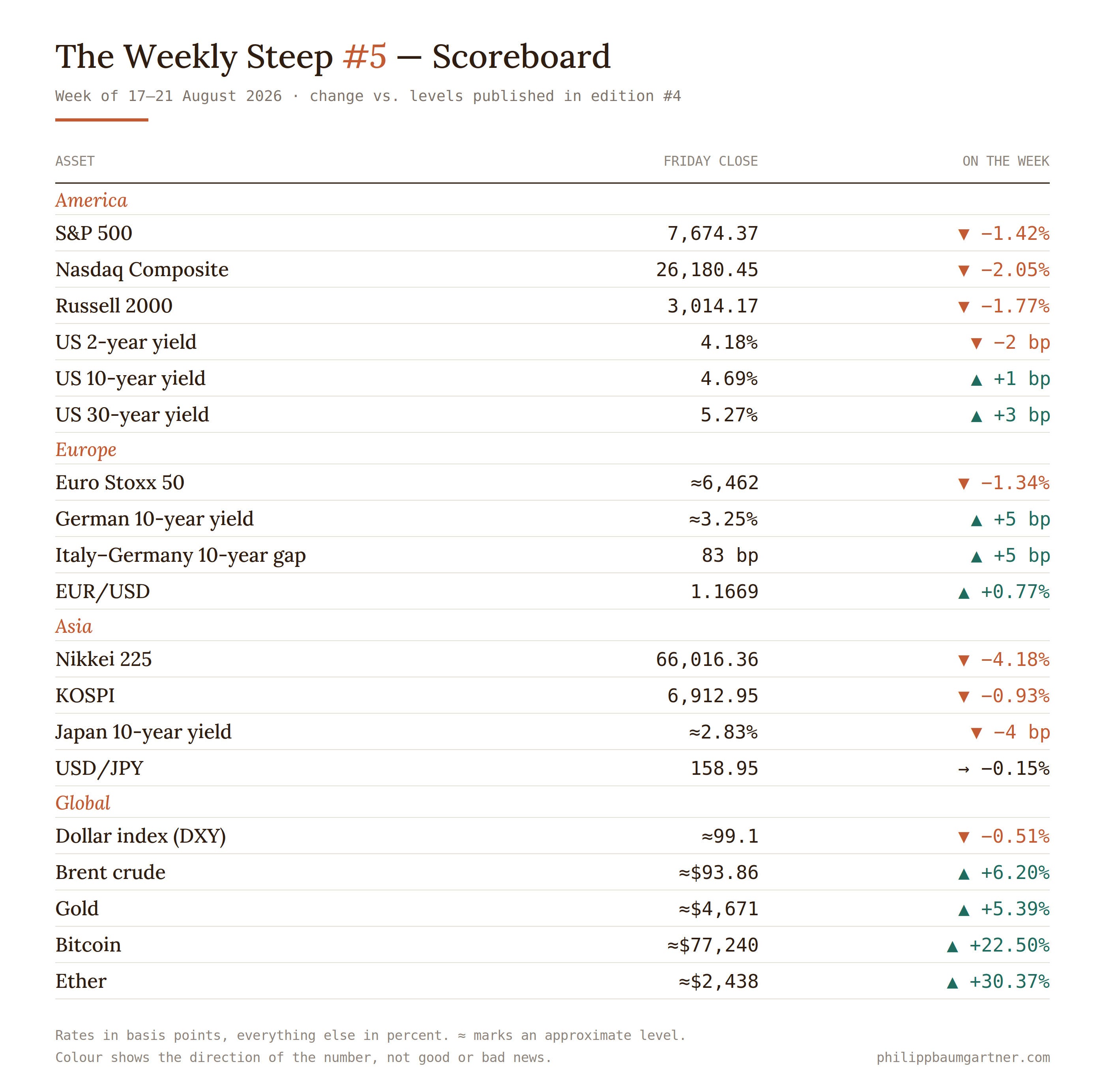
Reading the board. American equities fell for the first week since late July. The S&P 500 down 1.4%, the Nasdaq 2.1%, despite rising on Friday. Long-term government borrowing costs rose while short-term ones slipped, which is the shape of a market worried about debt.
Europe followed the same pattern. Germany's ten-year yield reached its highest since 2011 during the week, and France's touched 4.10% on Tuesday, a level last seen in 2009.
Japan’s Nikkei index fell 4.2%, the largest equity move on the board, after its own ten-year yield hit a thirty-year high mid-week.
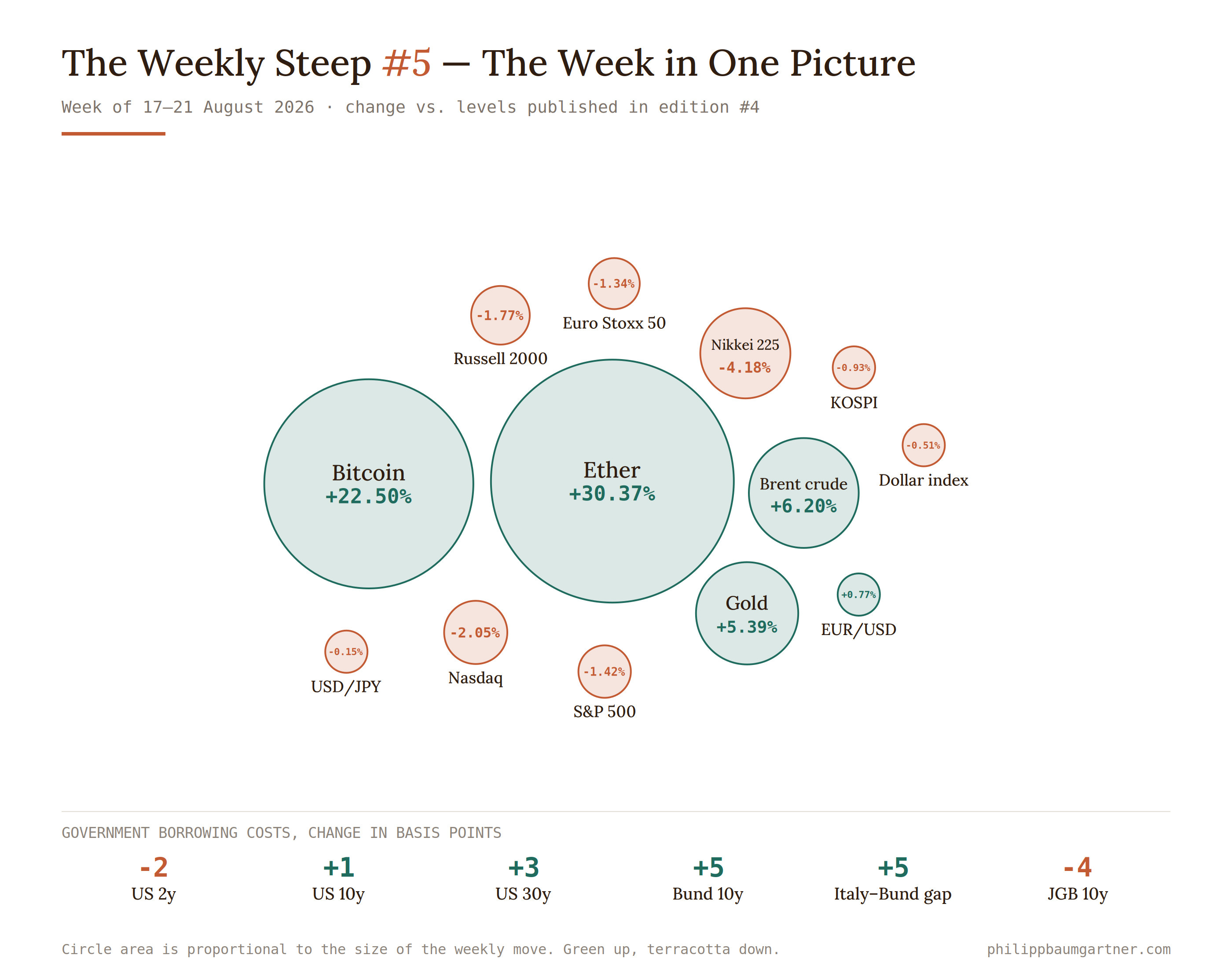
But the interesting part is what rose instead: Brent crude up 6.2%, gold up 5.4%, bitcoin up 22.5%, ether up 30%. Oil had its own reason in the Iran conflict. The other three share one: nobody can create more of them by decision.
But now let’s dive deeper.
1. The intervention that lasted a day
The Treasury stepped into its own bond market on Wednesday but the market handed the money back by Thursday.
Let’s start with what a buyback is. The government has already sold bonds that will not mature for decades. A buyback means it goes into the market and buys some of them back early. But why would they do that, you might ask? It’s quite simple: Fewer bonds available means a higher price for the ones that remain, and a higher price means a lower yield since the two always move in opposite directions.
On Wednesday the Treasury said it would at least double these operations for bonds maturing in ten to thirty years, running from 9 September to 4 November. As a consequence bond yields with a long maturity fell straight away.
That sounds good generally speaking. But the problem is more complicated than one might grasp straight away, because who wants to finance this relocation? There really is only one way. The Treasury has to raise that money elsewhere. It does so by issuing more short-term bills. So the total debt does not shrink at all - it simply gets shorter. And short-term debt has to be refinanced sooner, at whatever rate happens to prevail then.
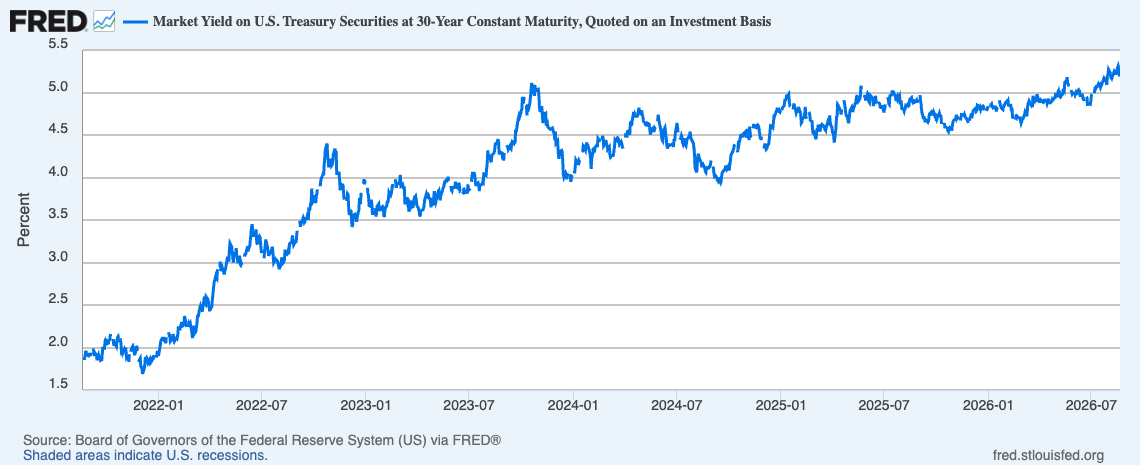
Investors worked this out within a day. The market’s own measure of expected inflation rose to its highest in more than two months, meaning traders read the operation as more likely to create inflation rather than to reduce borrowing costs. The thirty-year yield climbed straight back to where it had been before the announcement.
Secretary Bessent said afterwards that he has “a big tool kit”. This week the market tested one of the tools and gave it about twenty-four hours.
2. This is not an American problem
Germany, France and Japan all hit multi-decade highs in the same week.
It would be very easy to read this past week as a story about American deficits. Unfortunately the rest of the world faces the same problem.
Germany’s ten-year yield climbed above 3.25%, its highest since March 2011. France’s touched 4.10% on Tuesday, the highest since June 2009 — and France is not usually where European bond stress shows up first. Japan’s ten-year yield reached just under 3%, a thirty-year high, in a country that spent most of those thirty years with interest rates near zero.
The common factor is not any one government’s budget. Rich countries as a group are borrowing more, at the same time, into a market with a finite appetite for long-dated debt — while the central banks that spent a decade buying that debt have stopped. And governments are no longer the only ones queueing. American companies have issued almost $1.7 trillion of bonds this year, 27% more than last year, much of it to build AI capacity. That money competes for the same buyers.
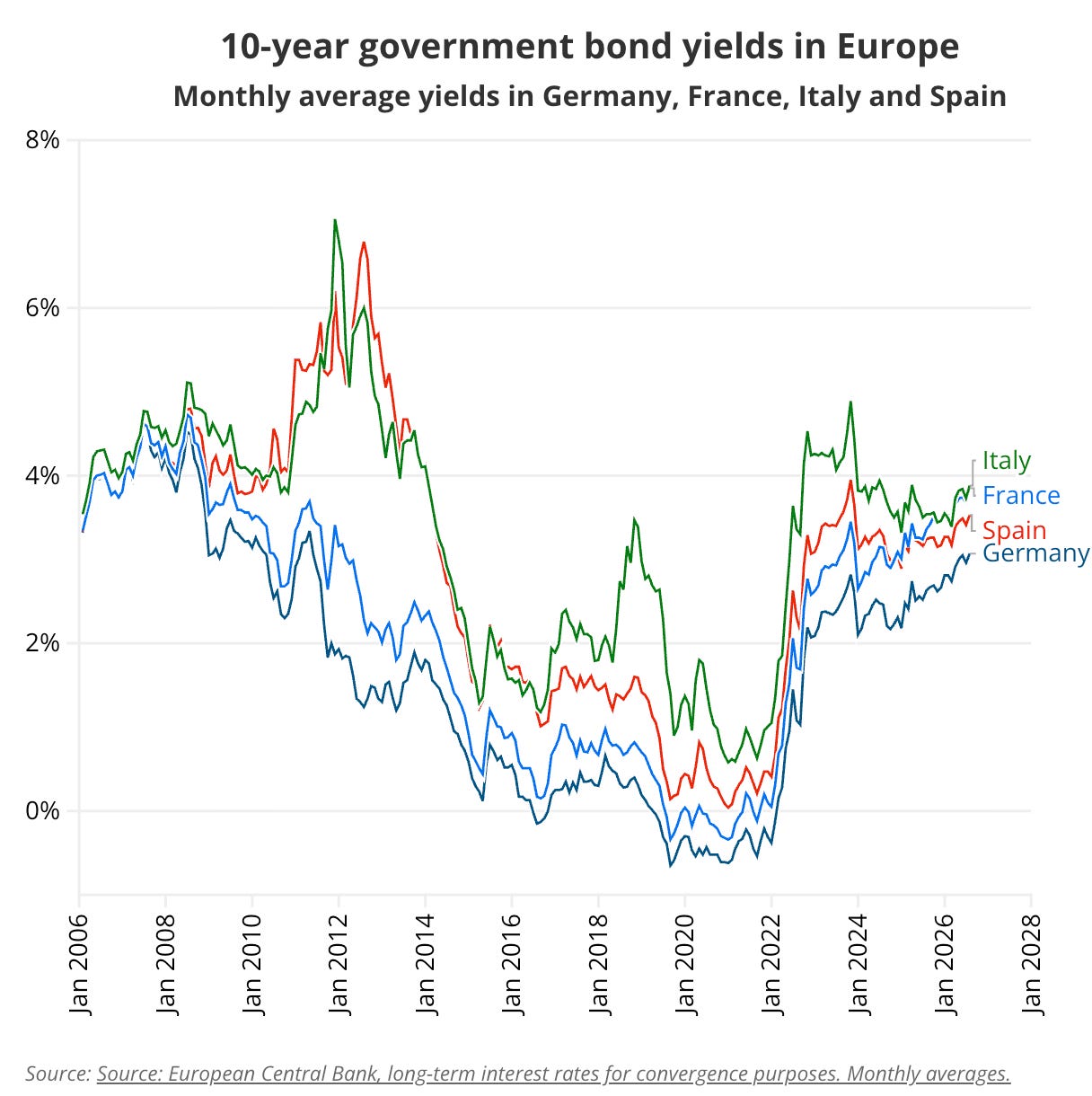
If you are a European reader this matters more than you might think. The German ten-year yield is the reference rate for the whole euro area. When it rises, so does what Italy, France and Spain pay, and so eventually does what banks charge for mortgages and business loans.
3. Gold and bitcoin did the same thing this week
Two very different assets rose hard in the same days that government bonds fell and this is no coincidence.
Gold finished around $4,671 an ounce, up more than 5% and its fifth consecutive weekly gain. Bitcoin rose about 22% to roughly $77,240, touching $79,000 on Friday — its best week in two years. Both moved while equities fell and while government borrowing costs hit multi-decade highs.
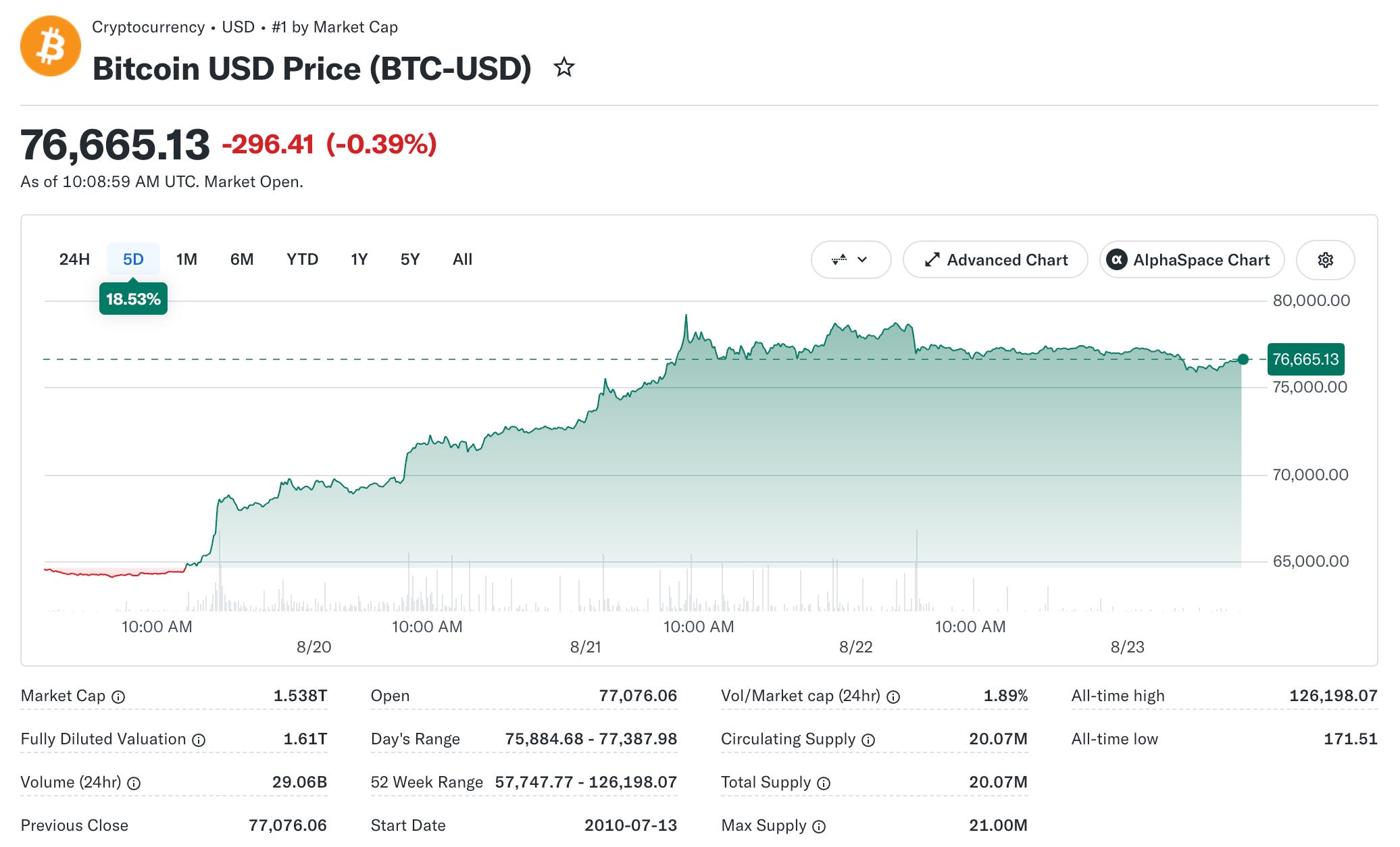
Generally speaking, a government with a large debt has two ways out that do not involve raising taxes or cutting spending: borrow more, or let inflation quietly reduce what the debt is worth. Investors who think the second is likely want to hold things whose supply nobody controls. Gold has been that for thousands of years. Bitcoin was designed to be it.
On Friday one of the largest investors in the world said exactly this out loud. Ray Dalio, who built Bridgewater into the biggest hedge fund on earth, wrote that America’s finances are “at an inflection point” and told investors to hold fewer bonds and put 10% to 15% of their money into gold, plus “a bit” of bitcoin.
His point being: about $5.5 trillion of government revenue this year against $7.5 trillion of spending, roughly $1 trillion of that going on interest alone, and some $10 trillion of existing debt that has to be refinanced. His guess at when this breaks is three years, give or take two. What makes the timing striking is what he named as evidence: Japan selling American bonds, long-term yields at multi-year highs, and Bessent’s buyback announcement. Those are the first two chapters of this letter.
Take the recommendation with the caveat it deserves. Dalio has spent years arguing bitcoin cannot replace gold and warning about its privacy and security risks. “A bit” is doing real work in that sentence.
Bitcoin also had reasons of its own this week. Exchange-traded funds took in $1.67 billion over five consecutive days, BlackRock alone bought more than a billion dollars of bitcoin and ether in two days, and Washington made a renewed push to pass crypto market rules. Those would have lifted the price whatever bonds did.
Watch whether gold and bitcoin keep moving together. If they separate, the debasement story was doing less work than it looks.
4. The economy refuses to give one answer
Last week the consumer looked broken. This week business activity hit a four-year high.
Last week’s letter reported that American retail sales fell 0.6% in July and consumer confidence came in at 51 against a forecast of 55. The picture was of a household sector running out of road.
This week’s data says something else. The flash survey of American business activity for August came in at 56.0 against a forecast of 54.0, the strongest reading since 2022, with services doing the work at 56.8 against 54.0 expected. Manufacturing was the exception, slipping to 53.2 against 53.9 expected, though anything above 50 still means growth.
And new claims for unemployment support fell to 206,000, a level the American labour market has not been far from all summer.
That last number needs a word of explanation, because it looks impossible next to a month in which the economy lost jobs. Initial claims count people who have just been laid off. They measure firing, and firing alone. The payroll figure is a net number: everybody hired, minus everybody who left for any reason.
Both can be low at the same time. If companies stop firing but also stop hiring, jobs disappear quietly. Let it be through retirements, through people leaving voluntarily, through graduates who never find a first position. None of those people can file a claim. Someone who quits generally has no entitlement, someone who retires has none, and someone who has never worked has nothing to claim against.
So the picture is not a strong labour market and a weak one at once. It is a market where almost nothing is happening in either direction. Few people losing jobs, few people finding them. That is a fragile kind of stability, and it is why one bad quarter for company earnings would show up faster than usual.
Data Check
These are survey numbers, so it is worth knowing what they actually measure. Every month S&P Global asks purchasing managers at thousands of companies one simple question: is activity higher or lower than last month? The answers get turned into a single figure where 50 is the dividing line. The August readings below are "flash" estimates, published from roughly the first four fifths of responses, which is why they arrive two weeks before the final version.
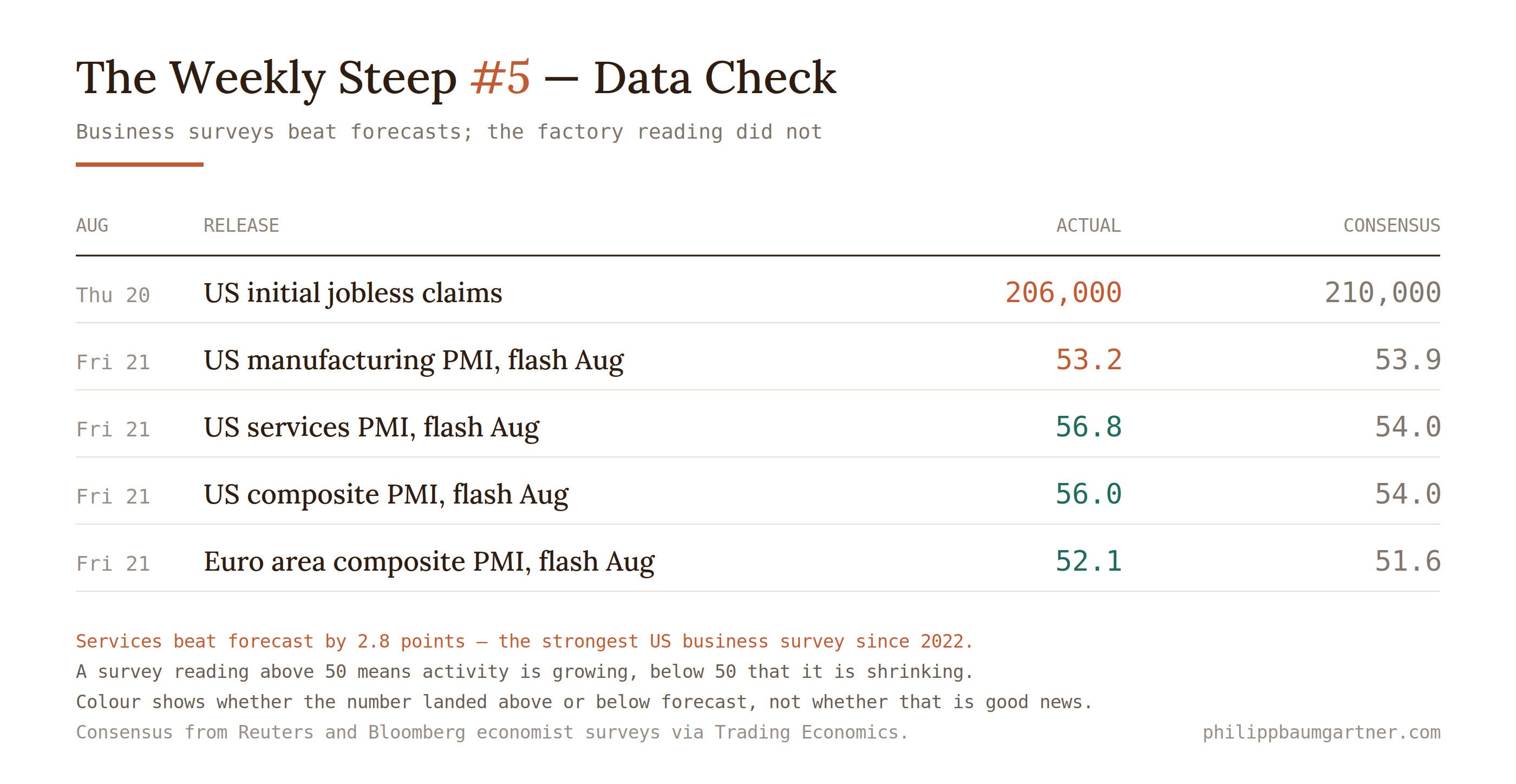
The services figure was the surprise. At 56.8 against 54.0 expected, it is the strongest American business survey since 2022 — and services is where the large majority of Americans work, which makes it the more consequential of the two. Manufacturing went the other way, at 53.2 against 53.9, though it is still comfortably in growth territory.
Europe grew too, more modestly, at 52.1. The composition there is the opposite of America’s: factories did the work, largely in Germany, while services barely improved.
Keep one limitation in mind. A survey records how business feels to the people running it. It does not count anything. Last week’s retail sales figure counted actual purchases and fell 0.6%. Both numbers can be accurate at the same time, which is exactly the tension the chapter above describes.
The Credit Grind
The safest government bonds in the euro area now yield more than at almost any point in the past year. The riskiest companies in Europe are paying almost the least.
A borrowing company pays two prices added together: the base cost of money, set by what governments pay, and a surcharge for the chance it fails to repay. This week those two moved in opposite directions, which is the whole point.
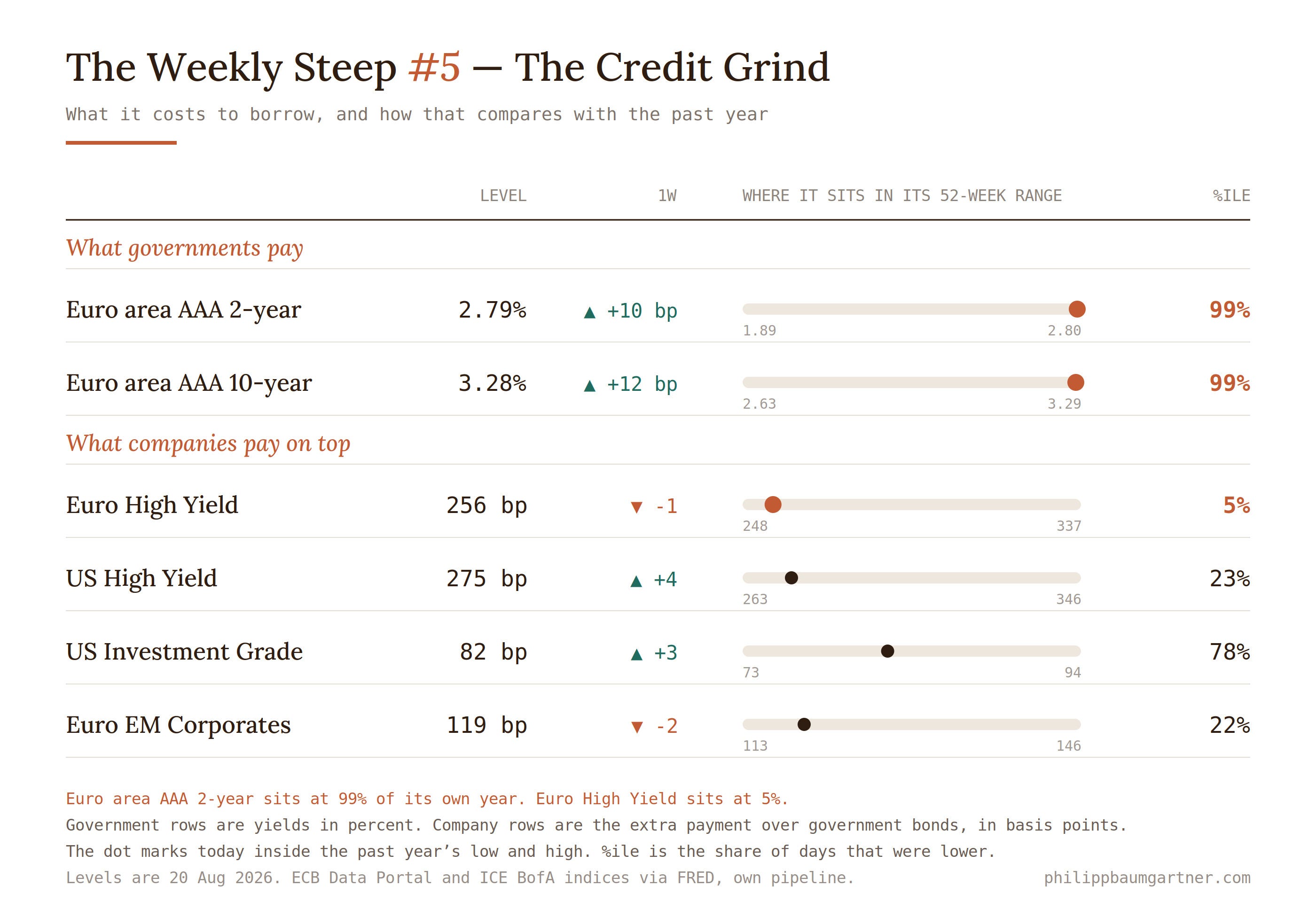
Look at the top two rows. Both euro government maturities sit at the 99th percentile of their own year, meaning there was only one day in the past twelve months when lending to a top-rated European government paid better than it does now. Both are within a basis point of their twelve-month high, and both got there in a single week — up 10 and 12 basis points.
Now the bottom four. Euro high yield tightened again to 256 basis points, the 5th percentile of its year: investors were paid more than this on 95% of the past year’s trading days. Compare that with the American rows. US investment grade — the debt of large, solid companies — jumped from the 48th percentile last week to the 78th. US high yield went from the 9th to the 23rd.
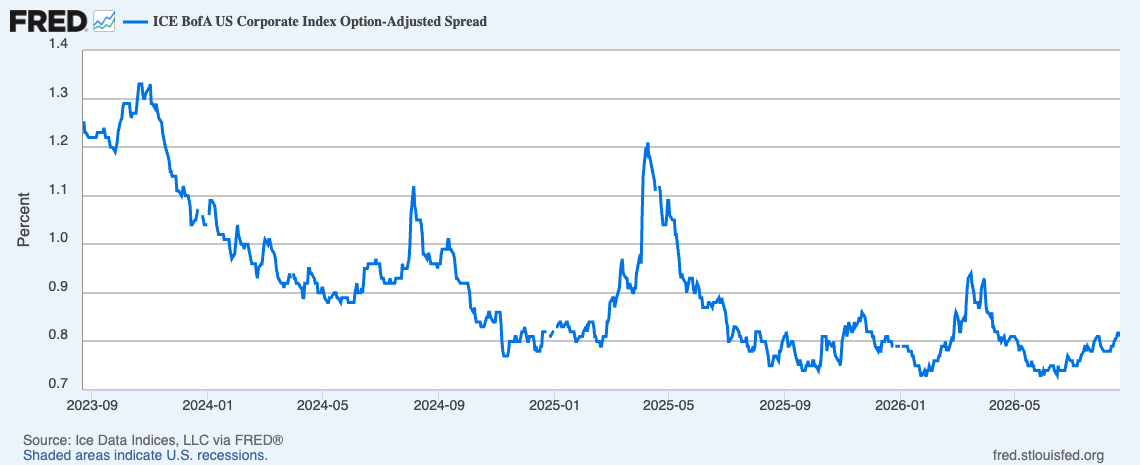
So the bond stress is reaching American corporate borrowers and has not yet reached European ones. Europe now pays 19 basis points less than America for junk-rated debt, the widest gap in weeks.
If you hold a European corporate bond fund, nearly all your yield now comes from the government part, and that part just got more valuable. The compensation for company risk is close to the thinnest of the year.
The Onchain Pour
Bitcoin’s best week in two years arrived exactly where last week’s warning signal said a bottom might form. And the way it happened matters more than the size of it.
Last week’s letter noted that only 51.4% of all bitcoin was worth more than its owner had paid, the weakest reading since 2023. That level has historically appeared near market lows, and also shortly before further falls. This time it was the first.
Bitcoin ended around $77,240, up roughly 22% on the week. Ether rose about 30% to near $2,438. Solana passed $100 for the first time since 3 February.
Here is the detail worth having. Open interest — the total value of outstanding bets on bitcoin’s future price — fell about 12% over the week and now sits at a five-month low, while the price rose 20%. Those two normally move together, because rallies usually come with more borrowed money chasing them. This one came with less.
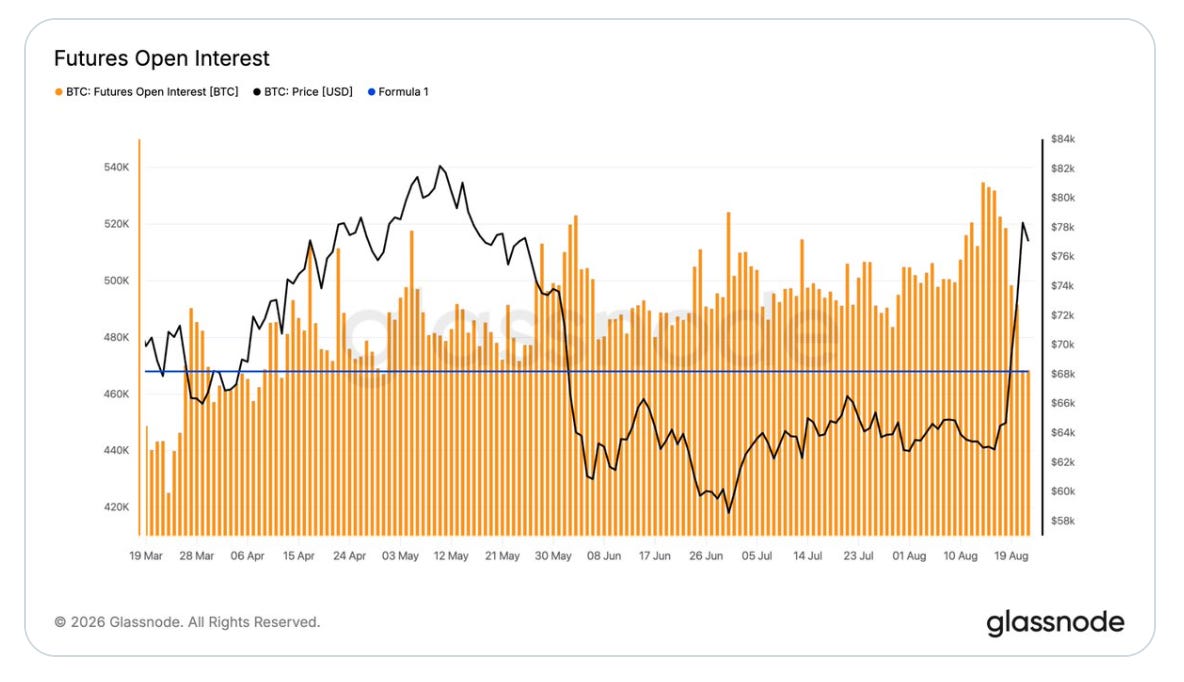
That reframes the $5 billion of leveraged positions liquidated over three days. Most of those were bets that the price would fall, and clearing them out left a market holding more coins and less debt. A rally built on people actually buying is a sturdier thing than one built on borrowed money, even if it is no guarantee of anything.
The caveat stands anyway: bitcoin now shows its most overbought reading since November 2024, which describes how far and how fast it has come, not where it goes next.
The Week Ahead
Monday 24 August.
Quiet on the data. The White House is expected to publish details of what President Trump has called an “economic D-day” against Iran — oil rose more than 5% last week on the anticipation alone.
Tuesday 25 August.
German business confidence at 10:00, forecast to improve to 87.2 from 86.6. US consumer confidence at 16:00 (consensus 91.2) is the first read on whether the collapse in sentiment continued into August. Then a two-year debt auction at 19:00 — the first of three this week, and the real test of whether last week’s buyback changed anything.
Wednesday 26 August — the one that counts. The July personal consumption expenditures price index at 14:30.
This is the inflation measure the central bank actually targets, rather than the consumer price index that gets the headlines. Consensus is 0.2% on the core measure for the month and 3.3% for the year. Second-quarter growth is revised at the same time, forecast down to 1.5% from 2.1%. A five-year auction follows at 19:00. And after the close, Nvidia reports earnings — the largest company in the index and the clearest read on whether the AI investment boom is still accelerating.
Thursday 27 August.
Jackson Hole opens, the annual gathering where central bankers say the things they have avoided all year. The ECB publishes the account of its July meeting at 13:30. Jobless claims at 14:30 (consensus 209,000), then a seven-year auction at 19:00.
Friday 28 August — the heavy one.
At 16:00, three things land together: Chair Warsh speaks at Jackson Hole, the final August consumer sentiment reading confirms or revises the 51 flash, and the Bureau of Labor Statistics publishes its preliminary annual revision to payrolls. Last year’s revision removed 911,000 jobs from the record after the fact. Euro area inflation flashes for France and Spain arrive during the morning.
Through the week.
Canada’s retaliation. Carney has promised to match the tariffs dollar for dollar but has not said on what. The direct sums are modest — about $20 billion of goods against nearly $900 billion of annual trade between the two countries, and the list runs to plywood, liquor and hockey equipment. What matters is whether it stops there.
☕ Last Sip
The lesson of the week is that a government can influence the price of its own debt for about a day. After that, the buyers decide.
Nobody failed to sell a bond this week, and nobody failed to pay one back. It is something slower and more ordinary: the group of people willing to lend to rich countries for thirty years has stopped growing as fast as the amount those countries want to borrow. Prices adjust until the two meet. What we watched this week was this adjusting.
The reason to pay attention, even if you own no bonds at all, is that this number sits underneath almost everything else.
Mortgages are priced off it. Company borrowing is priced off it. And every euro a government spends on interest is a euro it does not spend on anything else.
Next week gives us three auctions and a speech from Jackson Hole. That should tell us whether last week was a wobble or the start of something that keeps going.
Enjoy the last stretch of August. See you next Sunday for the next episode of “The Weekly Steep”.
Sources
Market levels: Trading Economics for indices, yields, currencies and commodities; CNBC and Yahoo Finance for the US closes; Il Sole 24 Ore and SoldiOnline for the Italian–German spread; Zai Diamond and Zaikei Shimbun for the New York close in dollar-yen and euro-dollar. Economic releases: S&P Global, US Department of Labor, Eurostat, Trading Economics calendar. Credit and euro curve: ICE BofA indices via FRED and the ECB Data Portal, from my own pipeline. Onchain: Cointelegraph and Yahoo Finance. Weekly changes are measured against the levels published in edition #4. Analysis and personal opinion — never investment advice.