
The Week in One Sip
Wednesday’s inflation report landed perfectly where economists expected it to. Consumer prices went up 3.4% over the year, down from 3.5%, with the core measure that strips out food and energy at 2.5%. Traders read it as the end of the rate-rise argument that has run all year. The probability of a US rate hike in September fell from about 57% a week ago to about roughly 30% by Friday. The equity market responded fast and share prices climbed to records.
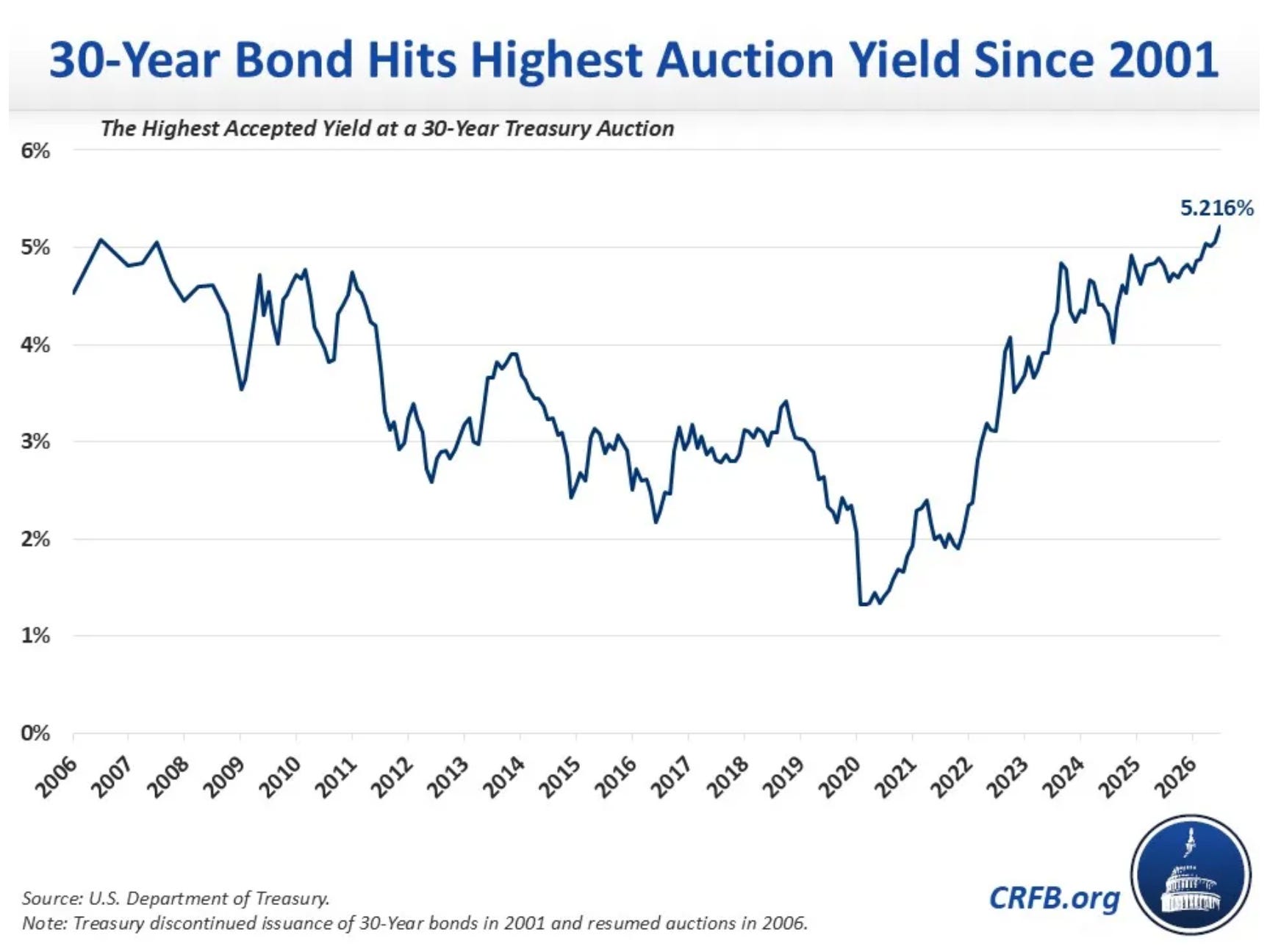
The same Wednesday, the Treasury reported a $432 billion deficit for July. This marks the largest July on record. On Thursday it sold thirty-year debt at 5.216%, which is the highest rate since 2001.
But that is the odd thing that wonders investors. If the central bank is less likely to raise rates, borrowing should be getting cheaper. It got more expensive instead, because the government now has more bonds to sell than it can find buyers for at the old price.
Then Friday brought something nobody expected: American shoppers stopped spending.
The Scoreboard
Lets have a look at our weekly scoreboard to start our session. There are two major things that spark interest. The first is how little moved from one Friday to the next. Most of these numbers ended the week close to where they started, and a quick glance would tell you nothing much happened during this week.
But this is wrong. A lot has happened. American shares hit a record on Thursday but gave it back on Friday. The ten-year government borrowing rate touched a nineteen-month high on Tuesday before settling almost exactly where it began. Weekly numbers are a snapshot of two moments, seven days apart, but sometimes they hide everything in between. This was such a week where the space in between was the story.
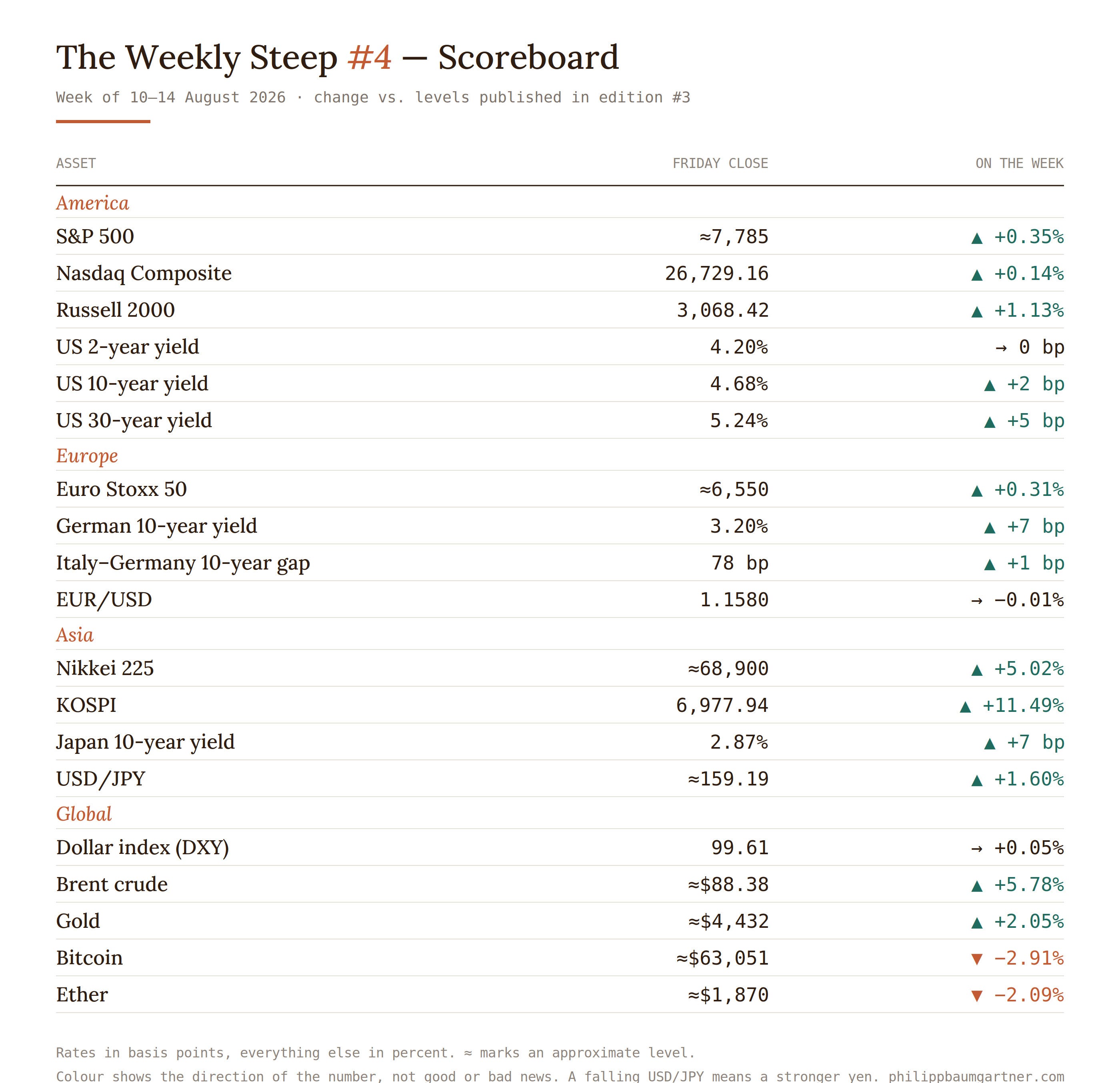
There was not much happening in the US. The markets barely moved. The S&P 500 up 0.4%, the Nasdaq 0.1%, but both touched records on Thursday before Friday’s retail sales report knocked them back down.
Government borrowing costs look almost unchanged too: the two-year flat, the ten-year up 2 basis points. The two-year and the ten-year answer different questions, which is why they can move apart.
The two-year is basically a bet on the central bank. It barely moved because traders spent the week deciding a September rate rise was most likely off the table. This is because the week's data made a September rate rise look unlikely. Wednesday's inflation report came in on forecast rather than hot, and Friday's collapse in retail sales and consumer confidence made a central bank raising rates into a slowing economy hard to imagine. By Friday the market put the odds of an increase at roughly 30%, down from about 57% a week earlier.
The ten-year is a different kind of story. That is where the government does much of its real borrowing, and its price depends on something simpler: how many bonds are being sold, and how many people want them. On Tuesday it touched 4.75%, the highest in nineteen months, before easing to 4.68% by Friday.
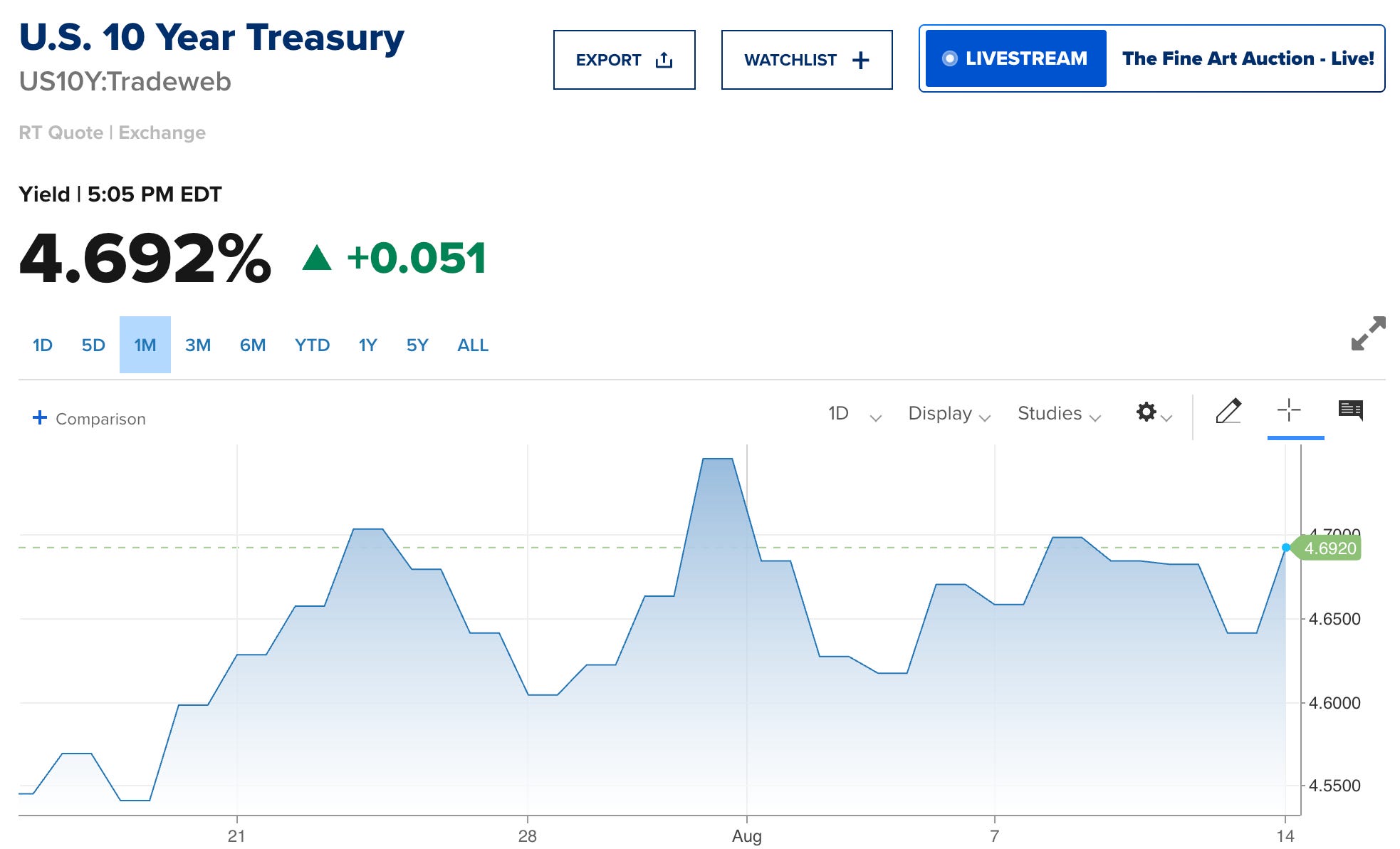
This is the number to care about, because it sets prices well outside the bond market. It is what American mortgage rates are built on. Q thirty-year home loan costs about 6.7% today for this reason. Large companies borrow off it too.
So in essence the week’s message was this: Traders stopped expecting the central bank to raise rates in September. You can read that expectation off the futures market, where people bet on the decision months ahead. The prices of those bets translate into odds. A week ago they pointed to roughly a 57% chance of an increase. By Friday it was near 30%. Normally that alone would make borrowing cheaper across the board. It did not. The government raises money by selling bonds at auction. Each bond pays a fixed amount every year. So if buyers are scarce and the government has to accept a lower price, that fixed payment now represents a bigger return for whoever buys and a bigger return for the lender is a higher cost for the borrower. Price down, yield up. They are two ways of saying the same thing.
This week the government had a great deal to sell, and buyers were not enthusiastic. Thursday’s thirty-year auction went through at 5.216%, the highest since 2001. So the ten-year rate climbed even while the central bank looked less threatening. When those two move apart like that, the cause is usually not interest-rate policy. It is the sheer volume of debt coming to market, which is the subject of the first chapter below.
Europe was quiet, though Germany’s ten-year yield reached a fifteen-year high mid-week before settling at 3.20%.
Asia carried the real movement. Korea’s KOSPI rose 11.5%, the same index that fell 5.1% the week before. The yen weakened 1.6% to around 159 per dollar, its worst week in three months.
1. The government is borrowing faster than the market wants to lend
A record July deficit, and a thirty-year debt sale at the highest rate in a quarter century.
Governments spend more than they collect and borrow the difference by selling bonds. Buyers set the price. When there are more bonds than eager buyers, the government pays more.
July’s gap was $432 billion, a record for the month. For the fiscal year so far the total is $1.8 trillion which is already more than the government borrowed in all of last year, with two months still to run.
One honest caveat. August began on a weekend, so roughly $99 billion of August benefit payments went out in July. Adjusted, the shortfall was $333 billion, still up 18% on a year earlier, but not the big headline number.
The market answered on Thursday. The Treasury sold $25 billion of thirty-year bonds at 5.216%, the highest since 2001. Buyers put in $2.39 of bids for every dollar on offer, down from $2.44 at the previous sale. The government got its money, but it had to reach a little further to find it. Wednesday's ten-year sale drew the highest financing cost at that maturity since 2007.
Interest on money already borrowed has cost $1.17 trillion in the first ten months of this budget year which is 15% more than the same stretch a year ago. That interest is not something separate from the deficit. It is one of the largest items inside of it.
So the chain runs exactly like this: more borrowing pushes the rate up, a higher rate makes next year’s interest bill bigger, a bigger bill widens the deficit, and a wider deficit means still more borrowing.
Anyone who has carried a balance on a credit card will recognise this loop.
2. Prices cooled. Shoppers stopped anyway.
July inflation came in exactly on forecast, and Friday’s data showed the American consumer is pulling back hard.
Inflation at 3.4% is the second consecutive monthly slowdown, and core at 2.5% is back where it sat before the Iran conflict began. Petrol prices fell 2.9% during the month. This is what a fading energy shock looks like.
Then Friday came. Retail sales fell 0.6% in July against expectations of a small rise. This is the sharpest drop in over a year. Consumer sentiment came in at 51 against forecasts of 55. Weaker consumer sentiment, weaker economy.
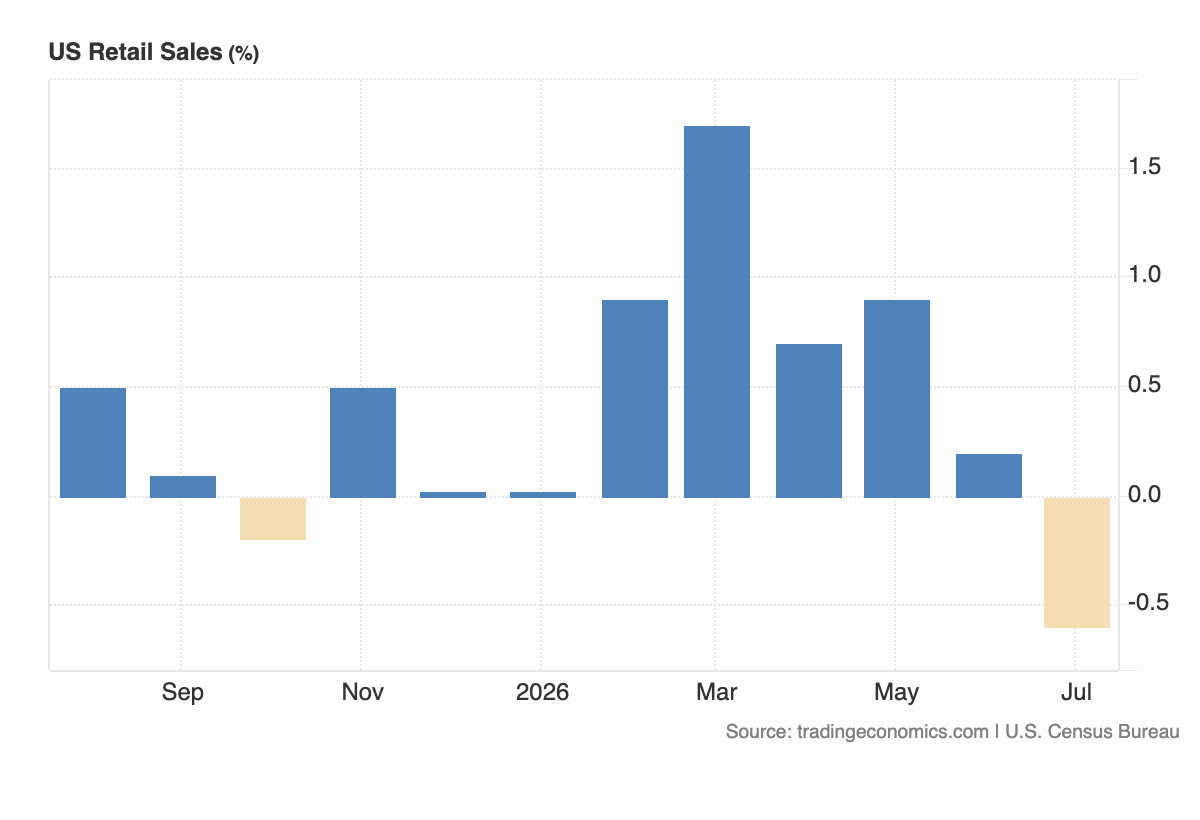
But what caused this? One number explains the gap between the cheerful inflation report and the gloomy shopper. Prices rose 3.4% over the year. Average hourly pay only rose about 3.2%. Inflation slowing is not the same as prices falling, and the average American’s pay is losing the power.
Energy still does the damage even while it fades: petrol costs 24.6% more than a year ago, heating oil 39.1% more. The annual comparison improves every month. The bill each month does not.
3. Korea again — and I got half of it wrong
The index that fell 5.1% last week rose 11.5% this week, and the money came from abroad.
Last week I wrote that Korea’s market was falling because two memory-chip makers dominate its index, and that Korean savers were moving money into American shares. The first half held. The second needs correcting from my end.
The KOSPI closed Friday at 6,977.94, up 11.5% on the week and briefly back above 7,000, with five consecutive winning sessions. Memory chips led it up exactly as they led it down. Concentration cuts both ways, and one week is not enough to tell a structural problem from a bad fortnight.
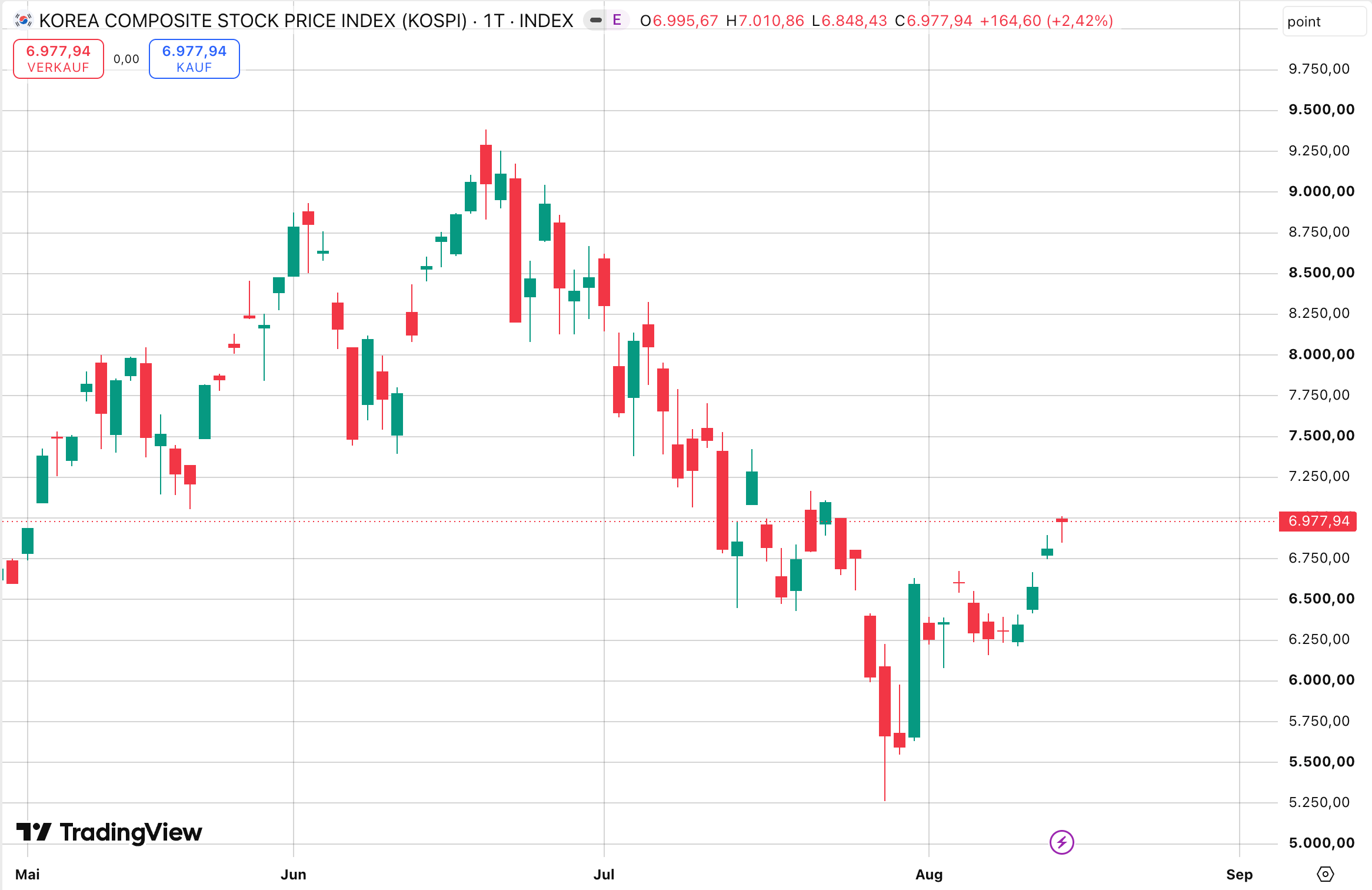
What I did not anticipate: foreign investors bought a net 3.03 trillion won of Korean shares in a single session. So while Korean retail savers were buying American stocks in July, foreign institutions were buying the market those savers were leaving.
That is worth remembering about a whole class of story. “Locals are fleeing their own market” is compelling, and it was true. But it was also one side of the ledger.
4. The yen gave back half the rescue
Three weeks after the first joint US–Japan intervention since 1998, the currency is most of the way back down.
Last week’s letter said intervention buys time rather than fixing anything, because the interest-rate gap that pushed the yen down was still there. That resolved faster than expected.
The yen fell about 1.6% to roughly 159 per dollar, its largest weekly loss in three months, surrendering close to half the ground gained when Tokyo and Washington bought it together in late July. The 160 level that triggered the first intervention is back in no time.
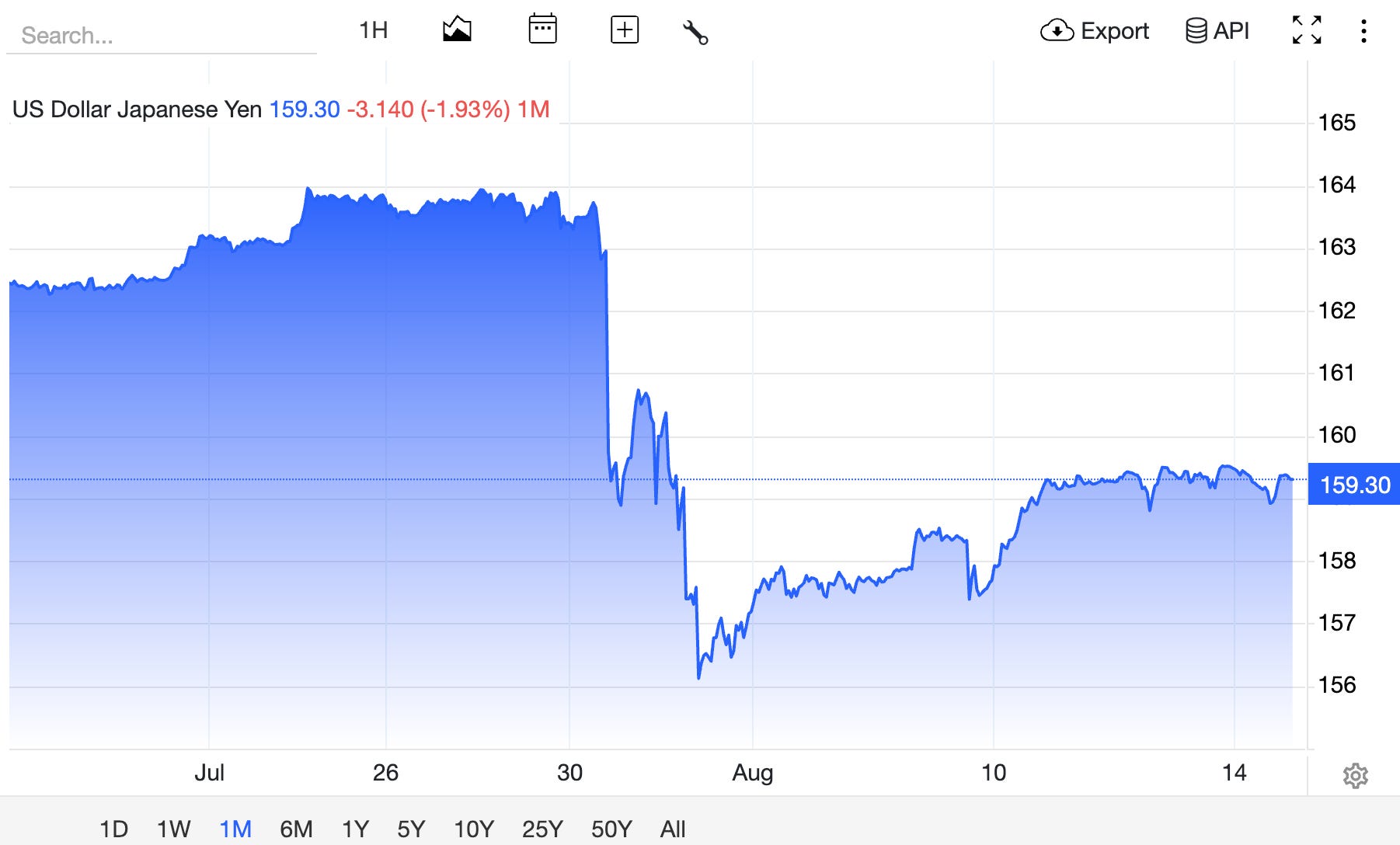
There is a second-order effect that connects to the first chapter. Japan is among the largest foreign owners of American government debt. If Tokyo intervenes again it may need to sell US Treasuries to fund the purchase and traders priced that possibility into US long-term yields this week. A currency operation in Tokyo is now part of why Washington pays more to borrow and why the US has a specific interest in the yen.
The Bank of Japan meets on 17 and 18 September, and analysts expect it to raise its rate to 1.25% from 1%. To see why that matters more than another round of buying, look at the gap. Japan pays about 1% on its money. America pays between 3.50% and 3.75%. Money moves toward the better return, so an investor sitting on yen has a standing reason to sell them and buy dollars instead. That selling is the thing pushing the yen down, and it happens every day, in small amounts, from thousands of separate decisions.
Intervention does not touch any of that. It is one very large purchase on one afternoon. It moves the price for a few days but it changes nobody’s reason behind the moves.
Data Check
Two kinds of number came out this week, and they split cleanly.
One kind measures prices. Consumer inflation on Wednesday, producer prices on Thursday. Both landed almost exactly where economists had predicted.
The other kind measures what households actually do. How many filed for unemployment support, how much they spent in shops, how they feel about the months ahead. All of those came in worse than expected, and retail sales missed by a wide margin.

So the week was not really an argument about inflation. That question got answered on Wednesday and largely settled. What it opened instead is a different one: whether American households are still able to carry the economy the way they have for the past two years.
The Credit Grind
European junk-rated companies are paying the smallest premium over governments in almost the entire past year. In the same week those governments paid the most in decades.
A borrowing company pays two prices added together: the base cost of money, set by what governments pay, and a surcharge for the chance it fails to repay. This week those two moved in opposite directions, which is the point.
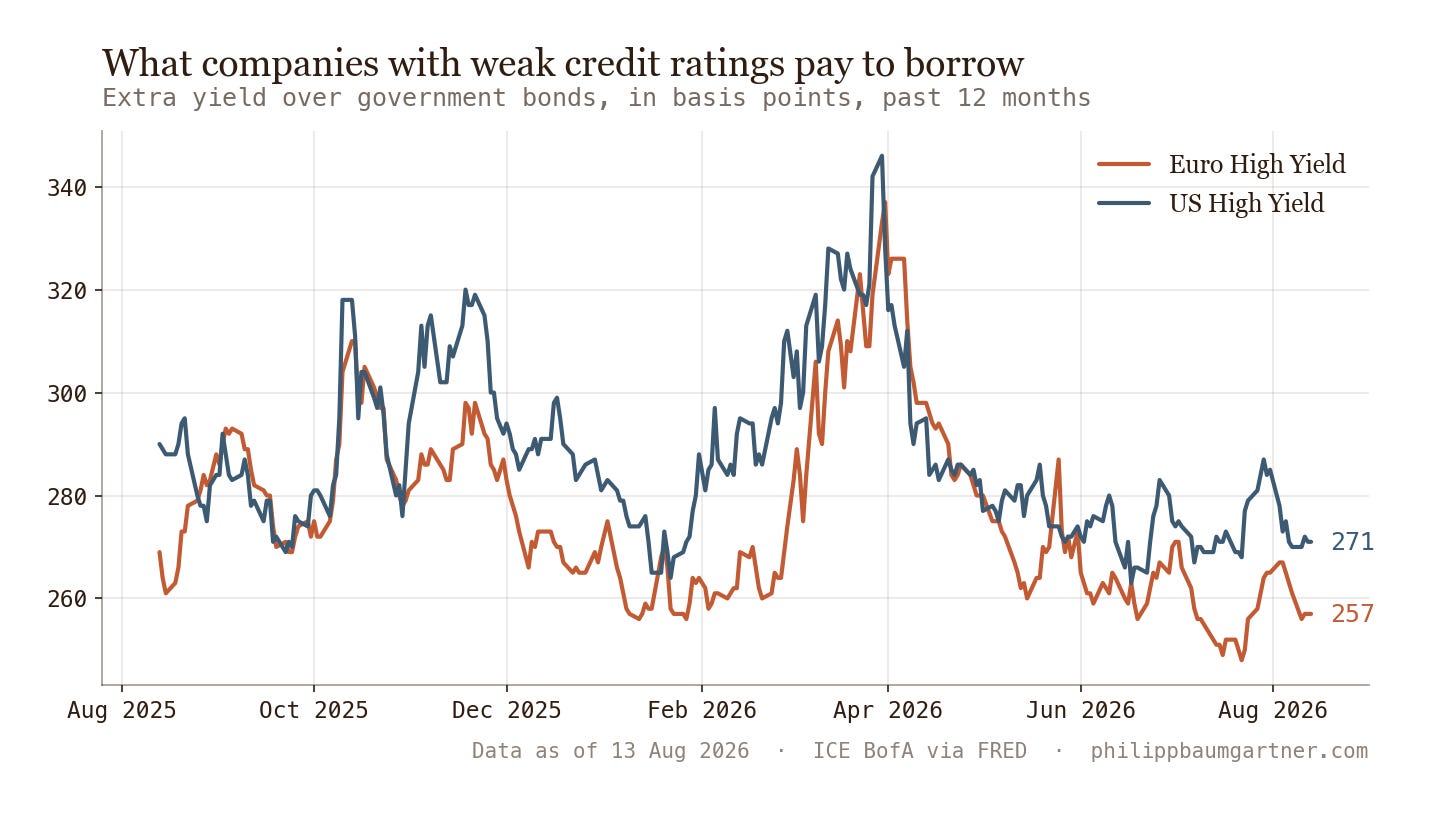
Euro high yield fell another 6 basis points this week, to 257. The direction is the confusing part: a smaller number means investors are asking for less extra payment to lend to these companies, not more.
How little? 257 sits in the 6th percentile of the past year. On 94% of the trading days behind us, lenders were paid more than they are being paid today. The American equivalent sits at the 9th percentile, almost as low.
Now hold that next to what governments pay. The two-year euro government yield sits in the 93rd percentile of its own year, the ten-year in the 92nd.
Normally these two move together. When borrowing gets more expensive in general, it gets more expensive for risky companies too. This week that broke apart. The same investors, in the same few days, wanted close to the most they have wanted all year to lend to governments and close to the least to lend to Europe’s weakest companies.
If you hold a corporate bond fund, that is worth knowing. Almost all of the yield you collect right now comes from the safe half. Very little of it is payment for the risk you are carrying.
The Onchain Pour
Bitcoin fell while the stock market held their records, and Washington moved closer to crypto than it has ever been.
Bitcoin ended Friday around $63,050, down 2.9% on the week. Ether finished near $1,870, down 2.1%. CryptoQuant reported that the share of bitcoin held at a profit has dropped into territory it has historically reached only near market bottoms. This is either a floor forming or a floor about to break. We will keep monitoring the current situation.
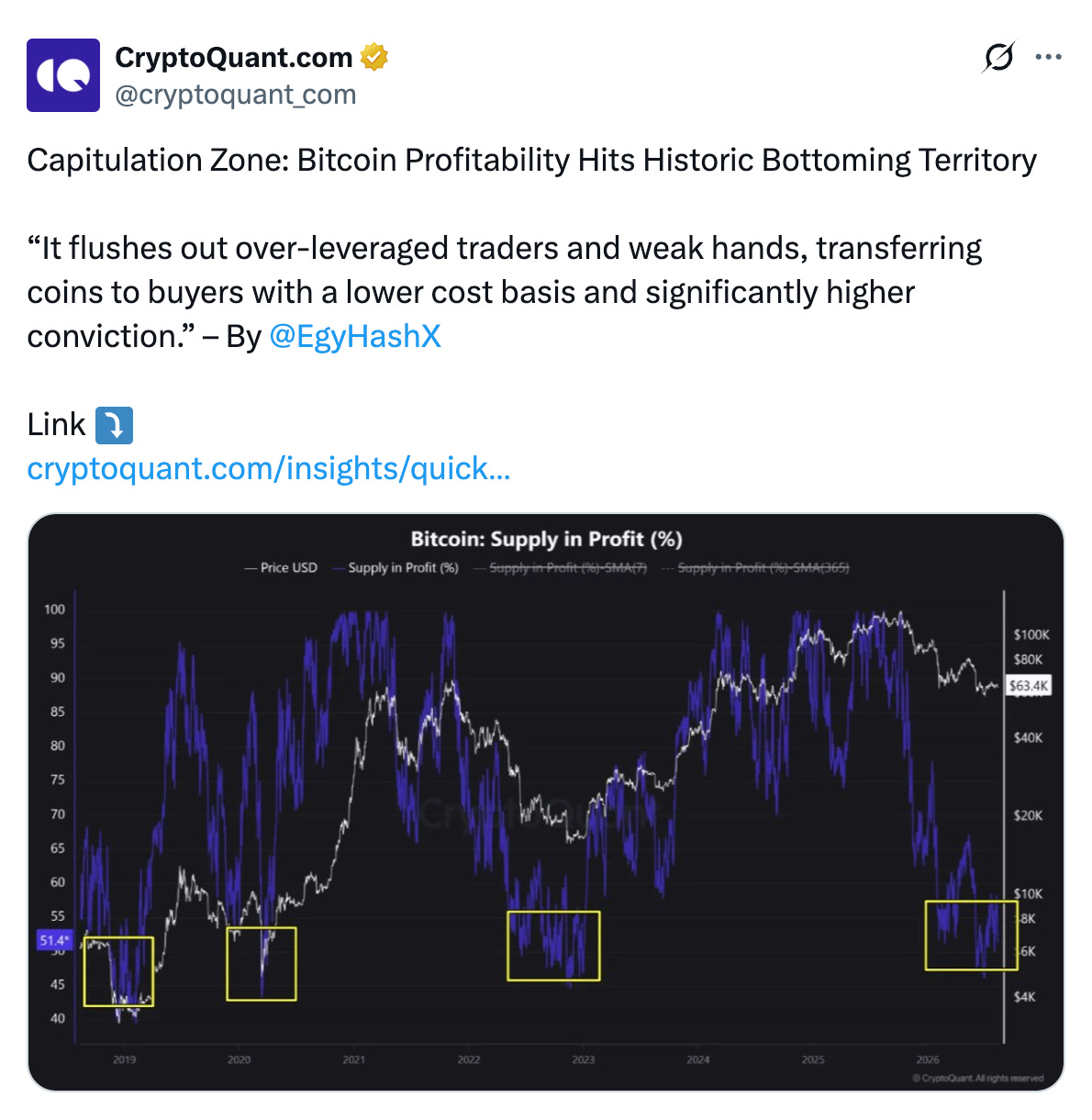
But the policy news was larger than the price news. A US regulator conditionally approved a bank charter for World Liberty Financial, the Trump family’s crypto venture: a sitting president’s family business receiving permission to operate as a bank in an industry his administration regulates.
The White House hosts executives from Coinbase, a16z, Ripple, Chainlink and the prediction market Kalshi on Wednesday.
The Week Ahead
Monday 17 August.
Japan’s second-quarter growth at 01:50 (consensus 0.5%). China’s July industrial production and retail sales at 04:00 — retail sales are forecast to pick up to 1.5% from 1%. Then the one worth marking: US foreign investment flows for June at 22:00, which shows how much American government debt overseas buyers actually bought. Given this week, that number matters more than usual.
Tuesday 18 August.
UK unemployment and wages at 08:00 (pay growth forecast to slow to 4% from 4.3%). German investor sentiment at 11:00, expected to improve to 30 from 26.3. US housing starts and building permits at 14:30, then pending home sales at 16:00 after last month’s 5.4% collapse.
Wednesday 19 August — the busy one.
UK inflation at 08:00 is forecast to jump to 2.9% from 2.6%. Lagarde speaks at 09:10. Euro area final July inflation at 11:00 (consensus 2.9%). A US twenty-year bond auction at 19:00 is the next test of the demand that wobbled on Thursday. Then the record of the July Fed meeting at 20:00 — the one where three officials voted to raise rates. What they said to each other is the clearest guide available to September.
Thursday 20 August.
The ECB publishes the account of its own July meeting at 13:30. US jobless claims at 14:30 (consensus 210,000) and the Philadelphia Fed factory survey, forecast to fall hard to 25.3 from 41.4.
Friday 21 August.
Japanese inflation at 01:30, with the core measure expected to rise to 1.8% from 1.6% — relevant to whether the Bank of Japan moves in September. Flash business surveys for France, Germany, the euro area and the UK through the morning, and the US equivalent at 15:45.
Through the week.
Home Depot, Lowe’s, Target and Walmart report. This the clearest read on whether Friday’s retail sales drop was a one month event or a turn.
Unscheduled and larger than all of it: the US–Iran ceasefire was reported at a standstill on Friday evening, and President Trump said he would declare the Strait of Hormuz United States territory.
That happened after markets closed and is in none of the numbers above.
☕ Last Sip
Two true things pointed in the exact opposite directions this week.
Inflation is fading and the central bank is standing down. The government’s borrowing costs hit a twenty-five-year high anyway. Both will still be true on Monday.
Enjoy what is left of August. See you next week for the next episode of The Weekly Steep.
Sources
Market levels: Trading Economics for indices, yields, currencies and commodities; Kiplinger and Yahoo Finance for the US closes; Il Sole 24 Ore for the Italian–German spread. Economic releases: US Bureau of Labor Statistics, US Treasury, Eurostat, Trading Economics calendar. Credit: ICE BofA indices via FRED, from my own pipeline. Onchain: Cointelegraph and CryptoQuant. Weekly changes are measured against the levels published in edition #3. Analysis and personal opinion — never investment advice.