
The Week in One Sip
One piece of groundwork first, because everything below runs on it.
When a government spends more than it collects in taxes, it borrows the difference by selling bonds. A bond is an IOU: give me €100 today, I’ll pay you interest every year and return the €100 on a fixed date. The interest rate on that IOU is the yield, and a US government bond is a Treasury. The two-year is repaid in two years and mostly reflects what traders expect the central bank to do soon. The thirty-year is repaid in thirty and reflects something slower.
Now the week. Oil dropped about 8% on hopes of peace with Iran. The US economy grew 1.5% last quarter against a 2.1% forecast, and slower growth normally means less pressure on prices. Sure enough, the inflation measure America’s central bank watches most closely cooled as well. That combination almost always makes long-term borrowing cheaper.
On Wednesday the Federal Reserve held its main interest rate steady for the fifth meeting running, with three of its own officials voting for a rise. Chair Kevin Warsh declined to say what happens next.
The two-year yield fell, exactly as you’d expect. The thirty-year rose to 5.25%, the highest since 2007.
Short-term borrowing got cheaper. Thirty-year borrowing got dearer. In a week when every piece of news pointed the other way. The chapters below explain why, and what it costs you.
One more thing happened while I was writing: late Saturday night, President Trump called off a planned strike on Iran and said a framework for a deal had been agreed. That will move Monday’s open, and I come back to it at the end.
This week’s chapters
1. The bond market stopped listening — why long-term rates rose against the news
2. Japan came home — America’s most reliable lender is buying at home instead
3. What goes up too fast comes down — Korea, chips, and borrowed money
4. Dancing until the music stops — AI spending meets the cash register
5. Something is working — jobs held up, and a record in new businesses
The Scoreboard
Here is where markets closed on Friday, and how each moved over the week.
Before your eye lands on the numbers, look at the three American bond lines. The two-year fell while the ten-year and thirty-year rose. Everything else on the board moved more or less together. That disagreement is the story.
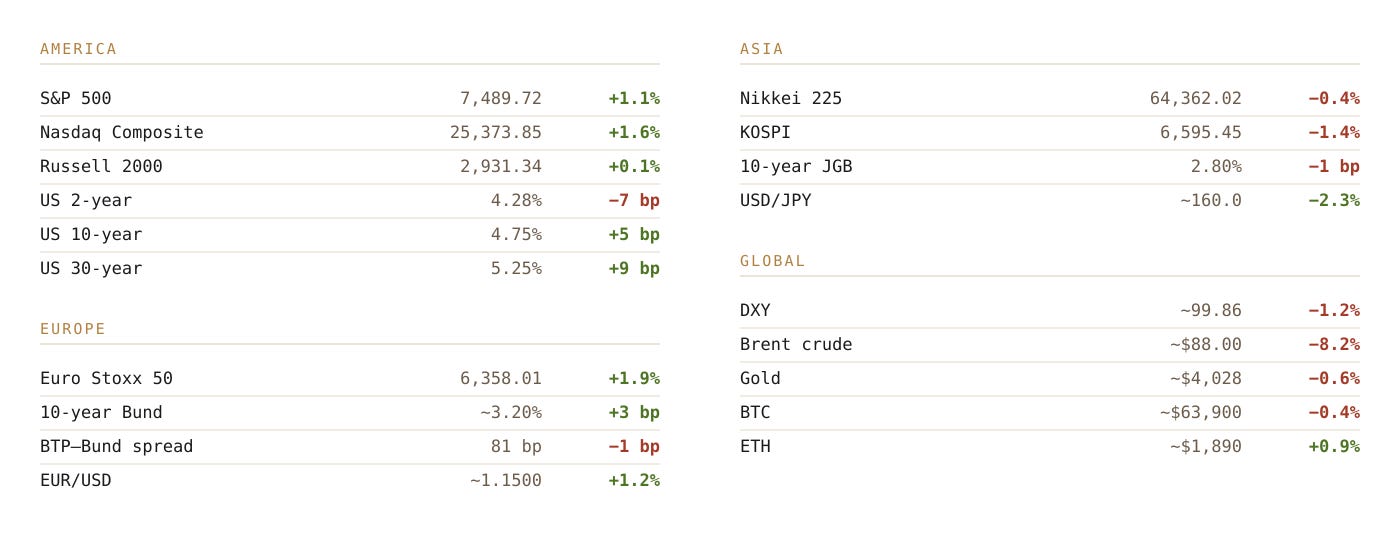
A basis point (bp) is one hundredth of a percentage point. A rising yield means dearer new borrowing and a lower price for bonds already issued. Closes: Asia 08:00, Europe 17:30, US 22:00 CET. Levels marked ~ are approximate.
Reading the board. America looks calm and wasn’t: the Nasdaq’s 1.6% covers six falling days into Wednesday, then a surge when Microsoft alone gained $450 billion in a single session.
Europe quietly had the best of it, with German shares leading and the Euro Stoxx 50 up 1.9%. The line marked BTP–Bund is the extra interest Italy pays over Germany to borrow for ten years, the standard gauge of nerves about the eurozone. At 81 basis points it sits near a fifteen-year low.
Asia was where the violence was. Korea’s KOSPI rose 17.9% on Friday, its biggest single day ever, and still ended the week down 1.4%. That tells you how bad Tuesday and Wednesday were.
1. The bond market stopped listening
Long-term borrowing costs rose against every piece of news this week, because lenders are charging extra for uncertainty rather than for inflation.
The Federal Reserve does not set long-term interest rates. It sets one rate — what banks charge each other overnight. Everything longer is set by investors buying and selling bonds, and when an investor decides what to demand for a thirty-year loan, they are pricing two separate things. Where will that overnight rate average over thirty years? And how much extra do I want for the risk that I’m wrong? Call the second part a nervousness fee.
Usually both move together. This week you could watch them come apart. Traders cut the odds of a September rate rise from around 80% to 63%, and the two-year yield fell seven basis points with them. The thirty-year went the other way, and after stripping out expected inflation, what lenders actually earn on it is now the highest since 2008.
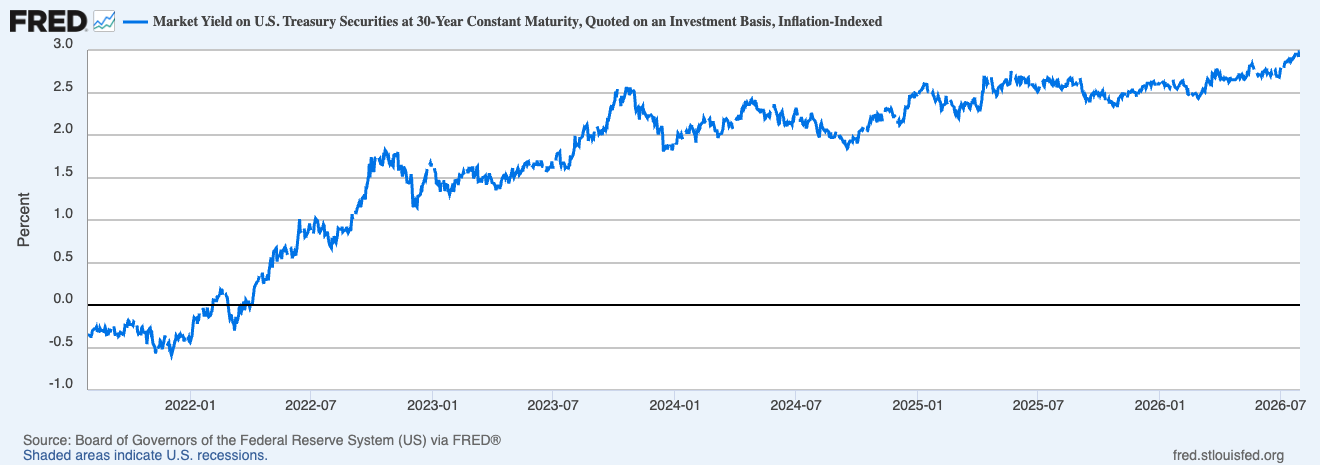
Two things are feeding that fee. Warsh spoke forcefully about inflation on Wednesday and then held rates for the fifth meeting running, with no guidance on what comes next, and reports on Friday suggest he wants fewer scheduled meetings each year. Meanwhile American government debt passed $40 trillion — debt the government refinances roughly a third of every year, which makes it closer to a mortgage that resets than one fixed for the term. Market rates reach its interest bill in months.
The Fed has been cutting since 2024. The thirty-year yield is clearly higher than when those cuts began. A central bank lowering short rates while long rates climb is being overruled by the people who actually hand over the money.
What this means for you: the rate on a thirty-year mortgage is set by investors’ willingness to lend for thirty years, not by Fed announcements. That’s why headlines can say “the Fed cut rates” while your quote doesn’t move.
2. Japan came home
Japanese institutions have bought American government debt for decades. Rising interest rates at home are ending that.
For thirty years Japanese government bonds paid almost nothing, because the Bank of Japan held the ten-year rate near zero on purpose. So Japanese pension funds and insurers, sitting on vast savings and earning nothing at home, bought foreign bonds instead — above all American ones. Japan became the largest foreign owner of US government debt.
That is unwinding, faster than most people notice. The Bank of Japan dropped its cap in 2024 and raised its main rate to 1% in June. Japan’s ten-year yield now sits at 2.80%, a level last seen in the 1990s. This week the central bank held while warning that inflation might overshoot.
The consequence is simple. A Japanese insurer can finally earn a decent return at home, in its own currency, with no exchange-rate risk. So it stops buying American paper and brings the money back — $96 billion of it over the past three months, leaving holdings at $1.14 trillion, the lowest since April 2025.


Then there’s the yen, which had fallen to a forty-year low against the dollar. That makes everything Japan imports dearer, and on Thursday Tokyo stepped in, selling dollar reserves to buy back its own currency. It spent an estimated $53 billion in one day, the largest such intervention on record anywhere. Reuters reports America is now helping.
For all that, Japan’s ten-year yield finished the week one basis point lower than it started. A central bank meeting, a record intervention and a currency at forty-year lows moved it almost not at all, which tells you the pressure is structural rather than event-driven.
What this means for you: one of the most dependable buyers of American government debt is stepping back, exactly when America needs to sell more of it.
3. What goes up too fast comes down
Chip shares ran too far, Korean small investors bought the top with borrowed money, and the unwind ran automatically.
You’ve seen this shape before, even if you’ve never owned a chip stock. A sector runs hard for over a year. Money floods in near the peak, much of it through leveraged products, which multiply gains and losses two or three times over. Small investors, who by definition arrive after the good performance has already happened, take their biggest position at the highest price.
Then it turns. Chip shares worldwide fell 23.2% in July, their worst month since 2002. In Korea, where appetite for these products ran especially hot, ordinary investors had bought more than $60 billion of shares since April while foreign institutions sold over $70 billion, and borrowed money hit a record 38.6 trillion won in late June.
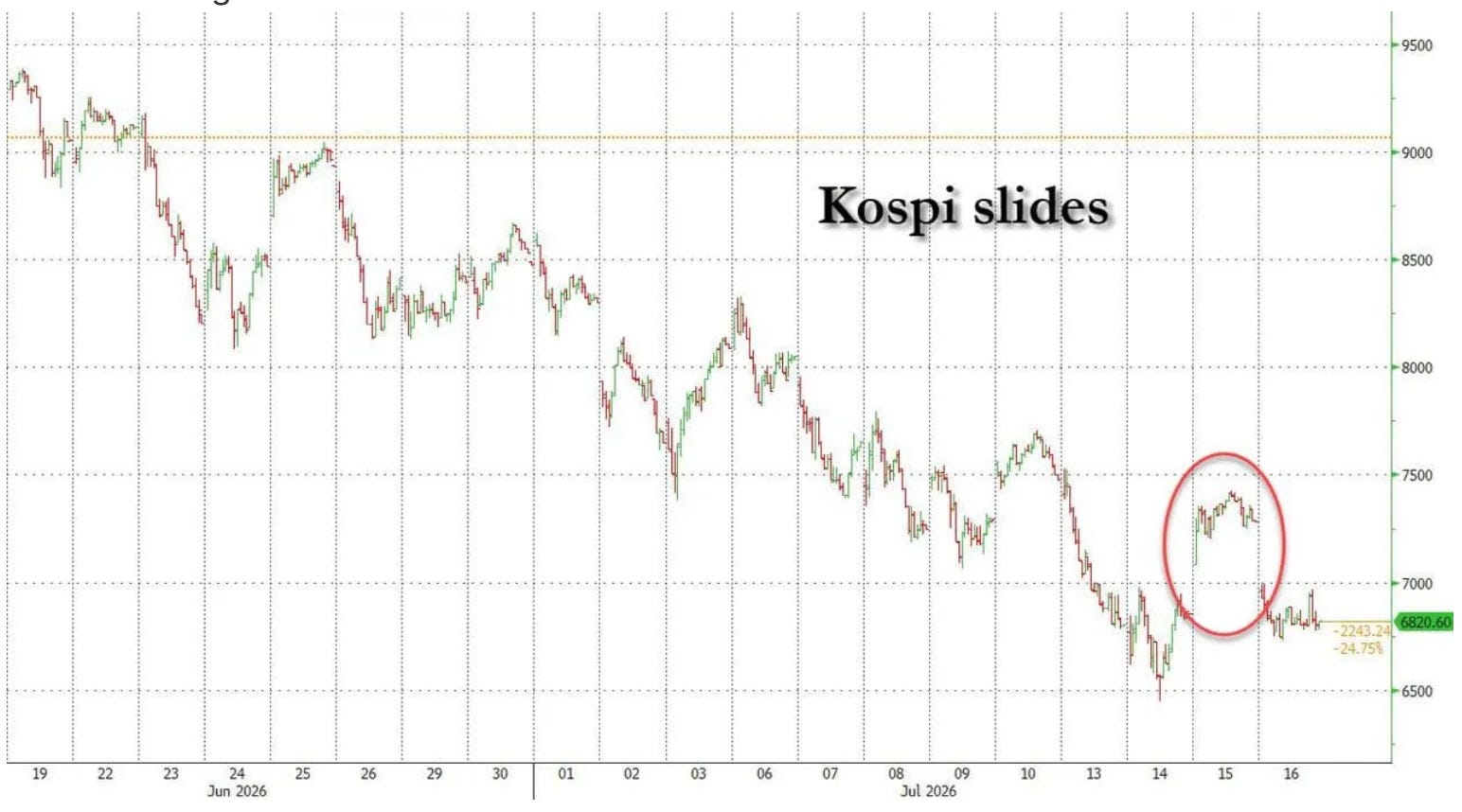
Then the market fell so fast on three consecutive days that trading halted automatically each time, something never seen before. Citi estimates more than 360,000 people were forced to sell everything, 62% of them under 35, with losses near $38.7 billion. Almost all of it happened without anyone deciding anything, triggered by clauses written into the contracts.
On Friday the finance ministry capped these products, foreign institutions bought a record amount as small investors sold a record amount, and the index jumped 17.9%. It still ended the week down.
The mechanism is worth understanding. Borrow to buy, and a falling price forces you to sell. Your selling pushes the price lower, which forces the next person out. Being right about the long term doesn’t help.
What this means for you: you can’t control whether a hot sector cools. You can control whether you’re forced to sell when it does. Borrowed money takes that choice away at the worst possible moment.
4. Dancing until the music stops
The four biggest cloud companies will spend three quarters of a trillion dollars on AI this year, and investors have started asking whether it comes back as cash.
In 2007 the boss of Citigroup said that as long as the music was playing, you had to get up and dance. The music stopped shortly after, and it did not end well.
The four largest cloud companies are still dancing. All four spent enormously this quarter, all four guided higher, and together they plan $720–745 billion of building this year. Nobody wants to be the one who sat down early and looked foolish.
What changed this week is where the strain showed. Microsoft justified it: its cloud business grew 43% and passed $100 billion in annual revenue for the first time, and the shares had the best single day any company has ever recorded. Amazon rose 15.6% on Friday telling the same story.
Meta went the other way. Record revenue of $60.8 billion, costs up 55%, and free cash flow down 91% from a year ago to $784 million. Free cash flow is what’s left after a company both runs itself and pays for what it’s building — the money that funds dividends and services debt. Two years ago these were the most cash-generating businesses on earth, and several are now scraping zero.
Companies that can’t fund a building spree from cash borrow instead. Around $400 billion of new borrowing is expected, and the cost of insuring these companies against default hit a record this week.
What this means for you: the AI trade started as a story about asset-light companies with enormous margins. It’s becoming a story about heavily indebted ones building warehouses of chips, and those two behave very differently when money gets tight.
5. Something is working
Jobs held up and record numbers of people are starting companies, and both deserve as much attention as the problems above.
I don’t want to leave you on the debt, and I don’t need to.
Each week America counts first-time filings for unemployment benefits, the fastest signal available on whether people are losing work. That number came in at 197,000, near its lowest in decades. The fear at the end of last year was an unemployment rate rolling over, and it hasn’t happened.
The second one I like more. Record numbers of new technology companies are being registered, and many are one or two people working from a bedroom. The barrier to starting a software business keeps collapsing.
There’s a link back to chapter four worth spotting. Enormously expensive building booms have rarely been solved by building more, but by someone finding a way to need less — cheaper extraction after an oil shock, better chips after a shortage. That someone usually works at a tiny new company, and there have never been more of those.
What this means for you: the boom and the correction can both be true. Expensive capital cycles routinely disappoint the investors funding them and benefit everyone who ends up using what got built.
The Week Ahead
Two events dominate, and around them sits the busiest week for government bond sales in months.
Monday 3 August
US factory survey, 16:00 CET. A poll of purchasing managers where anything above 50 means expansion. Expected at 54.0 after 53.3. Read the prices component first: it was 73.0 last month and is forecast at 70, and that’s where July’s oil move shows up before it reaches anything else.
US bank lending survey, 20:00 CET. Banks report whether they’re tightening standards on loans. It rarely makes headlines, but it’s the earliest warning that credit is getting harder to obtain, which matters a great deal given chapter four.
US Treasury borrowing estimates, 21:00 CET. The warm-up for Wednesday.
Eurozone factory survey, 10:00 CET, expected at 52.0.
Tuesday 4 August
SpaceX first earnings as a public company, after the US close. It listed in June in the largest IPO in history and has since fallen roughly 45% from its peak. Two trading days later, up to 911.5 million shares held by employees and early investors become sellable — about $110 billion of stock arriving in a market where only 5% of the company trades freely. Musk’s own stake stays locked until June 2027.
AMD earnings, after the close. The first large chip company to report since the sector fell 23% in July. Analysts expect revenue up 47% from a year ago, so the question is whether the business is still growing while the shares fall.
Japan sells ten-year debt, 05:35 CET. The last auction cleared at 2.729%. Weak demand pushes Japanese yields higher and feeds straight back into chapter two.
US job openings, 16:00 CET, expected at 7.25 million after 7.59 million.
Wednesday 5 August
US Treasury refunding announcement, 14:30 CET. The most important scheduled event of the week, and almost nobody covers it. Treasury says how much it plans to borrow and at which maturities. With thirty-year borrowing at 5.25%, the split between cheap short-term bills and expensive long bonds tells you what the government itself expects to happen.
US private payrolls estimate, 14:15 CET, expected at 75,000 after 98,000. A rough steer into Friday.
US services survey, 16:00 CET, expected at 54.2. Services are roughly four fifths of the American economy, so this outranks Monday’s factory number by some distance.
Germany sells ten-year and thirty-year debt, 11:30 CET.
Japanese wage data, 01:30 CET, expected at 3.4% growth. Wages are what the Bank of Japan watches before raising rates again.
Thursday 6 August
SpaceX share unlock. The shares described above become sellable.
Japan sells thirty-year debt, 05:35 CET. The last one cleared at 3.993%, and Japan’s longest-dated bonds have been the most fragile part of that market all year.
US weekly jobless claims, 14:30 CET, expected at 200,000.
US unit labour costs, 14:30 CET, expected to jump to 2.7% from 1.8%. This measures what it costs an employer to produce a unit of output, and rising costs eventually reach prices.
Eurozone retail sales, 11:00 CET.
Friday 7 August
US jobs report, 14:30 CET. How many jobs America added in July, and the last major labour reading before the Fed meets on 16 September. Expected at 91,000 after a weak 57,000, with unemployment forecast to tick up to 4.3% from 4.2% and wages up 3.5% from a year ago.
China trade data, 05:00 CET. Exports grew 27% last month, a figure few economists take at face value.
US consumer inflation expectations, 17:00 CET, last at 3.7%. What ordinary Americans think inflation will be, and the number that decides whether the Fed’s credibility is holding.
Data Check
Every scheduled release comes with a forecast attached before it lands. Read the gaps rather than the levels — a number arriving exactly where everyone predicted moves nothing, because the price already reflects it.
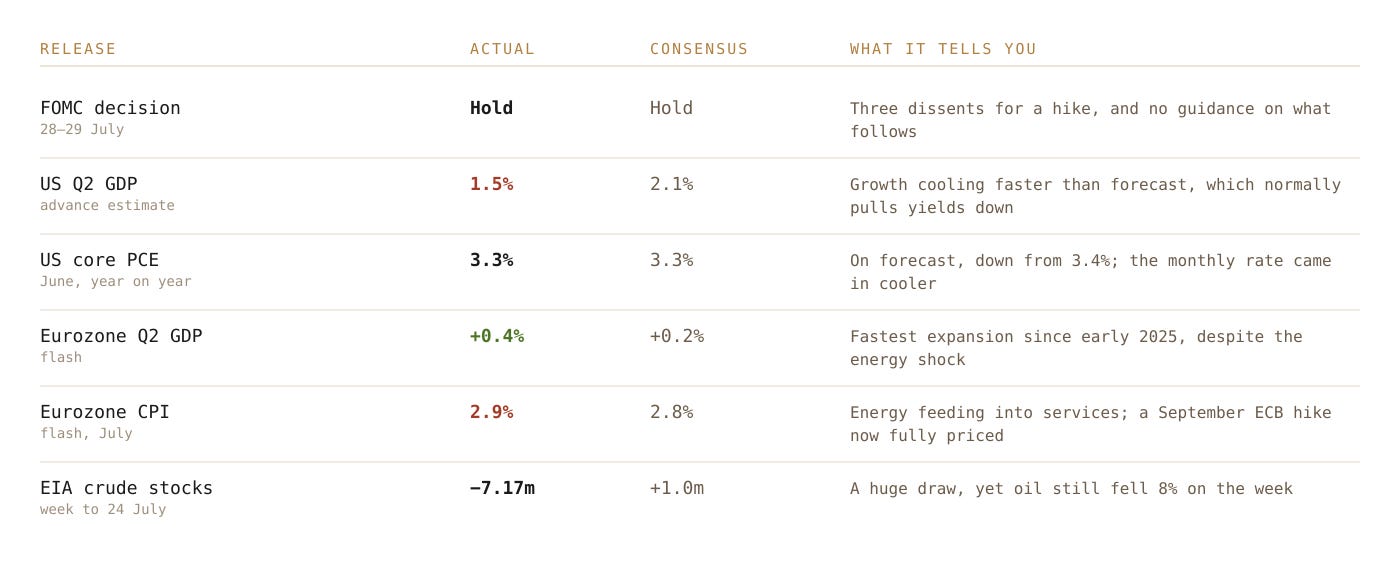
Consensus is the median forecast from surveys of bank and research economists run by Reuters and Bloomberg, published free by Trading Economics.
Two deserve a second look. The eurozone grew faster than expected while inflation rose, which is why investors now fully expect the European Central Bank to raise rates twice more by early 2027.
And look at the oil storage number. American stockpiles fell by 7.17 million barrels when forecasters expected a rise of 1 million, which describes a market genuinely short of oil. The price fell 8% anyway. That tells you how much of July’s price was fear about the war rather than actual shortage.
The Onchain Pour
Bitcoin ignored a strong week everywhere else, which is the most interesting thing it’s done in months.
It held near $64,300 through a session in which Korea surged 17.9%, chip shares soared and the Nasdaq rallied, finishing the week down about 2% at $63,870, with ether at $1,890.
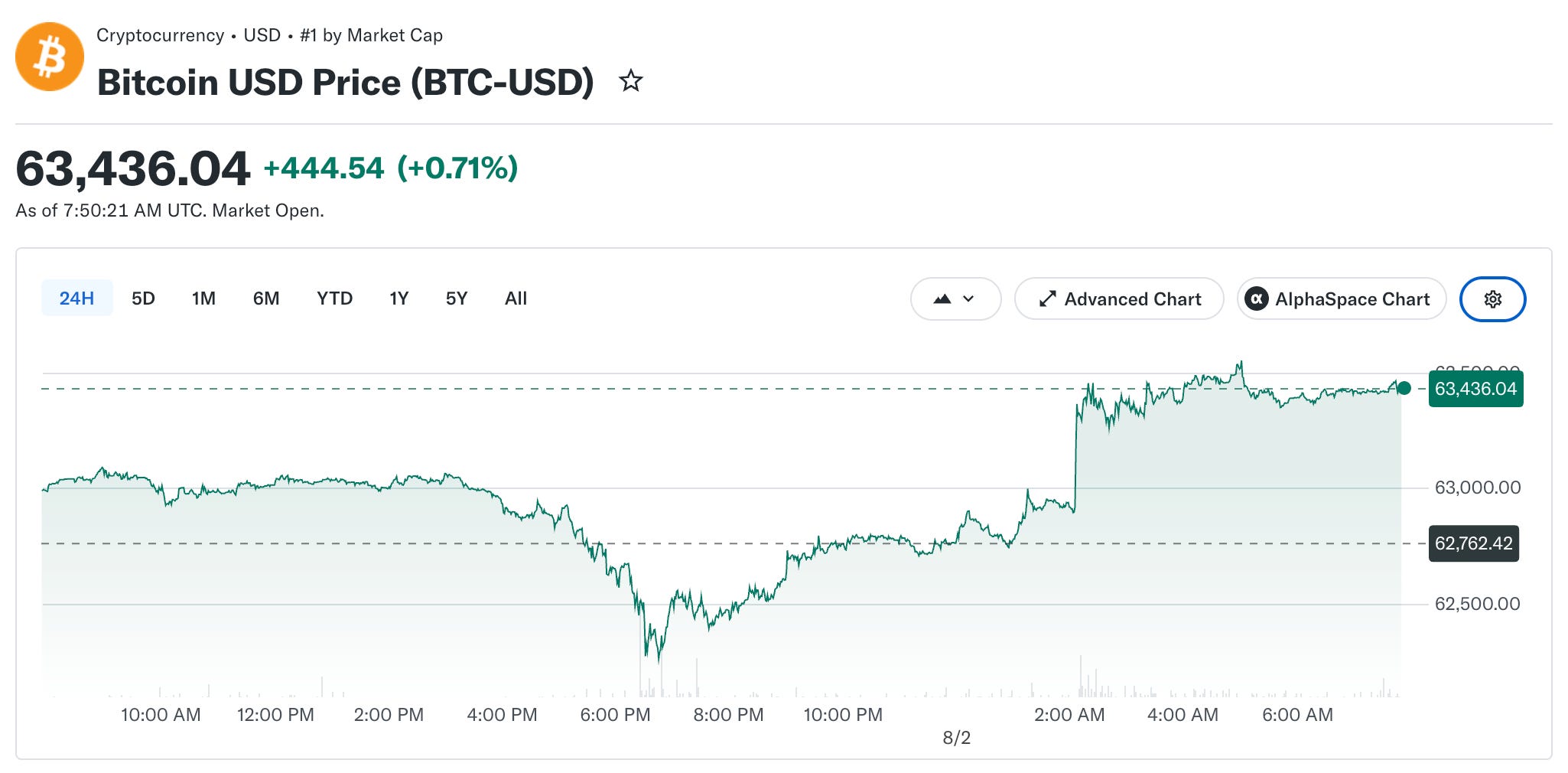
All year Bitcoin has moved like an excitable technology share, so sitting out a rally like that is a real change. It did move on the Fed decision, which suggests it’s tracking interest rates now rather than the stock market. Whether that holds is what I’ll watch in August.
Two developments matter more than the price. Circle won a limited banking licence from New York’s financial regulator. And Open USD launched — a stablecoin, meaning a token designed to always be worth one dollar, this one backed by more than 140 businesses including Visa, Mastercard and BlackRock. It launched on Ethereum, a public network anyone can build on, rather than a private chain of its own. The plumbing of the financial system is being rebuilt by the incumbents, in public, on open networks.
Last Drop
Something happened while I was writing this. Late Saturday night, Trump announced he had cancelled a planned attack on Iran, saying the outline of a deal had been agreed — one that would fully reopen the Strait of Hormuz and end Iran’s nuclear programme. Israel has joined the commitment, and mediators from Qatar and Oman met Iran’s foreign minister on Saturday. Nothing is signed, and as I write Iran hasn’t confirmed.
About a fifth of the world’s seaborne oil passes through that strait, and part of today’s oil price is simply payment for the risk it stays shut. If it genuinely reopens, that part disappears fast, and oil at $88 has a long way to fall.
Then watch what America pays to borrow for thirty years, because it faces a real test. Cheaper oil means less inflation, which normally means lower rates. This week that logic was ignored completely. If the thirty-year yield holds above 5.20% even as a peace deal arrives, you have your answer about what’s really driving it — and it isn’t the war.
See you next Sunday ladies & gents.
Sources
Scoreboard levels come from the Advisor Perspectives Treasury Yields Snapshot and CNBC for US yields, Yahoo Finance and CNBC for equity closes, Il Sole 24 Ore and ANSA for the BTP–Bund spread, Rigzone for Brent, Seoul Economic Daily for the KOSPI, Trading Economics Japan for the JGB, and CoinDesk for crypto. The 10-year Bund level is calculated from the Italian yield minus the published spread rather than reported directly. Market data as of Friday 31 July 2026. News and events to Sunday 2 August 2026, 09:15 CET.