
On Thursday Alphabet, the owner of Google, lost 12.6% of its share price, in its biggest one-day fall since it listed in 2004. This happened after it reported earnings below forecast and capital spending of $51.4 billion in a single quarter. Last week I asked whether a bad Thursday for chip stocks was a one-day fright. Now we have the answer: it was not. On Friday Intel also dropped 28.6% and an index of chip makers fell 7.2%, which pulled the Nasdaq Composite down 2.9% in a day.
All of this happened while the economy looked strong at first sight. America grew at an annual rate of 3.4% in the third quarter, and two members of its central bank voted on Wednesday to raise interest rates.
The chapters below take the AI bill first, then the central banks, then oil, where the next scheduled event is an American election.
This week’s main chapters
Investors want proof before they pay for AI
Central banks are waiting, and the wait is getting shorter
Oil is priced for a fight that has not started
The Scoreboard
Nineteen numbers, and the pattern to look for is how far apart the stock market and the bond market sit. Borrowing costs for governments fell almost everywhere, while crypto, gold and the Nasdaq all fell.
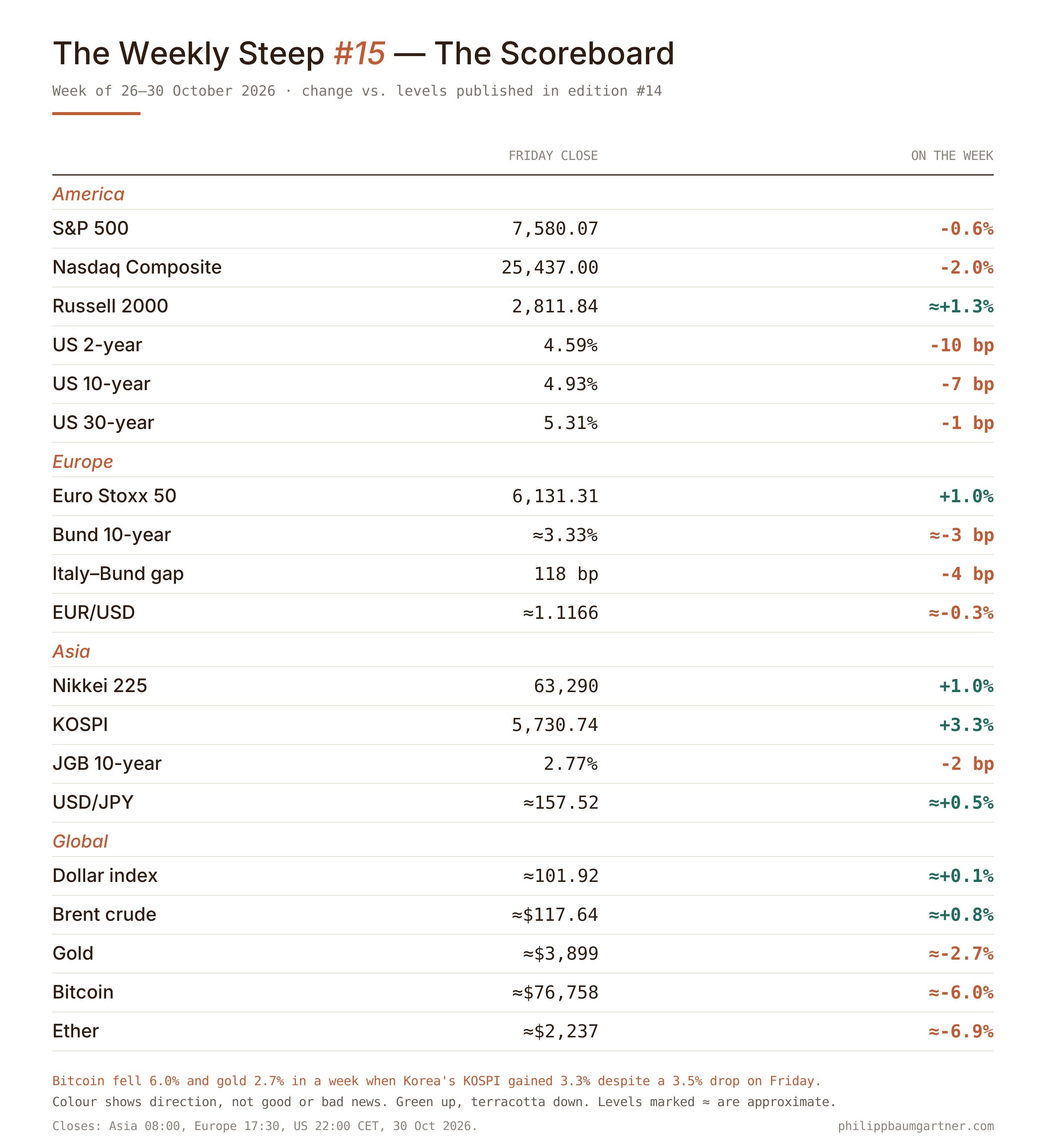
America looked calm until Friday. The S&P 500, the index of 500 large companies, lost 0.6% to 7,580.07, the Nasdaq Composite lost 2.0%, and America’s two-year borrowing rate fell 10 basis points to 4.59%. The Russell 2000, an index of smaller companies, gained about 1.3%. Europe had a quieter week: the Euro Stoxx 50 rose 1.0% and the extra rate Italy pays over Germany for ten years narrowed by 4 basis points to 118. In Asia the KOSPI, South Korea’s main index, gained 3.3% for the week even though it fell 3.5% on Friday alone. Gold lost about 2.7%, and bitcoin about 6.0%.
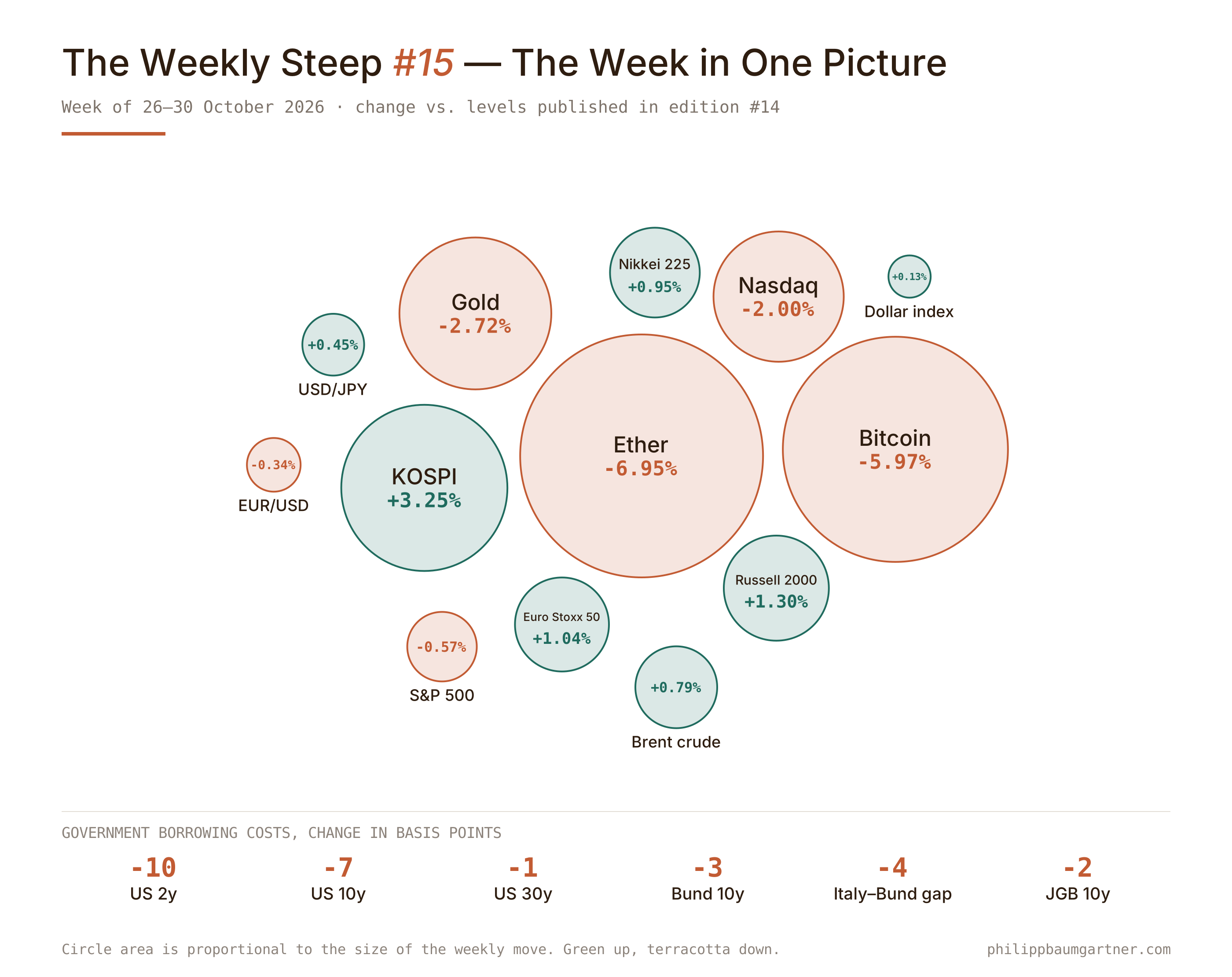
The two big red circles are ether and bitcoin. Every borrowing cost in the strip underneath fell, which for bonds means cheaper borrowing.
1. Investors want proof before they pay for AI
Companies that spend heavily on AI now lose value on the day they show the bill, even when the growth in their AI business doubles.
Building AI means paying first and earning later. Companies spend on chips and data centres, which accountants call capital spending, and hope the revenue arrives. A share price is a bet on that later money, so every extra billion spent raises the bar.
Alphabet reported on Wednesday after the US close. Its cloud business, which rents computing power to other companies, grew 103% to $30.7 billion. Yet profit per share was $2.12 against about $3.02 expected by analysts, and a paper loss of $8.7 billion on investments it holds took 55 cents of that, so the shortfall was real even without it. The bigger problem was the bill: spending on equipment and data centres was $51.4 billion in the quarter, twice last year’s, and after paying for it the company had negative free cash flow of $9.1 billion, meaning more cash went out than came in. On Friday Intel fell on a weak outlook, Amazon fell 1.4% after a miss and a trailing-year cash outflow of $42 billion, and the Nasdaq had its worst month since March 2025.

The best counter-argument is in the same numbers: demand for AI computing is real. Two things worked. Microsoft’s Azure cloud business grew 48% to $33.2 billion, and the semiconductor selling in Seoul did not stop the KOSPI finishing the week up. On Monday morning it was up about 2.8% again and US stock futures, which price the next day’s open, pointed higher, so the sell-off had not widened by the time I wrote this.
2. Central banks are waiting, and the wait is getting shorter
America, Europe and Japan all left interest rates unchanged this week, and each one signalled that its next move could be up.
A central bank raises its lending rate to slow rising prices, and it waits when it cannot yet tell whether prices are rising for a lasting reason. This week three of them waited at once.
America’s Federal Reserve held its rate at 3.75–4.00% on Wednesday in a 10–2 vote, with Governor Lisa Cook and Beth Hammack of the Cleveland Fed asking for a quarter-point rise. Inflation by the Fed’s favourite gauge, the PCE price index, ran at 3.6% over the year, and futures put about a 76% chance on a rise in December. The European Central Bank held its deposit rate at 2.50% on Thursday, unanimously but after debating a hike, with euro-area inflation at 3.8% and energy prices up 18.8%. The Bank of Japan held at 1.25% in an 8–1 vote, with one member wanting 1.50%, and said underlying inflation had reached its 2% goal.
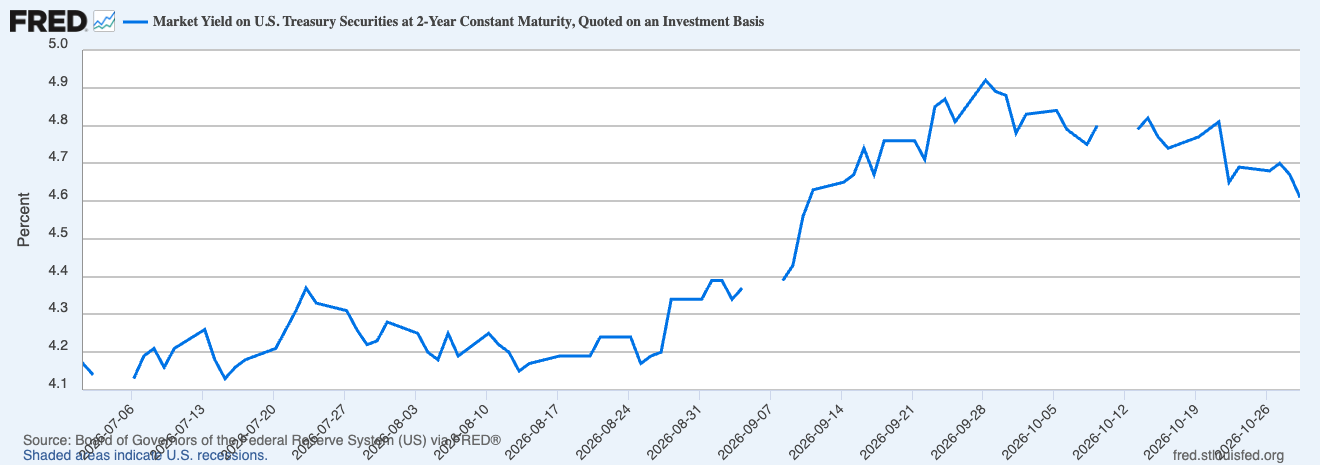
America’s two-year borrowing rate still fell 10 basis points on the week, and no source I found gives one reason. Two things worked. New claims for unemployment support fell to 194,000, and euro-area output grew 0.4% in the third quarter against 0.2% forecast.
3. Oil is priced for a fight that has not started
Brent crude has risen 13.6% in October on the expectation of an American strike on Iran after the 3 November election, and gold fell to a one-year low in the same week.
Oil matters because it goes into fuel, freight and fertiliser, so a dearer barrel raises prices elsewhere a few weeks later. Brent is the international benchmark, and a futures contract is a promise to buy a barrel on a set date.
The December Brent contract expired on Friday at $117.64, up 2.4% on the day and the highest since late April. Reuters reported that officials had briefed President Trump on military options for Iran, with strikes possible after Tuesday’s midterm elections, and that a tanker was attacked in the Strait of Hormuz, the narrow sea route for much of the world’s oil. Qatari mediators were back in Tehran trying to arrange a US–Iran deal. Gold settled at $3,899, a one-year low, even though gold usually rises on war fears. My reading is that rising bets on rate rises made gold less attractive, but no source says so, and I would drop it if gold rebounds while rate bets hold.
That drain has started. On Monday Brent fell 2–3% to about $111 as American and Iranian officials entered a third day of talks in Doha, with Tehran proposing a two-day plan to reopen the strait, although two tankers were reported hit by mines on Sunday. Two things worked.
The Data Check
Eight releases, and the pattern is that America beat nearly every forecast it was measured against. Five came in above forecast, two matched, and one, jobless claims, came in below.
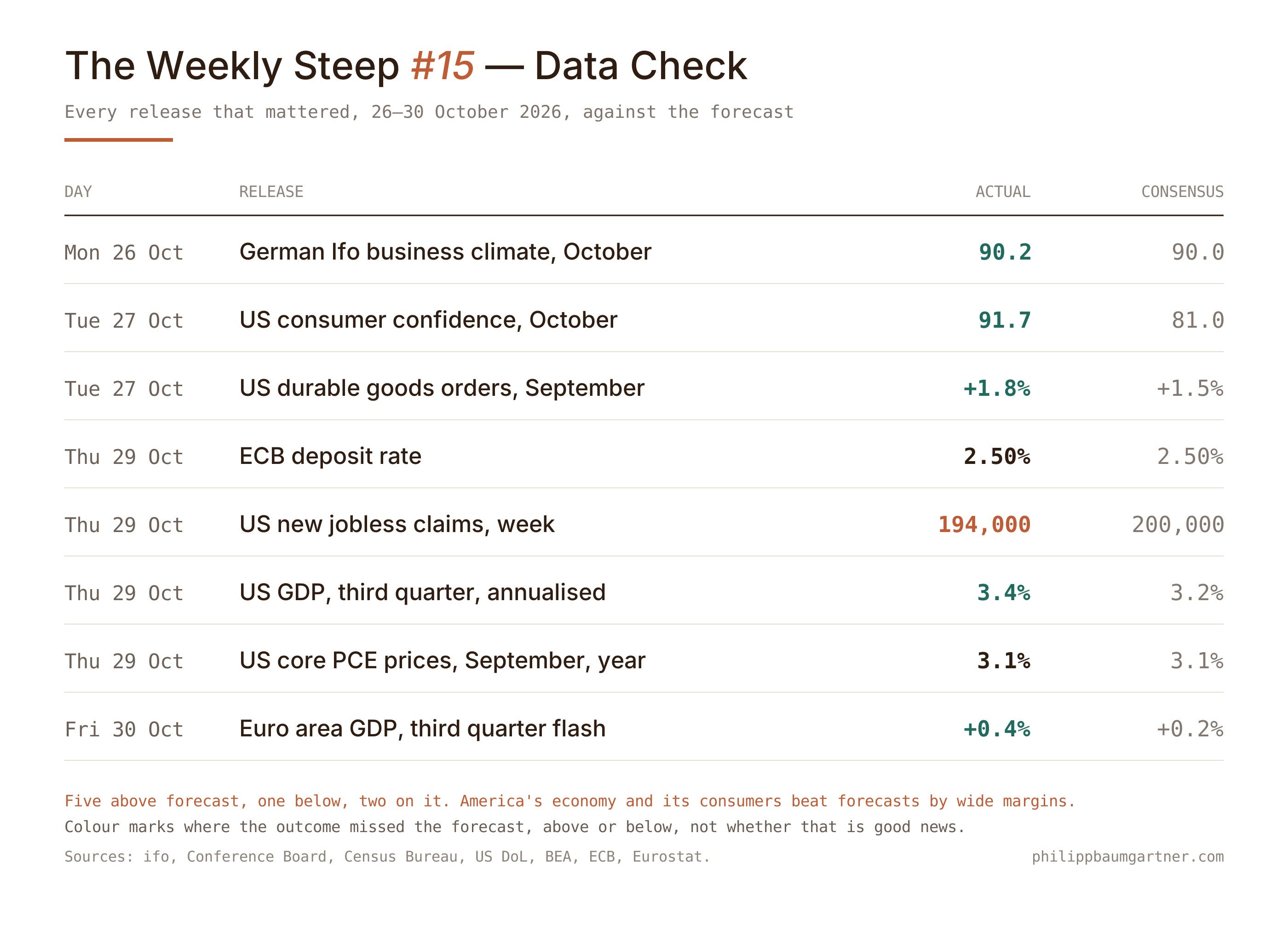
Consumer confidence is the surprise worth a second look. The Conference Board’s index jumped to 91.7 against about 81 expected, yet the same survey said people plan to buy fewer big-ticket items. Claims fell below forecast, which is the good direction for workers. Core PCE inflation, which leaves out food and energy, came in on forecast at 3.1%.
The Credit Grind
Euro-area companies that borrow at the riskiest rating pay 348 basis points over government rates, more than on 98% of the past year’s days, and that gap to America grew to 22 basis points.
A company borrowing money pays two prices added together. One is the base cost of money, which comes from what governments pay. The other is a surcharge for the chance that this particular company stops paying.
Percentile means the share of the past year’s days that sat below today’s level. A reading of 98% means investors were paid less than this on 98% of the days. Look at the gap between Europe and America, which has opened from 14 to 22 basis points.
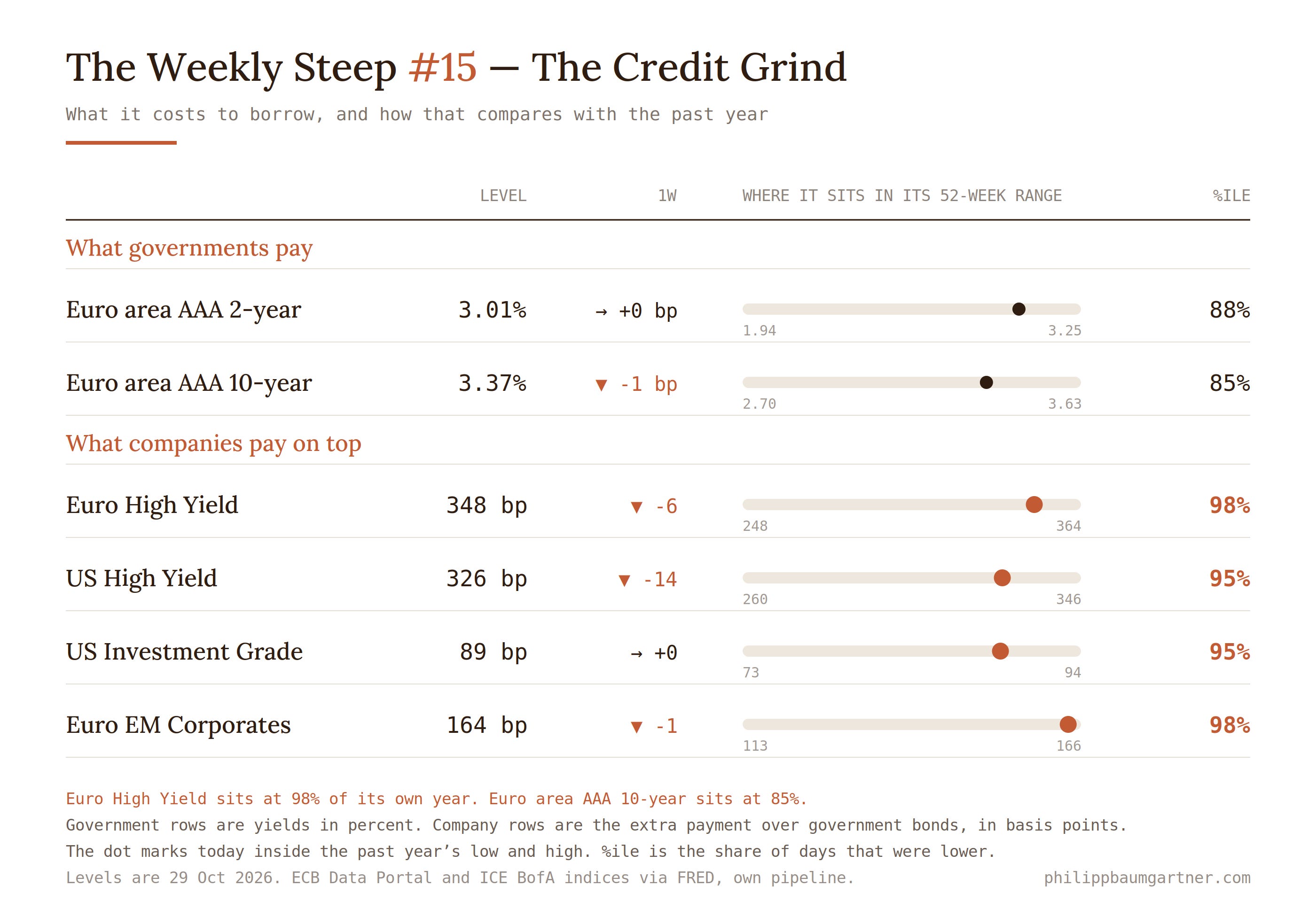
The base cost is high but not extreme. The euro-area ten-year yield on top-rated government bonds is 3.37%, in the 85th percentile, and the two-year is 3.01%, in the 88th. The surcharge is the unusual part. Euro high yield, the index of riskier borrowers, fell 6 basis points from last week’s 354, still close to its 52-week high of 364. American high yield fell 14 to 326, so America’s surcharge shrank twice as fast as Europe’s.
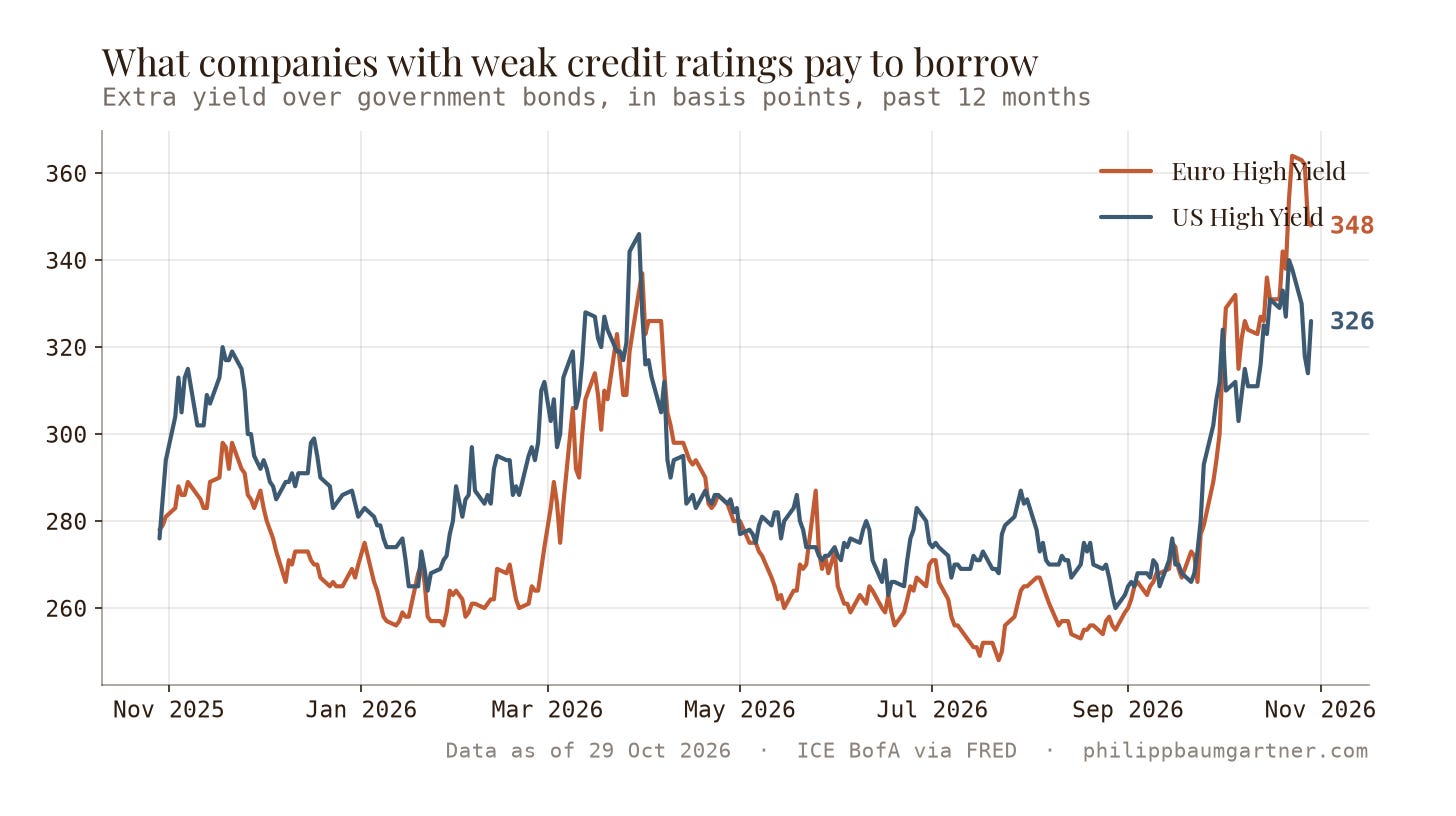
The data end on Thursday, before Friday’s tech sell-off. If you hold a euro corporate bond fund, you are paid close to the most in a year for weak borrowers, and next week’s numbers will show whether Friday made them dearer.
The Onchain Pour
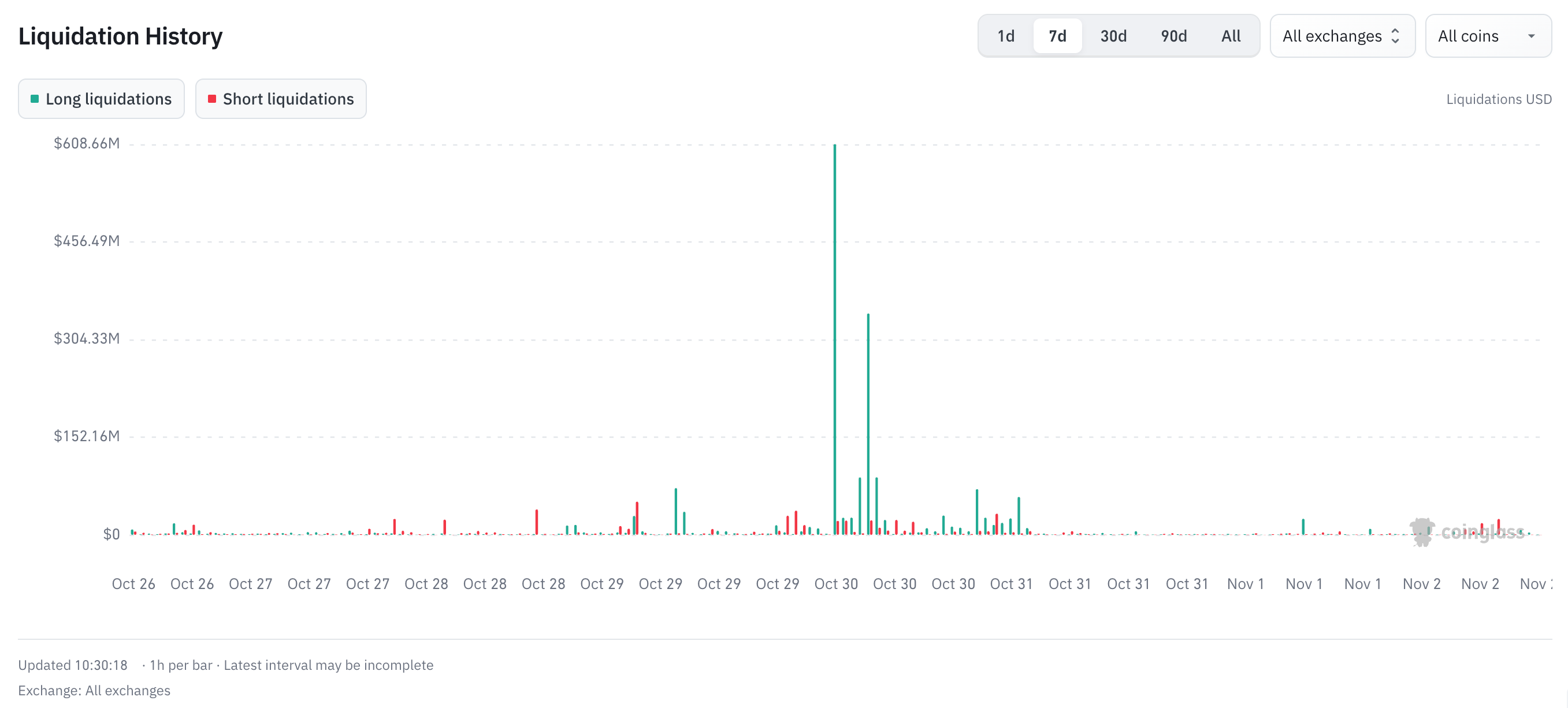
Crypto fell hard after the largest exchange hack on record, with Binance putting the damage at $6.3 billion.
Bitcoin finished near $76,760, down about 6.0% on the week, and ether near $2,240, down about 6.9%. Binance, the world’s largest crypto exchange, said on Friday that a security breach cost about $6.3 billion, froze about $3 billion of assets, suspended withdrawals and pledged to cover all losses. It expects to reopen withdrawals within 48 hours. More than $1.5 billion of leveraged bets, called futures, were forced closed, and Coinbase shares fell 10.6%. Last week I noted October on course to close below its $83,576 opening, and it did. Binance reopened bitcoin withdrawals on Sunday, said it had replaced most of the stolen assets (it says 95%, CNBC reports 90%), and the FBI named North Korea as the thief. Bitcoin traded near $78,000 on Monday.
Away from the hack, Visa said it settles over $25 billion a year in stablecoins, tokens pegged to the dollar, roughly ten times a year earlier. Ripple received a US national trust bank licence.
The Week Ahead
Three things decide the week: an American election on Tuesday, a Bank of England decision on Thursday and a US jobs report on Friday that sets the tone before the next round of central bank meetings in December. Around them sit a few earnings reports that will show whether Friday’s chip sell-off was a one-day event. American clocks went back on Sunday, so US releases now land at 14:30 and 16:00 CET instead of an hour earlier.
Palantir and Apple earnings — Monday, after the US close.
Both publish on Monday evening, which is today as you read this, and analysts' profit forecasts for Palantir range from $0.33 to $0.42 a share depending on the provider. Palantir sells AI software and Apple sells the phones that carry it, so together they show whether investors’ doubts about AI spending have spread beyond chips and cloud companies.
US manufacturing survey (ISM) — Monday, 16:00.
A monthly survey of purchasing managers at American factories, where 50 divides growth from shrinking. The forecast is 54.7 after 54.5, so a reading near that would say factories are still expanding while oil prices rise.
Reserve Bank of Australia — Tuesday, 04:30.
Newsquawk reports markets put about a 79% chance on a quarter-point rise to 4.85%, though sources disagree on how firm that is, so the decision is a real test of whether the rate-rise talk of the past week is spreading.
US midterm elections — Tuesday.
All 435 House seats and 35 Senate seats are up. Polymarket, a betting site, gives Democrats a 94% chance of winning the House and 69% for the Senate. Analysts quoted by FXStreet do not expect the result to change the economic outlook much, but oil traders are watching it because reports say American strikes on Iran could follow.
US job openings (JOLTS) — Tuesday, 16:00.
A count of unfilled jobs, last at 7.08 million. A falling number would suggest the labour market is cooling, which matters because two Fed members just voted to raise rates.
Euro-area inflation, first estimate — Wednesday, 11:00.
September inflation was 3.8%, with core inflation, which leaves out food and energy, at 2.5%. I found no forecast. The European Central Bank held its rate last week while saying it was not yet seeing price rises feed into wages, so a jump in the core figure would make a December rise harder to avoid.
US services survey (ISM) — Wednesday, 16:00.
The same kind of survey for America’s service companies, forecast 54.7 after 54.9. Its prices-paid part is the one to read, as it shows whether higher fuel costs are reaching customers. Sweden’s Riksbank also decides on Wednesday and is expected to raise its rate to 2.00%.
Bank of England — Thursday, 13:00.
The rate is 3.75%, and a quarter-point rise to 4.0% is expected, which would start a tightening cycle. The split of the vote is the first thing to look at, because three of the nine members already wanted a rise in September.
US jobs report — Friday, 14:30. The number that matters most this week.
Forecast: +55,000 jobs after +29,000 in September, with unemployment at 4.2% and wages up 0.3% on the month. Weak hiring would argue against a December rise at the Fed, while a strong number would add to the case Cook and Hammack made this week.
US consumer sentiment — Friday, 16:00.
A University of Michigan survey of how households feel, last at 48.0, along with how fast they expect prices to rise.
☕ Last Sip
Last week I asked whether Thursday’s chip sell-off was a one-day fright, and Friday answered it. This week the question moves on to what the sell-off does to the companies that report next, and whether a falling Nasdaq starts to change what central banks think about raising rates. A strong jobs report on Friday would keep December on the table at the Fed, the ECB and the Bank of Japan, while a weak one would give all three a reason to wait.
The thread I would keep an eye on is oil. It rose 13.6% in October on talk of a possible American strike, and nothing has happened yet. Monday’s fall to about $111 shows how fast the premium leaves when talks go well, and how quickly it could return if the Doha talks fail or the election brings a change of tone. If strikes do come, everything else in this letter becomes secondary.
Thank you for reading. Have a good week, and see you next Sunday.
Data cut-off
Market levels are Friday 30 October closes: Asia at 08:00 CET, Europe at 17:30 and the US at 22:00. Economic figures are as first published and may be revised, above all the US GDP and euro-area flash estimates. News is included to Monday 2 November, 09:00 CET, and nothing after is reflected, which means Monday’s US session and the Apple and Palantir results are not in it; the Iran talks in Doha were still moving. Monday’s moves in oil, bitcoin and Asian stocks are mentioned in the text but not in the Scoreboard, which stays at Friday’s closes.
Sources
Market levels from Yahoo Finance, CNBC, Reuters, Trading Economics, ANSA, Kyodo and Seoul Economic Daily; economic releases from BEA, the Federal Reserve, Eurostat, ifo and the Conference Board. Credit and euro curve data from ICE BofA indices via FRED and the ECB Data Portal, as of 29 October, own pipeline. Analysis and personal opinion, never investment advice.