
For four days the bond market acted like something had broken beneath the surface. The premium companies pay on top of government borrowing costs rose about 40 basis points in Europe and 44 in the US. Italy’s extra cost over Germany touched 131 basis points on Friday morning. What America pays to borrow for thirty years reached 5.63%. This is the highest it has been since April of 2002.
Then the jobs figures landed at 14:30 CET on Friday, and they were bad. 29,000 new jobs in September against the 84,000 economists had estimated. Unemployment went up to 4.2%.
But now the funny part. Markets absolutely loved these news. Why is that you ask? The chance of another rate hike by the fed this month fell from 64% to 16% in a few hours. Equities rallied, yields came back down, and the week closed looking much calmer than it had been for most of it.
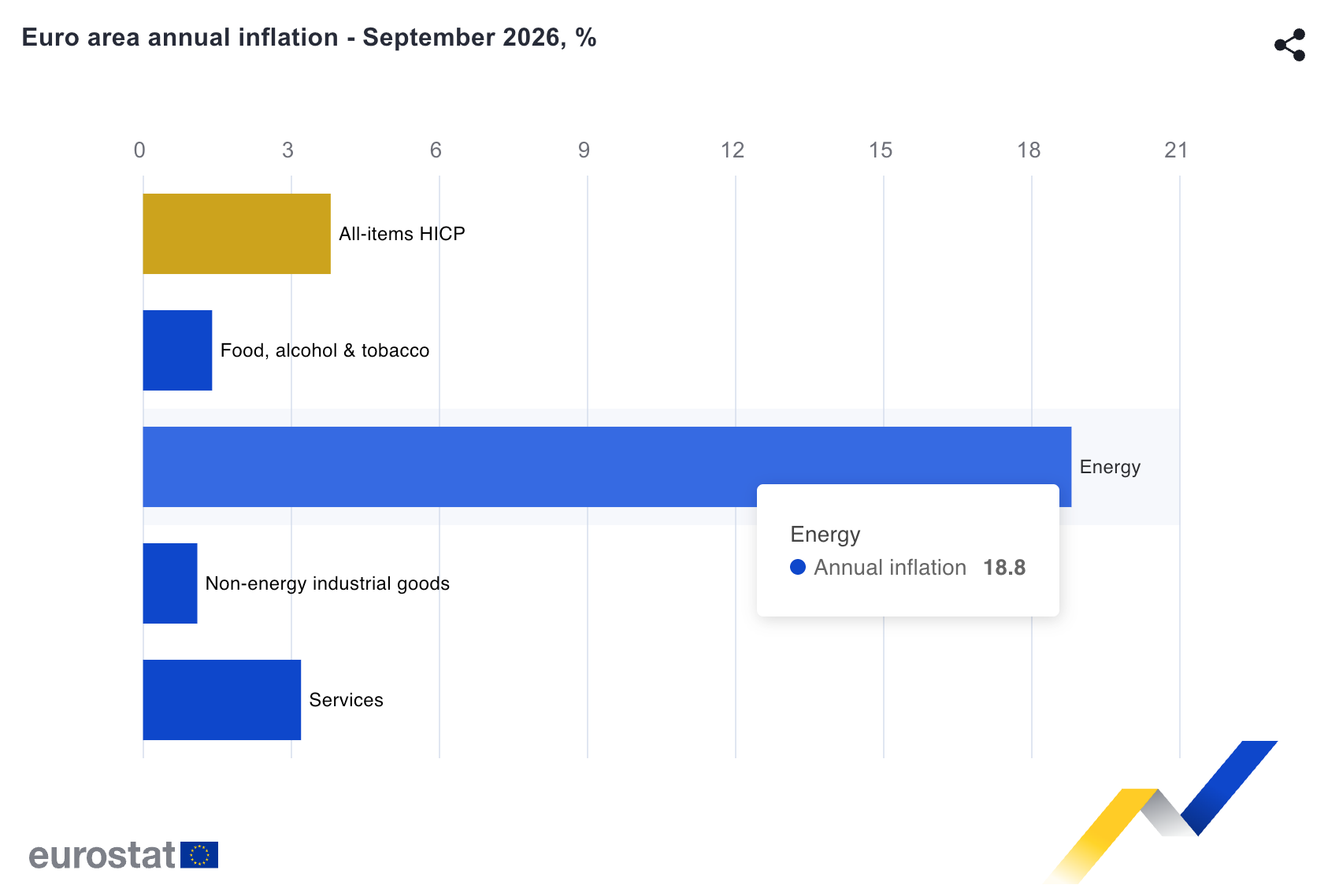
Euro area inflation on the other hand came in at 3.8% for September, the highest in three years, with energy up 18.8% over twelve months.
But now let’s grab yourself a coffee and dive into it properly.
The Scoreboard
Nineteen numbers, and what stands out is how little the stock market rows moved.
Watch the gap between the equity rows and everything that measures the price of borrowing. Most weeks those travel together. This week they went separate ways, and the borrowing side is the one carrying spicy information.
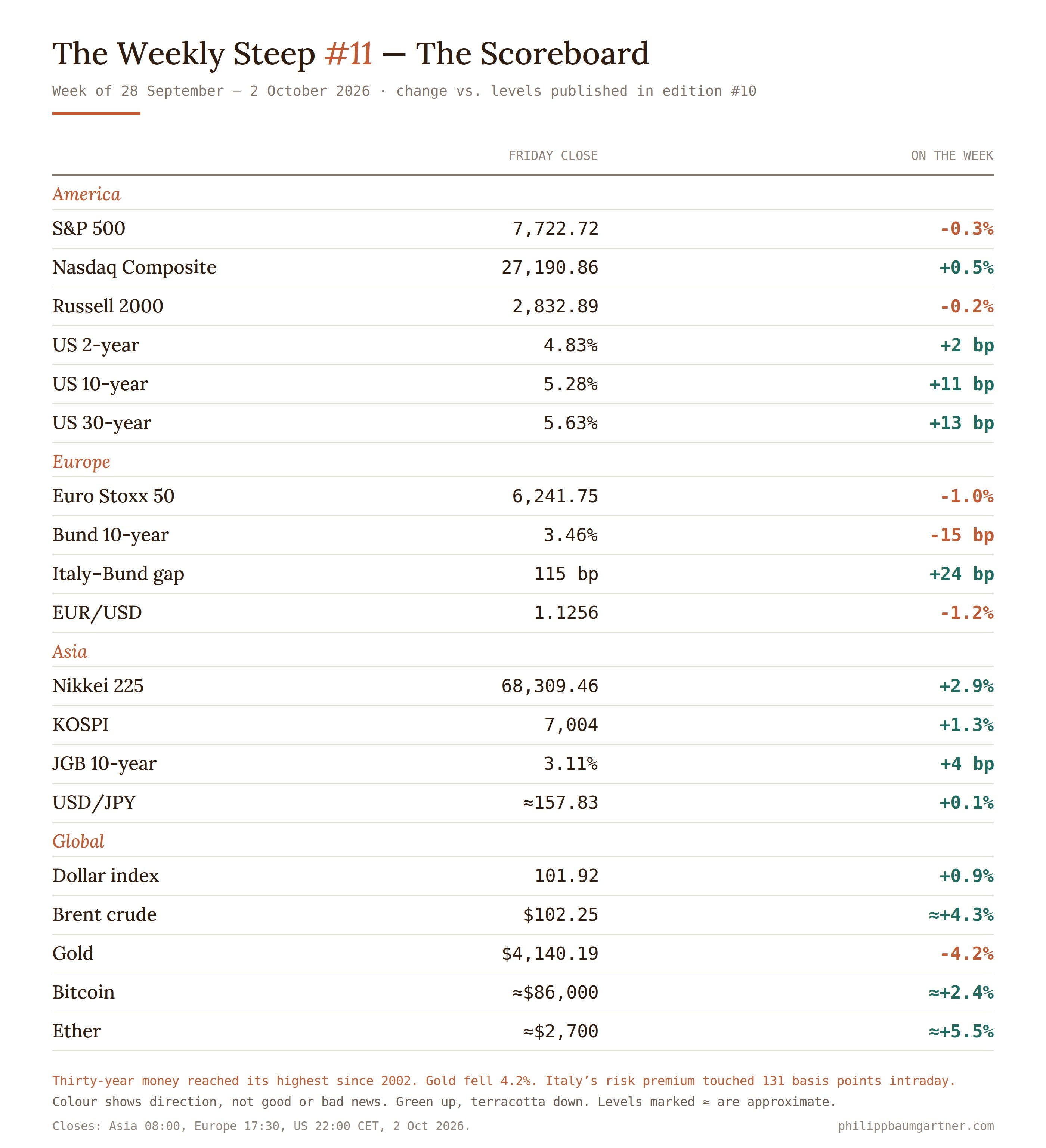
America is where the week happened. US stocks ended roughly flat and debt got noticeably dearer. The S&P 500 closed at 7,722.72, down 0.3%.
The Nasdaq Composite managed +0.5%, smaller companies in the Russell 2000 slipped 0.2%. Meanwhile the ten-year US-treasury rose by 11 basis points to an astonishing 5.28% and thirty-year 13 to 5.63%. The two year, which tracks what people think the central bank will do soon, barely moved at all.
Europe is where the split was most visible to follow. Germany's ten-year borrowing cost fell 15 basis points to 3.46%. Italy pays 4.6% for the same ten-year loan, and that difference, what lenders charge for being less certain of getting their money back, grew by 24 basis points so almost a quarter of a percentage point this week, to 1.15 points. Investors sold the debt of the more indebted country and bought the debt of the less indebted one, same week, same reason. The Euro Stoxx 50 lost 1.0% to 6,241.75 and touched a three-and-a-half-month low before Friday's bounce.
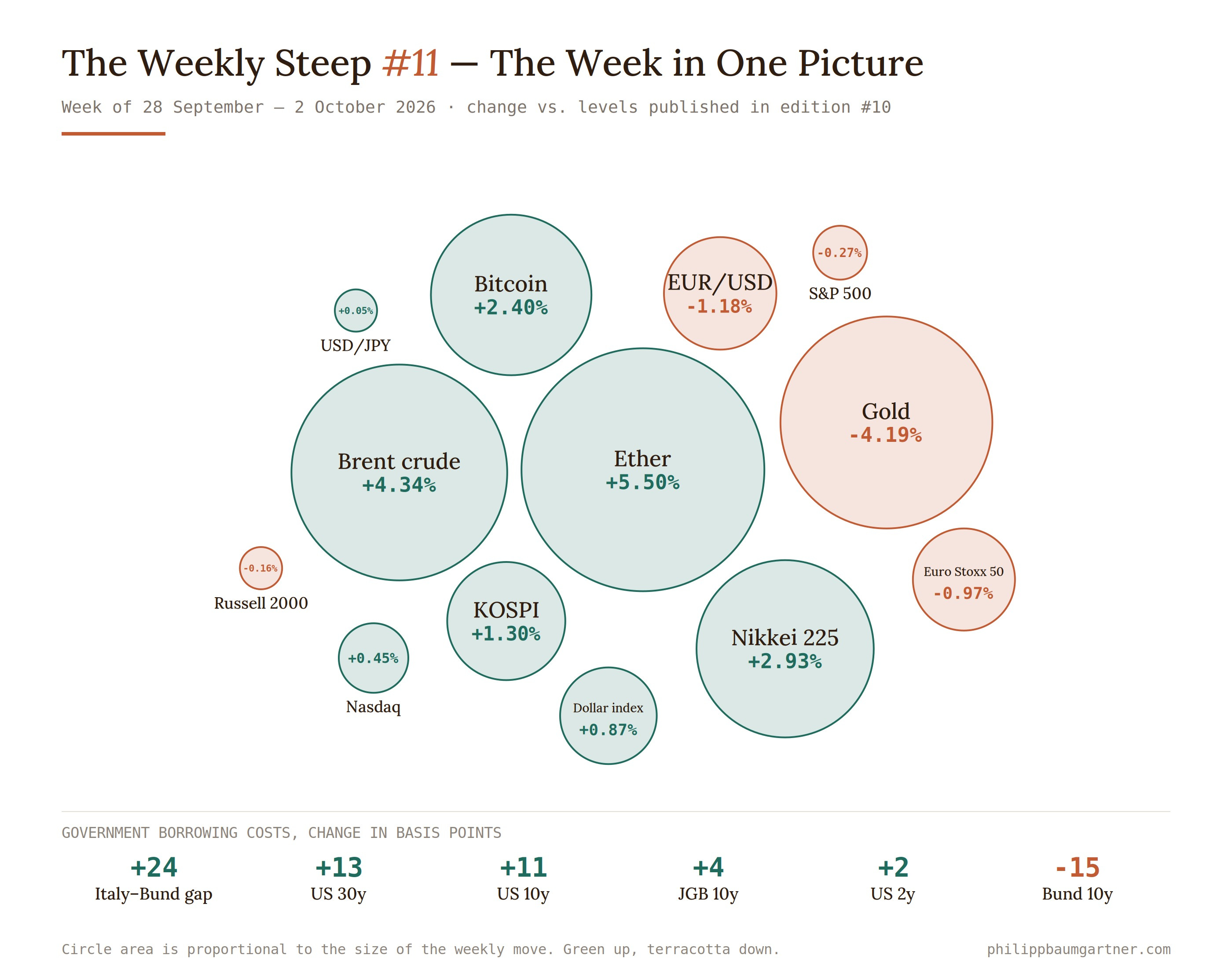
Asia had a pretty solid week. The Nikkei 225 rose 2.9% to 68,309.46, its third winning week in a row, and Korea’s main index climbed back above 7,000. Japanese ten-year borrowing edged up 4 basis points to 3.11% after the Bank of Japan’s September minutes pointed to another rate rise before the year is out.
Gold is the biggest single move on the board and it goes the wrong way. Down 4.2% to $4,140.19, in a week when euro inflation hit a three-year high and oil sat above $100. The dollar explains some of it, up 0.9%. The rest is chapter three.
1. Europe’s borrowing costs split in two
Germany got cheaper to lend to. Italy got dearer.
A government borrows by selling bonds, and the rate it has to offer depends on how sure buyers are of getting their money back. Germany and Italy share a currency, a central bank and a rulebook. They do not share a debt pile, and this week that difference did all the talking.
German ten-year borrowing fell 15 basis points to 3.46%. Italy went the other way — the gap over Germany opened to about 115 basis points by Friday’s close, after touching 131 that morning. Three weeks ago it was near 91.
The mechanism runs through oil. Crude above $100 a barrel feeds into inflation, and euro area inflation duly printed 3.8% for September, with energy alone up 18.8% over the year. Higher inflation means the central bank keeps rates up for longer, and that raises the interest bill on every government that has to keep refinancing. A country with a small debt pile absorbs it. A country with a large one has to pay up to keep buyers interested. Italy’s debt is among the largest in Europe relative to the size of its economy, and France has the same problem.
Money leaving Italian bonds has to go somewhere. The obvious somewhere is German bonds. That is why one yield fell while the other rose.
Keep it in proportion, though. At 115 basis points Italy is paying a premium that looked unremarkable in 2023 and cheap in 2018. The move is fast rather than extreme, and that single Friday-morning print of 131 says more about how thin trading was than about Italy’s solvency.
2. Two counts of one month, and they disagreed again
ADP said the American labour market had a decent September. The government said it had a bad one, and then made the two months before it even worse.
ADP is a payroll company. It handles wage administration for a large share of American private employers, which means it can count who actually got paid. On Wednesday it reported 90,000 new private jobs against the 68,000 economists expected. A clean beat.
On Friday the Bureau of Labor Statistics, the government’s statistics office, reported the non farm payroll stats. These came in at 29,000 new jobs against 84,000 expected. It also revised July from a gain of 21,000 into a loss of 10,000, and August down from 162,000 to 133,000. Unemployment rose to 4.2%. Average hourly pay went up 5 cents in the month, which comes to 3.0% over the year.
Two organisations counted the same weeks and landed 61,000 apart. The one with the longer history pointed down.
Traders read it within minutes as the end of the rate-rise question. They had been pricing a 64% chance of the Federal Reserve raising rates at its meeting on 27 and 28 October. By Friday evening that was 16%.
A three-month average of 51,000 new jobs a month used to arrive with a recession attached. It does not look like that now, because the number of people available to work is also growing slowly, so fewer new jobs are needed to keep unemployment steady. That is the honest version. It also means there is very little room for one bad month.
3. Gold had every reason to rise but fell 4.2% instead
Inflation went up. Oil stayed above $100. And the metal people buy to protect themselves against both had its worst week in months.
Gold pays no interest and no dividend. Holding it costs you whatever you could have earned on a government bond instead, so the price tends to fall when that alternative gets more attractive. This week it got a lot more attractive. American ten-year borrowing paid 5.28% by Friday, thirty-year 5.63%.
The dollar did the rest. Gold is priced in dollars, so a stronger dollar makes the same ounce dearer for everyone outside America and demand falls. The dollar index rose 0.9% on the week while the euro fell 1.2%.
So the inflation story and the interest rate story pulled against each other, and the interest rate story won by a distance. Worth remembering the next time a gold rally gets explained purely by inflation fear. The same reasoning should have held this week. It did not.
Two things went genuinely well, and they deserve the same airtime as the rest. Japanese shares finished a third straight winning week, up 2.9%, in a country whose central bank is tightening rather than loosening. And the Group of Seven agreed to release up to 100 million barrels of emergency oil over four months — the first coordinated attempt to put a ceiling on the fuel price that is driving every inflation number in this letter.
Data Check
Five releases mattered, and the week splits neatly down the middle: what the private sector reported, and what the official statistics said two days later.
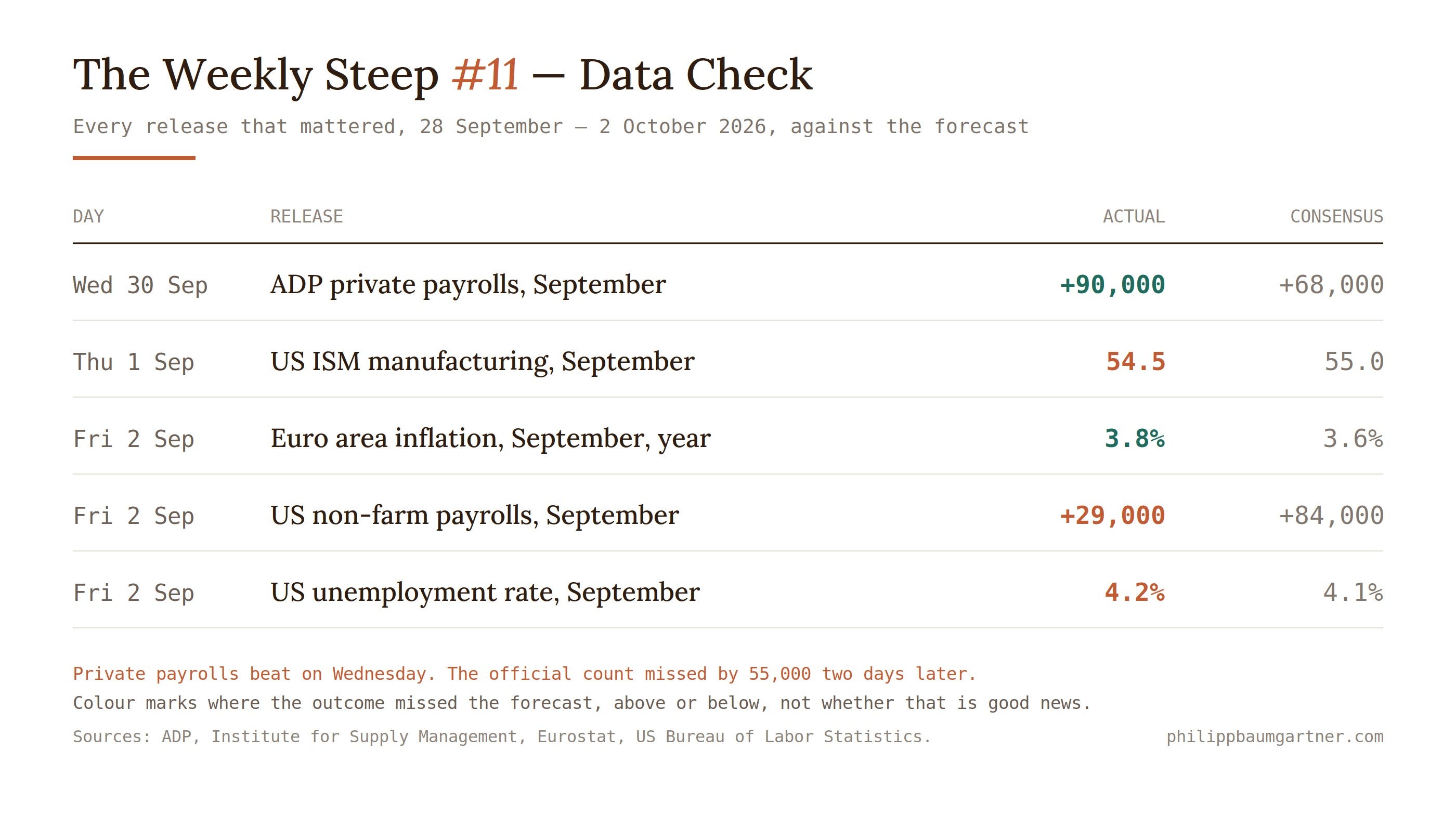
The euro area inflation row is the one worth a second look, because it was the quiet one. 3.8% against 3.6% expected is a two-tenths miss that moved nothing on the day, and it is also the highest reading in three years and the reason Italian borrowing costs had the week they had. The counter-example sits two rows above: ADP’s 90,000 was the only number all week pointing to a healthy labour market, and it came first.
The Credit Grind
The premium companies pay to borrow rose more this week than in any week of the past year, and it happened on both sides of the Atlantic at once.
Anyone lending to a company is paid for two things. One is the price of money itself, which governments set. The other is compensation for the chance this particular company stops paying. That second part is what this section tracks, and it has spent most of 2026 being remarkably cheap but ended this week.
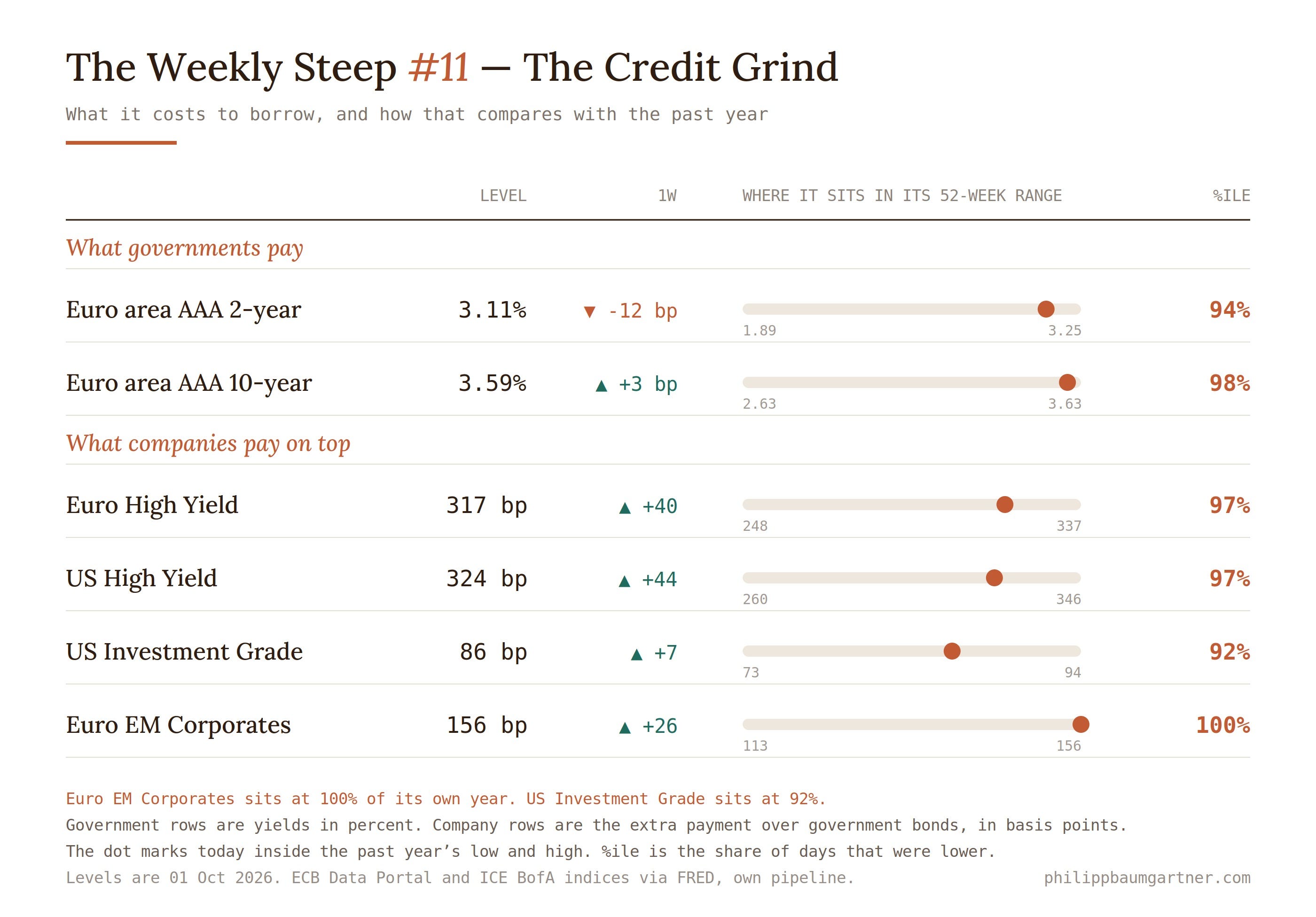
Let’s start with the bottom row. Euro emerging market corporates now pay 156 basis points over governments, and the last column reads 100%. That column counts the share of the past year’s trading days that sat lower than today, so 100% means this is the dearest these companies have been to lend to in twelve months. There is no cheaper day left to compare it with.
The two high yield rows, the debt of companies rated least likely to repay, sit at the 97th percentile on both continents. Europe rose 40 basis points in the week to 317, America 44 to 324. Even investment grade, the debt of large and solid American companies, rose 7 to 86 and sits at the 92nd percentile.
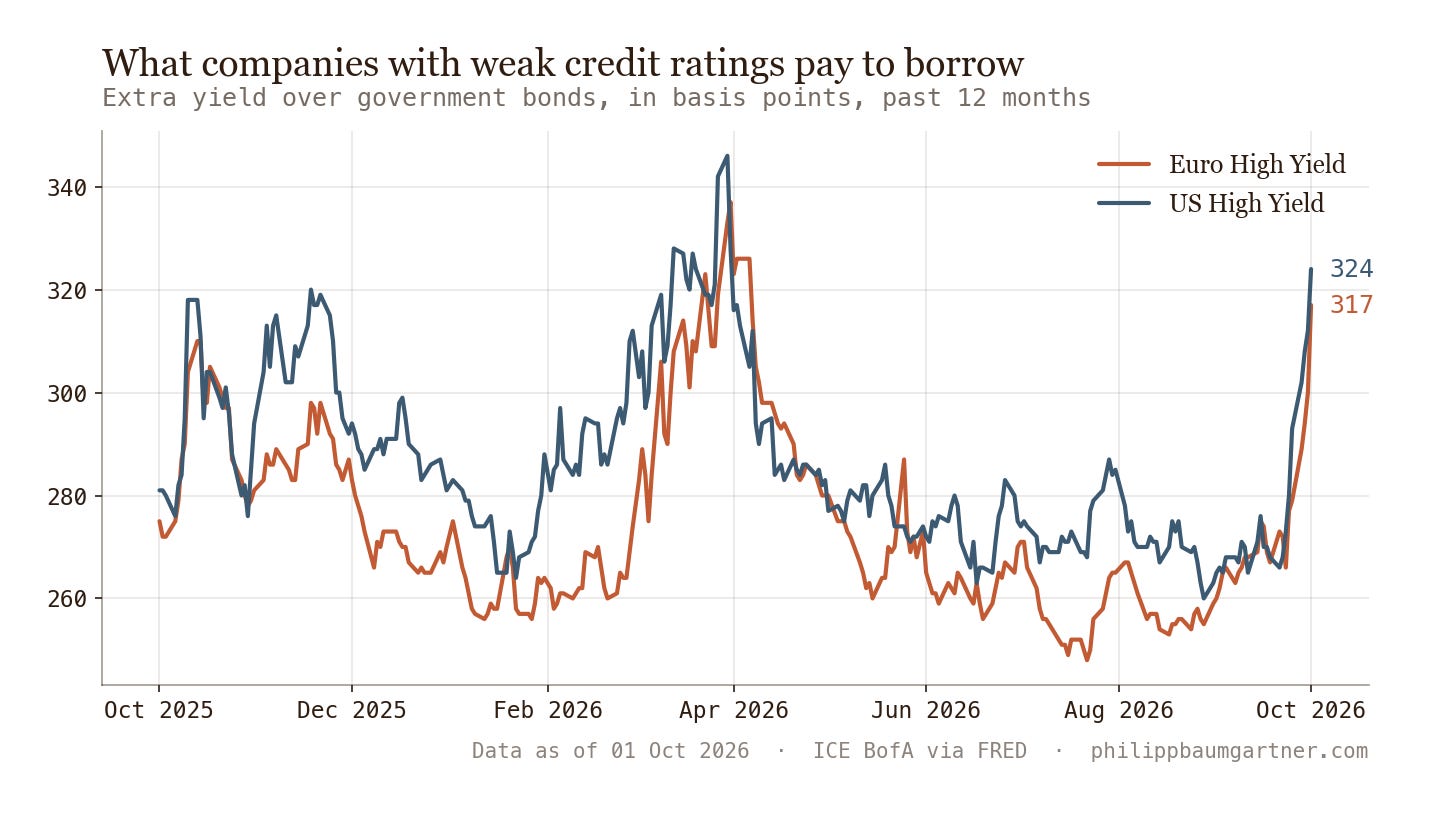
Four indices moving together like that is a different animal from one index moving alone. It says the price of taking company risk got reset across the board, rather than one borrower getting into trouble.
The government rows underneath tell you what reset it. Two-year euro borrowing fell 12 basis points while ten-year rose 3, a market that expects the central bank to sit still and still wants more to lend for a decade.
If you hold a corporate bond fund, the compensation you have been missing all year arrived in a single week. The price of it arriving is that the bonds you already owned fell.
The Onchain Pour
Crypto went up while credit sold off, which is a combination worth sitting with for a second.
Bitcoin ended near $86,000, up about 2.4% against the $84,000 published here last Sunday. Ether finished around $2,700, up 5.5%, breaking out of the $2,600 range it had held since late September. Both did their best work on Friday, when falling bond yields and the collapse in rate-rise odds did the heavy lifting.
The flows point the same way. More than 40,000 bitcoin have left exchanges since 22 September, which usually means buyers moving coins into storage rather than keeping them handy to sell. CryptoQuant counts 75,000 bitcoin picked up by large holders over thirty days.


Glassnode adds the uncomfortable detail. The people selling into this rally are the ones who bought the 2025 run at around $97,000 and $89,000, and they are offloading more coins per day than any other group this year. The ones who bought the decline are holding. A rally that runs on earlier buyers giving up has a ceiling made of their average purchase price, and that ceiling sits above today’s level.
The Week Ahead
After a week like that one, the calendar looks thin, and that is the point. No central bank meets. No American inflation report lands. The week’s job is to tell you whether the credit selloff was a repricing that has now happened, or the opening move in something longer.
Wednesday evening carries the most weight. The Federal Reserve publishes the account of its September meeting, the one where it raised rates, and traders will comb it for how close the vote was and what would make the committee move again. It arrives into a market that has just cut the odds of an October rise from 64% to 16%, so any hint that September was more contested than it looked would land hard.
The other thing to watch is the auctions. America sells ten-year debt on Wednesday and thirty-year debt on Thursday, in a week when thirty-year borrowing just hit its highest since 2002. Who turns up tells you whether this week was investors repricing risk or investors stepping away.
US ISM services survey — Monday, 16:00.
Consensus 55.1 after 55.4. Services employ most Americans, and the survey’s own employment component has been below 50 for months while the headline sits comfortably above it.
German factory orders — Tuesday, 08:00.
Consensus −1.0% after +2.5%. German factories are the part of Europe most exposed to an energy price up 18.8% over the year.
Euro area retail sales — Tuesday, 11:00.
Consensus +0.3% after −0.6%. A first read on whether European households are absorbing higher fuel bills or cutting elsewhere.
German industrial production — Wednesday, 08:00.
Consensus +0.5% after −1.1%.
Federal Reserve minutes — Wednesday, 20:00.
The account of the 15–16 September meeting. A ten-year debt auction runs during the afternoon.
ECB meeting account — Thursday, 13:30.
The European equivalent, and the better guide to whether 3.8% inflation changes anything in Frankfurt. Jobless claims at 14:30, consensus 200,000. A thirty-year auction follows.
Canadian employment — Friday, 14:30.
Consensus +9,500, unemployment expected to tick up to 6.5%.
University of Michigan consumer sentiment — Friday, 16:00.
Consensus 48.1, unchanged and close to the weakest readings this survey has ever produced.
☕ Last Sip
Two weeks ago the question was whether the Federal Reserve would raise rates again. This week the market answered with a 16% probability — and spent the four days before that answer repricing the cost of lending to companies by more than it has in any week of 2026.
Both things can be true at once. A central bank that stops raising rates helps borrowers who already have cheap debt. It does nothing for the ones who have to refinance into a market that just decided risk was underpriced.
That is the tension to carry into the autumn, and the Fed’s own account on Wednesday is the next place it turns up.
Enjoy the first proper weekend of October. See you next Sunday.
Sources
Market levels from Yahoo Finance, the US Treasury, Trading Economics, ANSA and Sky TG24 for the Italian–German spread. Economic releases from ADP, the Institute for Supply Management, Eurostat and the US Bureau of Labor Statistics. Credit and euro curve data from ICE BofA indices via FRED and the ECB Data Portal, as of 1 October. Onchain from Glassnode and CryptoQuant via Cointelegraph. Weekly changes are measured against the levels published in edition #10. Analysis and personal opinion — never investment advice.