
The Week in One Sip
The weekend got away from me since there was plenty on, and here in Austria there was something worth celebrating, so the writing waited until the coffee was finished. Thank you for your patience. The markets, helpfully, did not move over the weekend.
The thirty-year American borrowing cost finished the week at 5.50 per cent, marking it the highest since 2004. The ten-year also touched its highest level since 2007. Both rose about sixteen basis points, a basis point being one hundredth of a percentage point, while the two-year rose only seven.


That is the exact shape this letter said would falsify its own reading: the test named was the thirty-year climbing back toward 5.5 per cent while the two-year held. Seven days later, both conditions are met. Equities rose anyway, with the S&P 500 gaining 1.2 per cent and closing within 0.7 per cent of its record, because oil did the heavy lifting on Friday and Brent dropped below 98 dollars a barrel.
The Scoreboard
Nineteen numbers, and the American bond block has inverted its own story from a week ago.
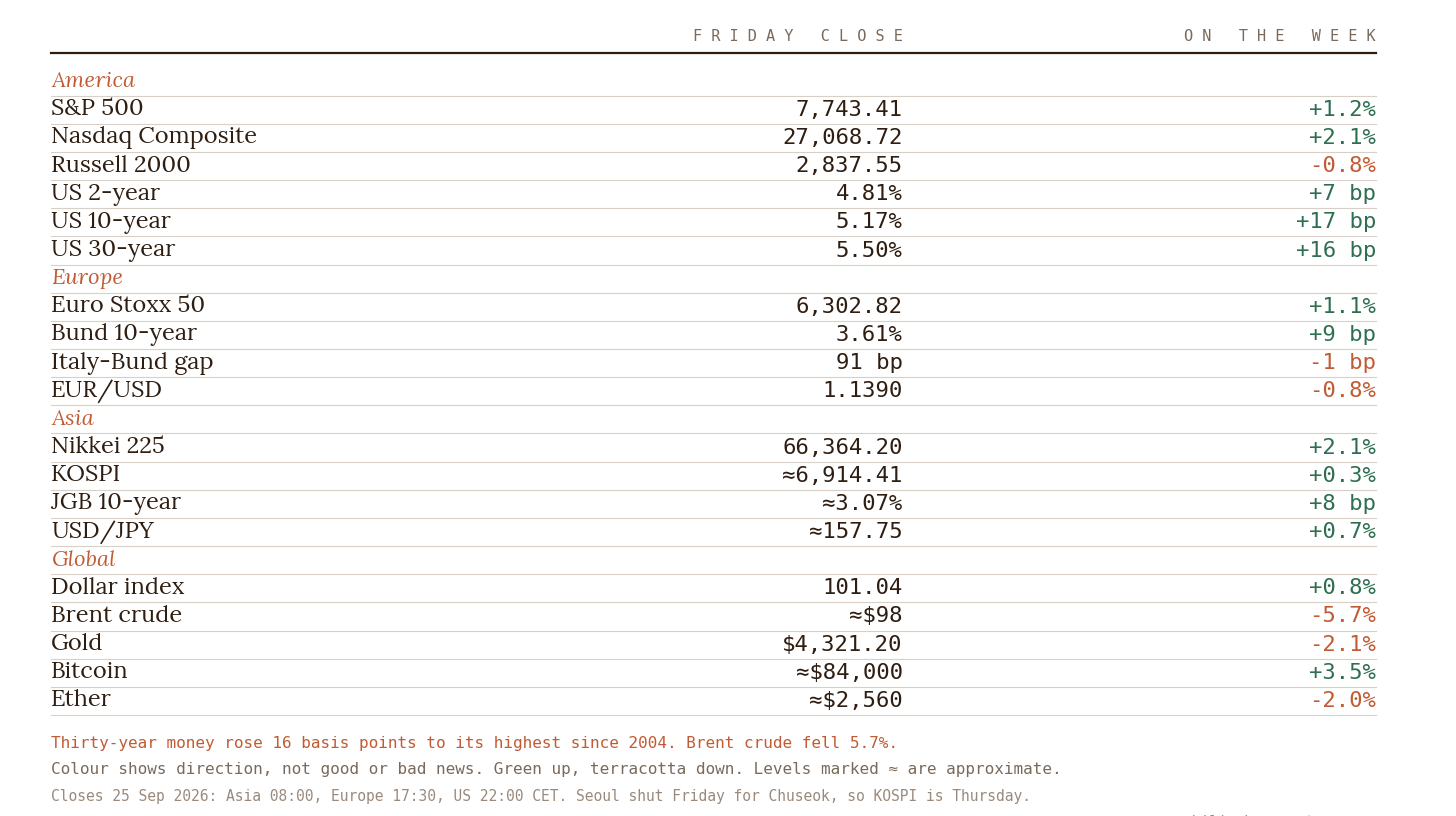
America rose across the board and did it unevenly. The Dow Jones ended a three-week losing streak with a 0.3 per cent gain. The Nasdaq added 2.1 per cent, helped by Meta Platforms rising nearly 13 per cent on the week after news about its artificial-intelligence agent Muse. Information technology gained 3.1 per cent, more than any other sector in the S&P 500. The Russell 2000 that represents smaller American companies, who borrow at floating rates, fell 0.8 per cent.


Europe followed America. The Euro Stoxx 50 gained 1.1 per cent, and German ten-year borrowing costs rose nine basis points to 3.61 per cent. What Italy pays above Germany narrowed by one, to 91 basis points, because German yields rose faster than Italian ones.
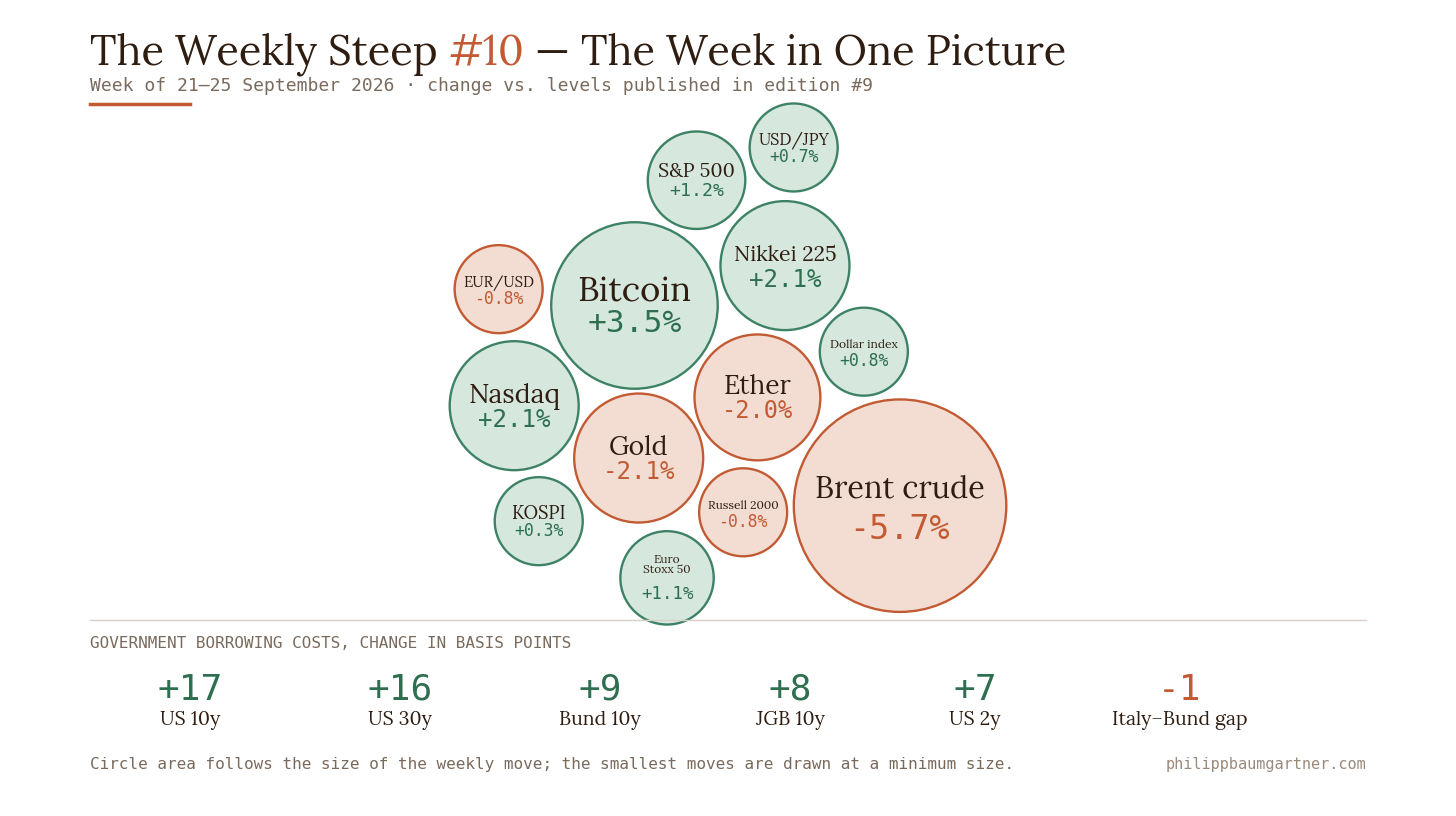
Asia was strong and partly closed. The Nikkei 225 rose 2.1 per cent to 66,364.20, its fifth consecutive daily gain, with 31 of the Tokyo exchange’s 33 industry groups finishing higher on Friday. Japan’s ten-year borrowing cost reached about 3.07 per cent, the highest since August 1996. The yen weakened a little further, to around 157.75 per dollar.
1. Short money paused and long money kept going
A week ago the gap between two-year and ten-year American borrowing costs was 25 basis points, the narrowest of the year. It now sits near 36.

Three things drove it, and the first is now measurable. American purchasing manager surveys landed on Wednesday at 57.0 for manufacturing against 53.6 expected, and 58.7 for services against 56.0, the fastest private-sector expansion in the series this year. Federal Reserve Governor Michael Barr spoke in hawkish terms the same afternoon. Energy prices stayed high through midweek because of the Iran conflict.
Then the Treasury tried to sell debt into it. The two-year auction on Tuesday cleared at 4.787 per cent against 4.204 the previous month. Wednesday’s five-year went at 5.033, above five per cent for the first time. Thursday’s seven-year cleared at 5.085. Each sale landed worse than the one before, which is the plainest evidence that buyers wanted paying more. Traders now price a roughly 64 per cent chance of another rate increase in October, up from about half a week earlier.

Thirty-year rates reflect how much debt is being sold and what inflation might average over decades, rather than what the central bank does next month. When they rise on their own, the cost of a home loan follows, and American thirty-year mortgage rates are now near seven per cent. So the correction to last week’s reading is this: the flattening was the long end lagging, and it has now caught up. I said that would change my mind, and it has.
2. Equities rose and almost nothing participated
The headline numbers were good. What sat underneath them was not. Friday was the ninth consecutive session in which more American companies hit a fifty-two-week low than a fifty-two-week high.


Across September, technology gained 5.4 per cent while utilities lost 5.9 per cent, and five of the eleven S&P 500 sectors fell 4.6 per cent or more. An index can rise while most of its members fall, as long as the largest few rise enough. That is what happened. It works until the largest few stop working as well.
3. Oil turned, and Friday turned with it
Brent crude fell below 98 dollars on Friday, down roughly six per cent on the week, and commodities as a group fell for the second week running. The trigger was diplomatic. Houthi forces in Yemen wrote to the European Union to say they would stop targeting European ships in the Red Sea, and reports circulated about a possible opening around the Strait of Hormuz. Iranian state media disputed that, which is a useful reminder of how thin the evidence is.

Cheaper oil lowers expected inflation, which lowers expected interest rates, which is why American companies rallied into the close and Treasury yields eased on Friday even after a brutal week. Gold went the other way, falling 2.1 per cent to 4,321 dollars. A rising dollar and rising real yields make an asset that pays no interest more expensive to hold, and this week that beat every geopolitical argument for owning it.
Data Check
Nine releases, and eight came in stronger than economists had forecast.
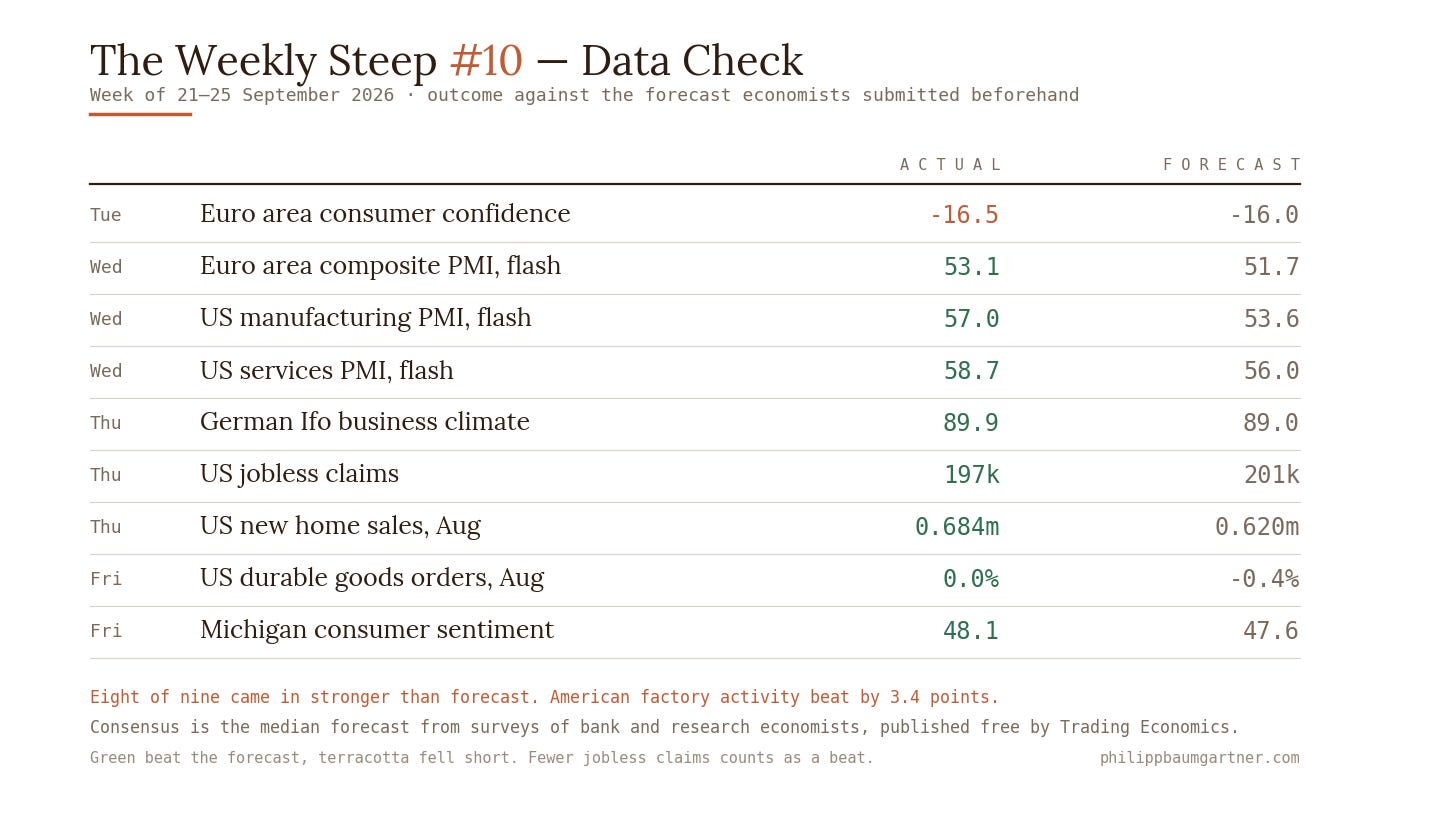
The American housing figures are the correction this letter owes its readers. A week ago this section read weak starts and permits as the first crack from higher borrowing costs. New home sales then rose 6.4 per cent in August to 684,000, well ahead of the 620,000 expected. Builders are discounting hard and buyers are taking it, which is a different story from the one I told.
What did break is how people feel. The University of Michigan’s final reading of consumer sentiment for September came in at 48.1, down from 51.7 in the preliminary cut three weeks earlier. Households now expect prices to rise 4.6 per cent over the coming year, against 4.0 per cent in the first estimate. Sentiment falling that far inside one month, while sales and hiring hold up, is the gap a central banker has to decide how to read.
The Credit Grind
European governments now pay more to borrow than on any day of the past year. And this week, for the first time in a month, what companies pay on top moved with them. Anyone lending to a company is paid for two things. One is the price of money itself, which governments set, because a state is the safest borrower in its own currency. The other is compensation for the chance this particular company stops paying. The board below separates the two.
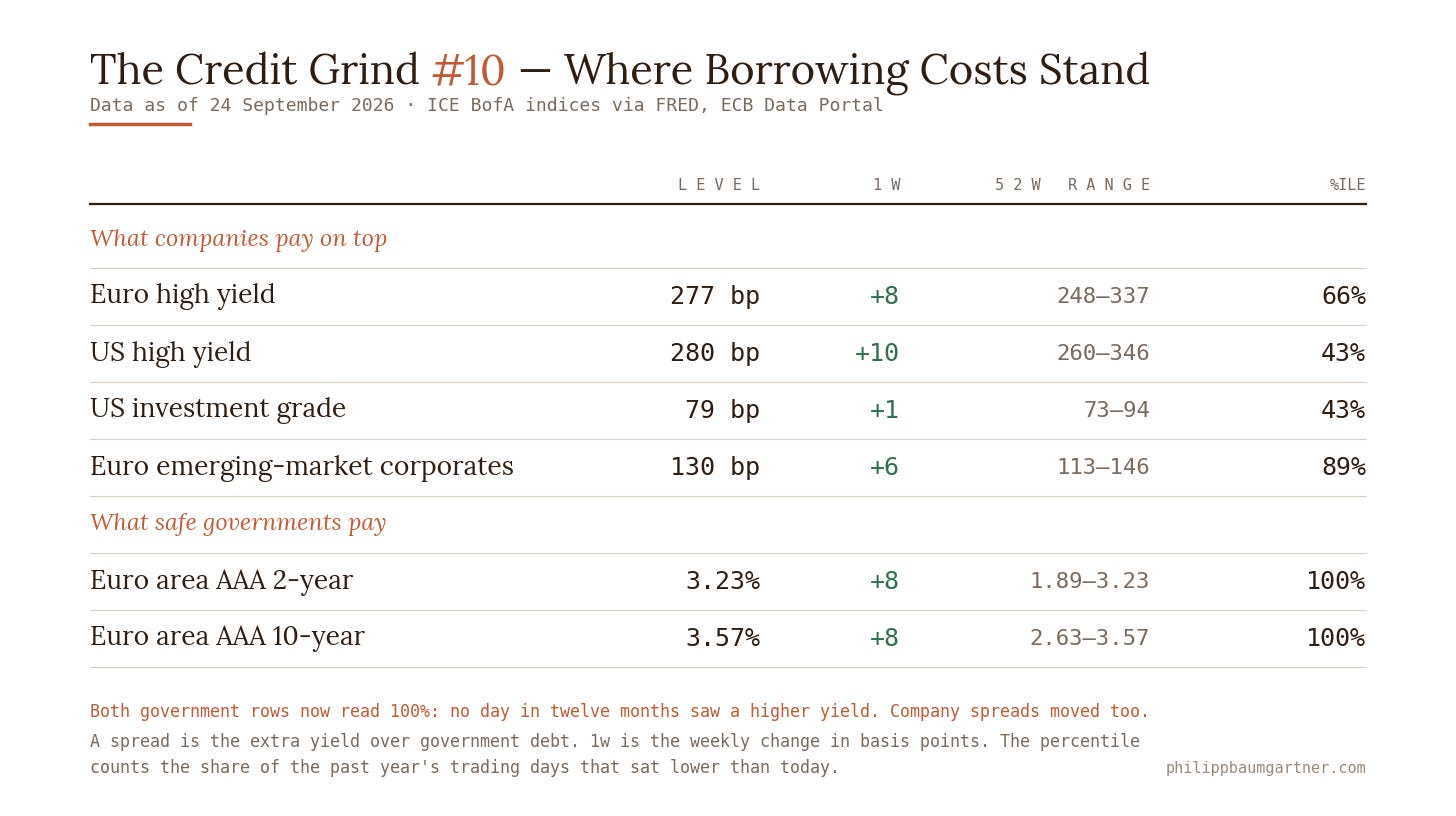
Both euro government rows read 100 per cent, which means no day in twelve months saw a higher yield. Two-year money in the euro area costs 3.23 per cent, up 112 basis points since January. The company rows are the news. European high yield which ia the debt of firms rated least likely to repay, rose eight basis points to 277, moving from the 47th percentile of its year to the 66th in a single week. American high yield rose ten to 280, from the 12th percentile to the 43rd. Euro emerging-market corporates sit at 130 basis points, the 89th percentile.
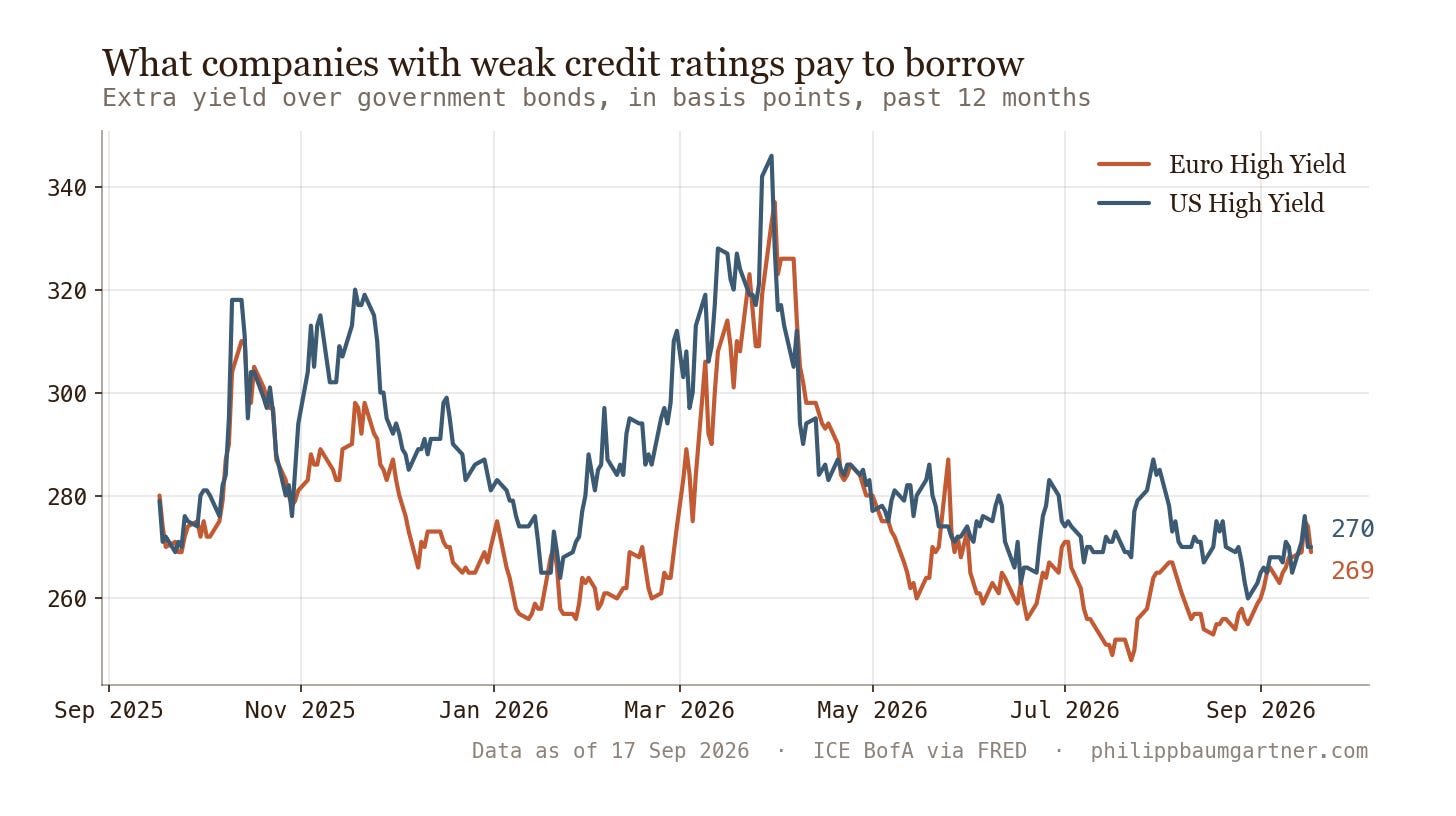
Last week this section said the risky part was priced as though nothing could go wrong. That changed. And the place it changed first is worth naming: Goldman Sachs reported midweek that insurance against default by the large cloud computing companies had moved two to four basis points wider while their shares sat unchanged. Those firms have been issuing debt heavily as yields climb. The equity market is still paying for the artificial-intelligence buildout. The credit market has started asking what it ultimately costs.
The Onchain Pour
Bitcoin broke above a resistance level early in the week and held there, finishing near 84,000 dollars, up roughly 3.5 per cent against the level published here last Sunday. Ether went the other way, slipping about two per cent to around 2,560. What stands out is the contrast with shares: in a week when barely anything in the American stock market participated in the rally, 44 of 46 tokens in one widely followed ecosystem index traded above their fifty-day average. Breadth collapsed in one market and held in the other.


Against that, two pieces of housekeeping. The exchange Bitget raised the figure for its security incident to 387.5 million dollars and launched a recovery bounty while preparing to restart withdrawals. And the United States seized bank accounts belonging to a payments group linked to Tether, the largest stablecoin issuer. Stablecoins are the plumbing that the institutional case for this asset class rests on, and pressure there is a different kind of risk from price.
The Week Ahead
This is the week the American labour market and the European price level both report, two days apart.
Monday, 16:30 — US Dallas Fed manufacturing index.
Last at 11.6, expected to fall to 1. Regional surveys have been the first to wobble.
Tuesday, 06:30 — Reserve Bank of Australia decision.
From 4.35 per cent, with economists expecting a rise to 4.6. A fourth central bank joining the tightening wave.
Tuesday, 16:00 — US job openings and consumer confidence.
Openings last at 7.271 million. Confidence at 89.4, expected at 90.
Wednesday, 03:30 — Chinese purchasing manager surveys.
Official manufacturing last at 49.8, expected at 50 — the line between contraction and growth.
Wednesday, 14:00 — German flash inflation for September.
Last at 2.9 per cent, expected at 3.2. The euro area’s largest economy moving further from target.
Wednesday, 14:30 — US personal consumption expenditures price index.
The Federal Reserve’s preferred inflation measure. Core last at 0.2 per cent month on month, expected at 0.3. This lands three weeks before the October meeting.
Thursday, 16:00 — US manufacturing survey from the Institute for Supply Management.
Last at 54.6. The prices component, last at 71.1 and expected at 72.5, is the one to read.
Friday, 11:00 — euro area flash inflation.
Last at 3.2 per cent, expected at 3.6. That is a large jump for one month, and the European Central Bank meets in October.
Friday, 14:30 — American jobs report.
162,000 jobs were added in August. Economists expect 84,000 for September, roughly half. Unemployment is seen holding at 4.1 per cent.
Sunday, 4 October — OPEC and non-OPEC ministerial meeting.
Held days after Brent fell six per cent.
☕ Last Sip
Being wrong quickly is better than being wrong slowly, and this letter was wrong twice. The thirty-year went where I said would break last week’s argument about the yield curve, so that argument breaks. And the housing crack I described in the same edition did not widen — new home sales beat comfortably. What replaces both is simpler. American long-term borrowing costs are at twenty-year highs because the economy keeps running hot and the government keeps selling debt into it, not because anyone expects a recession. Mortgage rates near seven per cent are what that looks like from a kitchen table, and consumer sentiment at 48 is what it feels like.
Watch Wednesday afternoon and Friday morning. Enjoy the start of the week.
Sources
Market levels from CNBC, Yahoo Finance, Investrade, the Associated Press, Trading Economics, ANSA and STL News. Economic releases and consensus figures from Trading Economics, the US Census Bureau and the University of Michigan. Auction results from the US Treasury. Credit and euro curve data from ICE BofA indices via FRED and the ECB Data Portal, as of 24 September. Charts and market colour from posts by @MikeZaccardi, @zerohedge, @unusual_whales, @Andre_Dragosch, @jvisserlabs and @Cointelegraph. Weekly changes are measured against the levels published in edition #9. Analysis and personal opinion — never investment advice.